Atma-Sphere MA1 OTL Valve 100W Monoblock Amps
Atma-Sphere MA1 OTL
 93 aufrufe im letzten monat, 44
 aufrufe in diesem monat
Letztes Update
31.12.2025
 Erläuterung
Ursprüngliche Beschreibung
Englisch, anderssprachige Texte sind Übersetzungen und können Fehler enthalten.
EnglischDeutschSpanischTürkisch
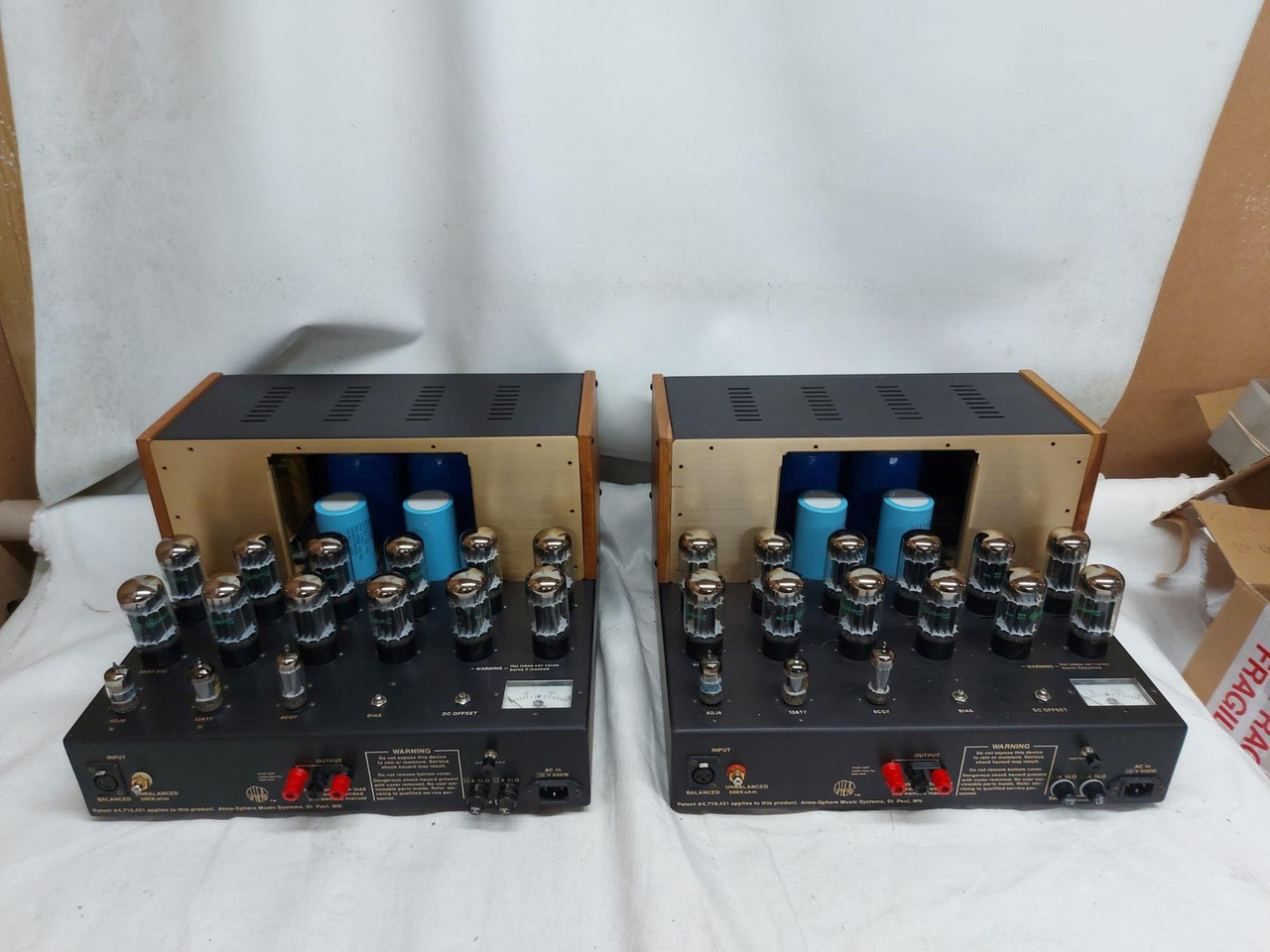
Very good condition and full working order.
Upgraded with soft start and fusible resistors for protection and full set of new old stock output valves GE 6AS7G
Many of the current crop of tube designers - a group growing in number of late - are improving upon old ideas by applying modern technology. The Atma-Sphere MA-1 is a good example of what can be done with a classic tube circuit and some creativity. It uses design ideas from the original Hall amplifier and the Wiggins Circlotron. (I'm not sure what that is, but it's a great name.) The result is one of the most accurate amplifiers I have heard. The MA-1 has been on the market for a little over three years now. It is an output transformerless (OTL) direct coupled design that is all triode and operates in class A. It utilizes a single stage of amplification and is a balanced, differential design with both RCA and XLR input jacks (the jacks not in use should be shorted). The MA-1 is phase inverting and each mono amp is rated at 100 watts pr channel into 8 ohms and 90 watts into 4 ohms. Because of potential problems in driving low impedance loads, Atma-Sphere now provides a separate, outboard Z Music Transformer housed in an oak box. This transformer may improve the amplifier's performance wth speakers rated at 4 ohms and lower or that have impedance curves that dip this low below 200 Hz.1 The on/off standby switch is located on the front panel of the amplifier next to a row of three LEDs; the "standby" mode allows the tubes to warm up before applying the b+ voltage to them. Leaving the amplifier on "standby" for at least 30 seconds before turning to "on" prevents damage to the tubes and lengthens their life. Atma-Sphere claims a tube life of 10,000 hours, if the amps are operated with care. The MA-1s are very stable and have a reputation for being extremely reliable. They sound good after a brief warm-up, but are at their best after an hour. By their physical appearance, the MA-1s give no hint of costing nearly $3000 each. The chassis I black brushed aluminum with wood side panels and gold lettering. The 15 tubes are placed in the rear of the amp, uncovered.2 A bias adjustment screw, a built-in meter, and a screw for adjusting DC offset makes such adjustments easy, even for someone as non-technical as I am. Each amplifier weighs 47 pounds. Ralph Karsten, Atma-Sphere's designer/owner, cautioned me to set the MA1s at least a foot apart side-to-side. Otherwise, the electromagnetic radiation given off to the sides by the two side-mounted toroidal transformers will interfere sonically with the adjacent amplifier. Karsten also suggested the amps would sound better not grounded, but with a "cheater" on the three way plug, that is unless I encountered hum problems.3 The MA-1s are among that small handful of components that deviate so little from neutrality that their sound becomes difficult to describe. As reviewers, we are used to looking for the areas of exceptional performance or the little flaws in the sound of components. The Atma-Spheres seem to do everything well, and although they may not set any new standards in any particular area, there is very little that I can criticize about their performance. What impresses me most about the sound of the MA-1, besides its neutrality, is its open, transparent soundstage and its bass. By neutrality, I mean that the reproduction of voices and instruments is believable and without an emphasis on any particular band of frequencies. Harmonic overtones bloom naturally from the fundamentals, and the sound is neither too dark no too bright. The stage that the MA-1s set is fairly wide, very deep and sounds open and airy. One thing that contributes to the excellent soundstaging is a total lack of grain or texture to the background. Intertransient sibilance is excellent. Instruments are separated in their own space and are very well focused on the stage – as we have come to expect from mono amplifier designs - and you are able to hear clearly back into the musical performance. One example of this is from Robert Cray's fine new CD Midnight Stroll [Mercury 846 652-2]. I recently heard him perform this material live in a medium size theater. On "The Forecast Calls For Pain," Cray is backed by Jimmy Pugh on a Hammond B-3 organ. Through the Atma-Spheres, I was able to follow the organ's rich sound clearly all the way through, even though it is placed back in the mix. This gave me much more of the feel of the live concert than other amplification on the same material. Hearing the first tympani in the beginning movement of Reiner ans CSO's Sheherazade [Chesky RC-4} through the MA-1s , the drums are clearly at the rear of the stage and you are aware of the rear wall and the movement of air. The MA-1s provide you with much detail and low level dynamics from instruments and voices whether at the front or rear of the stage; small intonations on a solo horn of violin are easily heard and add more shading to the musical colors. The sound of the MA-1s is smooth and liquid yet the amp is "fast" in responding to transient demands. It is easy to follow an instrument or section of the orchestra through the most complex and demanding of passages. The sound never becomes congested nor feels compressed. Related to their apparent "speed," the MA-1s also have excellent high level dynamic contrasts. Good bass dynamics also capture my attention and the MA-1s are terrific in their lower range. High frequency dynamics are also excellent, such as the sound of a bell or cymbal being struck. A good example is at the opening of "Dusk" from Amanda McBroom's Growing Up in Hollywood Town [Sheffield Lab 13]. Here a bell is struck twice, harder the first time, and the MA-1s seem to respond to the change very quickly. Otherwise, the high frequencies sound very extended and just a little soft and delicate in the very top octave. On the Thiel CS 3.5s, the MA-1s have the best bass response of any tubed amplifier I have ever heard. Since I have been living with the Manley Reference 350s for the past year, I consider this quite an accomplishment.4 The Atma-Sphere's bass is powerful and dynamic but its superb definition is what makes it something special. First of all, the midbass is tight and clean, reminding me of good solid state amplification, but the associated dryness. The midbass also has what the British refer to as "tunefulness" and "rythmic drive." * Pop music and jazz really come to life; you will not be able to keep your foot still. You can hear the air of the lower frequencies and the pitch of each drum beat and synthesizer note. The rest of the lower frequencies are also well defined, detailed, and extend very low. Well recorded tympani, for example, such as Reiner and CSO's Lt. Kije [Chesky RC10], caused my floor to shake. In comparison to the (un-updated) Manley 350s, the differences in the Atma-Sphere's sound are small and mainly ones of perspective. The two amplifiers sound more aloke than most brands of interconnect cable I have compared (Julian Hirsch would say, "I told you so."). But just because I found the difference to be small ones does not mean that you would not clearly prefer one over the other on your system. For example, the Manley seems to put you a little closer to the music; its sound is richer, darker and more immediate. The MA-1s seems to put you back a few rows with a little less upper midrange and high frequency energy. Violins sound smoother and more liquid through the MA-1s, with less bite, as though you were a distance back from them. The Atma-Spheres also have a more open, deeper and more transient soundstage than the Manleys (which adds to the feeling of being a little further back) and a little better bass definition, but the Manleys may have a little more bass power (with three and a half times the power rating). Traditionally, with Class A, purist amplification, you pay a high price for a given power rating. What you get is musicality with an ease of reproduction and sense of refinement that may not be available in amplifiers operating in other classes with higher power. Some loudspeakers may require more power than the MA-1s can provide and make a poor match with this amplifier. For those who can't live without the sound of the MA-1s but have speakers requiring more power, the MA-2 has just been introduced. The Atma-Spheres also provide the option of using them in a balanced configuration, a feature that is bound to become more popular in the future. The Atma-Sphere MA-1s are as musical and neutral as any amplifier I have heard. Their soundstage is open with the images focused clearly and a high degree of transparency and inner detail. Their bass response sets a new standard for tubed amplifiers in my experience. While the MA-1s may not break new ground for any individual parameter of performance, whe you add up all their strengths, they may well be one of the best-sounding 100-watt amplifiers available.-MK 1While reviewing the MA1s, I only had the Thiel 3.5s and Vandersteen 2Cis on hand to use with them, neither of which presented a difficult load nor really challenged the power rating of the amplifiers. My comments about their performance must be taken in this context. Perhaps Steven Stone can shed some light on how they fare with lower impedances or more demanding loads in his comment. I also did not use the MA-1s in their balanced mode. 2Tube compliment is twelve 6AS7 output tubes, one 6CG7 driver tube and a 12AT7 and a 6DJ8 for differential cascode voltage amplifiers. 3While working with the Atma-Spheres, I happened to have a conversation with Ray Schab of Arcici about their setup and physically isolating electronic components. I had been using the amplifiers in Mission Isoplats with Navcom Silencers between the amp and the Isoplat surface. Schab suggested that I would get better results by putting the Navcom under the Isoplat and leaving the amp on a solid surface. And wouldn't you know it – he was right. Although differences were subtle, I heard more detail, a shade more dynamics and better definition in the bass. Schab's theory is that putting Navcom or similar materials directly under an electronic component may actually overdamp its sound, rather than simply preventing floor vibrations from reaching the component. 4At this writing the Manleys have their original compliment of 6550A tubes and have not yet been updated to the KT90s. *Typical British silliness. The music has this. Not the equipment. Ever. Granted there is some equipment that lets it through more easily – but to attribute a characteristic of the music to the equipment is quite simply wrong.
Sehr guter Zustand und voll funktionsfähig.
Aufgerüstet mit Sanftanlauf und Schmelzsicherungen zum Schutz sowie einem kompletten Satz neuer, alter GE 6AS7G-Ausgangsröhren.
Viele der heutigen Röhrenentwickler – deren Zahl in letzter Zeit stetig wächst – verbessern alte Ideen durch den Einsatz moderner Technologie. Der Atma-Sphere MA-1 ist ein gutes Beispiel dafür, was mit einer klassischen Röhrenschaltung und etwas Kreativität möglich ist. Er verwendet Designideen des ursprünglichen Hall-Verstärkers und des Wiggins Circlotron (ich bin mir nicht sicher, was das ist, aber es ist ein großartiger Name). Das Ergebnis ist einer der präzisesten Verstärker, die ich je gehört habe. Der MA-1 ist seit etwas über drei Jahren auf dem Markt. Es handelt sich um einen transformatorlosen (OTL) direktgekoppelten Verstärker in Triodenbauweise, der in Klasse A arbeitet. Er verfügt über eine einstufige Verstärkung und ist symmetrisch und differenziell aufgebaut. Er besitzt sowohl RCA- als auch XLR-Eingangsbuchsen (die nicht verwendeten Buchsen sollten kurzgeschlossen werden). Der MA-1 ist ein Phasenumkehrer. Jeder Mono-Verstärker liefert 100 Watt pro Kanal an 8 Ohm und 90 Watt an 4 Ohm. Aufgrund potenzieller Probleme beim Betrieb niederohmiger Lasten bietet Atma-Sphere nun einen separaten, externen Z-Music-Transformator in einem Eichenholzgehäuse an. Dieser Transformator kann die Leistung des Verstärkers mit Lautsprechern mit einer Impedanz von 4 Ohm und darunter oder mit Impedanzkurven, die unterhalb von 200 Hz so tief abfallen, verbessern.<sup>1</sup> Der Standby-Schalter befindet sich an der Vorderseite des Verstärkers neben einer Reihe von drei LEDs. Im Standby-Modus können sich die Röhren aufwärmen, bevor die Anodenspannung (B+) angelegt wird. Wenn der Verstärker mindestens 30 Sekunden im Standby-Modus verbleibt, bevor er eingeschaltet wird, werden die Röhren nicht beschädigt und ihre Lebensdauer verlängert. Atma-Sphere gibt eine Röhrenlebensdauer von 10.000 Stunden an, sofern die Verstärker sorgsam betrieben werden. Die MA-1-Verstärker sind sehr stabil und gelten als äußerst zuverlässig. Sie klingen nach kurzer Aufwärmzeit gut, erreichen aber nach einer Stunde ihre optimale Klangqualität. Optisch lassen die MA-1 nicht vermuten, dass sie jeweils fast 3000 Dollar kosten. Das Gehäuse besteht aus gebürstetem, schwarzem Aluminium mit Seitenwänden aus Holz und goldener Beschriftung. Die 15 Röhren sind auf der Rückseite des Verstärkers freiliegend untergebracht.² Eine Bias-Einstellschraube, ein eingebautes Messgerät und eine Schraube zur Einstellung des DC-Offsets erleichtern diese Anpassungen, selbst für einen Laien wie mich. Jeder Verstärker wiegt 21,3 kg. Ralph Karsten, Entwickler und Inhaber von Atma-Sphere, riet mir, die MA-1 mit einem seitlichen Abstand von mindestens 30 cm aufzustellen. Andernfalls würde die von den beiden seitlich angebrachten Ringkerntransformatoren abgegebene elektromagnetische Strahlung den benachbarten Verstärker klanglich stören. Karsten schlug außerdem vor, die Verstärker klängen besser, wenn sie nicht geerdet, sondern mit einem Adapter am Dreiwegestecker verbunden wären – es sei denn, es traten Brummprobleme auf.<sup>3</sup> Die MA-1 gehören zu den wenigen Komponenten, die so wenig von der Neutralität abweichen, dass ihr Klang schwer zu beschreiben ist. Als Tester sind wir es gewohnt, nach Bereichen mit außergewöhnlicher Leistung oder kleinen Klangfehlern zu suchen. Die Atma-Spheres scheinen alles gut zu können, und obwohl sie vielleicht Obwohl sie in keinem Bereich neue Maßstäbe setzen, gibt es an ihrer Leistung kaum etwas auszusetzen. Was mich am Klang der MA-1 neben ihrer Neutralität am meisten beeindruckt, ist ihre offene, transparente Klangbühne und ihr Bass. Mit Neutralität meine ich, dass Stimmen und Instrumente glaubwürdig wiedergegeben werden, ohne dass ein bestimmter Frequenzbereich betont wird. Harmonische Obertöne entwickeln sich natürlich aus den Grundtönen, und der Klang ist weder zu dunkel noch zu hell. Die von den MA-1 erzeugte Klangbühne ist recht breit, sehr tief und klingt offen und luftig. Zu der exzellenten Klangbühne trägt auch die völlige Abwesenheit von Rauschen oder Textur im Hintergrund bei. Die Zischlaute sind exzellent. Instrumente sind räumlich getrennt und sehr gut auf der Bühne positioniert – wie man es von Mono-Verstärkern erwartet – und man kann die musikalische Darbietung klar und deutlich wahrnehmen. Ein Beispiel dafür ist Robert Crays hervorragende neue CD „Midnight Stroll“ [Mercury 846 652-2]. Ich habe ihn kürzlich in einem mittelgroßen Theater live mit diesem Material erlebt. Bei „The Forecast Calls For Pain“ wird Cray von Jimmy Pugh an einer Hammond B-3 Orgel begleitet. Dank der Atma-Spheres konnte ich den vollen Klang der Orgel klar und deutlich verfolgen, obwohl sie im Mix etwas zurückhaltend platziert ist. Das vermittelte mir ein viel intensiveres Live-Konzertgefühl als andere Verstärker bei demselben Material. Als ich die ersten Pauken im ersten Satz von Reiner und Chicago Symphonys „Scheherazade“ [Chesky RC-4] über die MA-1 hörte, waren die Trommeln deutlich im hinteren Bühnenbereich zu hören, und man nahm die Rückwand und die Luftbewegung wahr. Die MA-1 liefern viele Details und eine feine Dynamikwiedergabe von Instrumenten und Stimmen, egal ob vorne oder hinten auf der Bühne; selbst kleinste Intonationen eines Solohorns oder einer Violine sind gut hörbar und verleihen den Klangfarben mehr Nuancen. Der Klang der MA-1 ist weich und fließend, dennoch reagiert der Verstärker blitzschnell auf Transienten. Selbst in den komplexesten und anspruchsvollsten Passagen lässt sich ein Instrument oder eine Orchestergruppe mühelos verfolgen. Der Klang wirkt nie überladen oder komprimiert. Neben ihrer bemerkenswerten Schnelligkeit zeichnen sich die MA-1 auch durch exzellente Dynamikkontraste im Hochtonbereich aus. Die gute Bassdynamik überzeugt ebenfalls, und die MA-1 sind im Tieftonbereich hervorragend. Auch die Dynamik im Hochtonbereich ist exzellent, beispielsweise beim Anschlagen einer Glocke oder eines Beckens. Ein gutes Beispiel dafür findet sich im Intro von „Dusk“ aus Amanda McBrooms „Growing Up in Hollywood Town“ [Sheffield Lab 13]. Hier wird eine Glocke zweimal angeschlagen, beim ersten Mal lauter, und die MA-1 reagieren scheinbar blitzschnell auf diese Veränderung. Ansonsten klingen die hohen Frequenzen sehr ausgedehnt und nur in der obersten Oktave etwas weich und zart. An den Thiel CS 3.5 bieten die MA-1 die beste Basswiedergabe aller Röhrenverstärker, die ich je gehört habe. Da ich die Manley Reference 350 nun schon seit einem Jahr nutze, betrachte ich dies als beachtliche Leistung.⁴ Der Bass der Atma-Sphere ist kraftvoll und dynamisch, aber ihre überragende Definition macht sie zu etwas Besonderem. Zunächst einmal ist der Mittelbass straff und sauber und erinnert mich an gute Transistorverstärker, allerdings mit der damit verbundenen Trockenheit. Der Mittelbass besitzt zudem das, was die Briten als „Melodie“ und „rhythmischen Drive“ bezeichnen. * Popmusik und Jazz erwachen zum Leben; man kann einfach nicht stillsitzen. Man hört die Luftigkeit der tiefen Frequenzen und die Tonhöhe jedes einzelnen Schlagzeugschlags und jeder Synthesizer-Note. Auch die übrigen tiefen Frequenzen sind gut definiert, detailliert und reichen sehr tief. Gut aufgenommene Pauken, beispielsweise „Lt. Kije“ von Reiner und dem Chicago Symphony Orchestra (Chesky RC10), ließen meinen Boden erzittern. Im Vergleich zu den (nicht aktualisierten) Manley 350 sind die Unterschiede im Klang der Atma-Sphere gering und hauptsächlich folgender: Perspektive. Die beiden Verstärker klingen homogener als die meisten Verbindungskabel, die ich verglichen habe (Julian Hirsch würde sagen: „Hab ich’s doch gesagt!“). Nur weil ich die Unterschiede als gering empfunden habe, heißt das aber nicht, dass Sie nicht einen der beiden Verstärker in Ihrer Anlage deutlich bevorzugen würden. Der Manley beispielsweise scheint Sie näher an die Musik heranzubringen; sein Klang ist satter, dunkler und direkter. Die MA-1 hingegen lassen Sie etwas weiter entfernt erscheinen, mit etwas weniger Energie im oberen Mitteltonbereich und den Höhen. Violinen klingen über die MA-1 weicher und fließender, weniger bissig, als ob Sie etwas weiter entfernt wären. Die Atma-Spheres bieten zudem eine offenere, tiefere und dynamischere Klangbühne als die Manleys (was das Gefühl, etwas weiter entfernt zu sein, verstärkt) und eine etwas bessere Bassdefinition, aber die Manleys haben möglicherweise etwas mehr Bassleistung (mit der dreieinhalbfachen Nennleistung). Traditionell zahlt man bei puristischer Class-A-Verstärkung einen hohen Preis für eine bestimmte Nennleistung. Das Ergebnis ist Musikalität, gepaart mit einer Wiedergabeleichtigkeit und einem Feingefühl, das bei leistungsstärkeren Verstärkern anderer Klassen möglicherweise nicht gegeben ist. Manche Lautsprecher benötigen mehr Leistung, als die MA-1 liefern können, und harmonieren daher nicht optimal mit diesem Verstärker. Für alle, die den Klang der MA-1 nicht missen möchten, aber Lautsprecher mit höherem Leistungsbedarf besitzen, wurde kürzlich der MA-2 eingeführt. Die Atma-Spheres bieten zudem die Möglichkeit, sie in einer symmetrischen Konfiguration zu betreiben – eine Funktion, die zukünftig sicherlich an Beliebtheit gewinnen wird. Die Atma-Sphere MA-1 klingen so musikalisch und neutral wie kaum ein anderer Verstärker, den ich kenne. Ihre Klangbühne ist offen, die Abbildung präzise und die Transparenz sowie die Detailwiedergabe äußerst hoch. Ihre Basswiedergabe setzt meiner Erfahrung nach neue Maßstäbe für Röhrenverstärker. Obwohl die MA-1 in puncto einzelner Leistungsparameter keine bahnbrechenden Neuerungen bieten, zählen sie in ihrer Gesamtheit zu den klanglich besten 100-Watt-Verstärkern auf dem Markt. – MK 1 Während des Tests der MA-1 standen mir lediglich die Thiel 3.5 und die Vandersteen 2Ci zur Verfügung. Beide stellten keine schwierige Last dar und reizten die Nennleistung der Verstärker nicht aus. Meine Anmerkungen zu ihrer Leistung sind daher in diesem Kontext zu verstehen. Möglicherweise kann Steven Stone in seinem Kommentar Aufschluss darüber geben, wie sie sich bei niedrigeren Impedanzen oder anspruchsvolleren Lasten schlagen. Ich habe die MA-1 auch nicht im symmetrischen Betrieb getestet. 2 Die Röhrenbestückung besteht aus zwölf 6AS7-Ausgangsröhren, einer 6CG7-Treiberröhre sowie einer 12AT7 und einer 6DJ8 für die Differenzial-Kaskoden-Spannungsverstärker. 3 Während meiner Arbeit mit den Atma-Spheres kam ich zufällig mit Ray Schab von Arcici über deren Aufbau und die physikalische Trennung elektronischer Bauteile ins Gespräch. Ich hatte die Verstärker in Mission Isoplats mit Navcom-Dämpfern zwischen Verstärker und Isoplat-Oberfläche verwendet. Schab schlug vor, bessere Ergebnisse zu erzielen, wenn ich die Navcom-Dämpfer unter die Isoplat lege und den Verstärker auf einer festen Unterlage lasse. Und siehe da – er hatte Recht. Obwohl die Unterschiede subtil waren, hörte ich mehr Details, etwas mehr Dynamik und eine bessere Definition im Bass. Schabs Theorie besagt, dass die direkte Platzierung von Navcom oder ähnlichen Materialien unter einem elektronischen Bauteil dessen Klang sogar übermäßig dämpfen kann, anstatt lediglich zu verhindern, dass Bodenschwingungen das Bauteil erreichen. Zum Zeitpunkt dieses Artikels sind die Manley-Verstärker noch mit ihren originalen 6550A-Röhren bestückt und wurden noch nicht auf KT90-Röhren umgerüstet. *Typisch britische Dummheit. Die Musik hat diesen Charakter. Nicht die Geräte. Niemals. Zugegeben, es gibt Geräte, die diesen Charakter leichter durchlassen – aber eine Eigenschaft der Musik den Geräten zuzuschreiben, ist schlichtweg falsch.
Muy buen estado y funcionamiento perfecto.
Mejorado con arranque suave y resistencias fusibles para protección, y un juego completo de válvulas de salida GE 6AS7G nuevas.
Muchos diseñadores de válvulas actuales, un grupo en constante crecimiento, están mejorando ideas antiguas aplicando tecnología moderna. El Atma-Sphere MA-1 es un buen ejemplo de lo que se puede lograr con un circuito clásico de válvulas y algo de creatividad. Utiliza ideas de diseño del amplificador Hall original y del Circlotrón Wiggins. (No estoy seguro de qué es, pero es un nombre genial). El resultado es uno de los amplificadores más precisos que he escuchado. El MA-1 lleva poco más de tres años en el mercado. Es un diseño de salida sin transformador (OTL) de acoplamiento directo, completamente triodo y opera en clase A. Utiliza una sola etapa de amplificación y es un diseño balanceado y diferencial con conectores de entrada RCA y XLR (los conectores que no se utilizan deben cortocircuitarse). El MA-1 es inversor de fase y cada amplificador mono tiene una potencia nominal de 100 vatios por canal a 8 ohmios y 90 vatios a 4 ohmios. Debido a los posibles problemas al manejar cargas de baja impedancia, Atma-Sphere ahora ofrece un transformador Z Music externo independiente, alojado en una caja de roble. Este transformador puede mejorar el rendimiento del amplificador con altavoces de 4 ohmios o menos, o con curvas de impedancia que la reducen por debajo de 200 Hz.¹ El interruptor de encendido/apagado en modo de espera se encuentra en el panel frontal del amplificador, junto a una fila de tres LED; el modo de espera permite que las válvulas se calienten antes de aplicarles la tensión b+. Dejar el amplificador en modo de espera durante al menos 30 segundos antes de encenderlo evita dañar las válvulas y prolonga su vida útil. Atma-Sphere afirma que las válvulas tienen una vida útil de 10 000 horas si se utilizan con cuidado. Los MA-1 son muy estables y tienen fama de ser extremadamente fiables. Suenan bien tras un breve calentamiento, pero alcanzan su máximo rendimiento tras una hora. Por su aspecto físico, los MA-1 no dan ninguna pista de que cuesten casi 3000 dólares cada uno. El chasis es de aluminio cepillado negro con paneles laterales de madera y letras doradas. Las 15 válvulas están situadas en la parte trasera del amplificador, sin cubrir.² Un tornillo de ajuste de polarización, un medidor integrado y un tornillo para ajustar la compensación de CC facilitan estos ajustes, incluso para alguien tan poco técnico como yo. Cada amplificador pesa 21 kg. Ralph Karsten, diseñador y propietario de Atma-Sphere, me advirtió que colocara los MA1 al menos a 30 cm de distancia entre sí. De lo contrario, la radiación electromagnética emitida a los lados por los dos transformadores toroidales montados lateralmente interferiría acústicamente con el amplificador adyacente. Karsten también sugirió que los amplificadores sonarían mejor sin conexión a tierra, sino con un "tramposo" en el conector de tres vías, a menos que encontrara problemas de zumbidos.³ Los MA-1 se encuentran entre ese pequeño grupo de componentes que se desvían tan poco de la neutralidad que su sonido se vuelve difícil de describir. Como revisores, estamos acostumbrados a buscar las áreas de rendimiento excepcional o los pequeños defectos en el sonido de los componentes. Los Atma-Spheres parecen hacerlo todo bien, y aunque pueden Aunque no han establecido nuevos estándares en ningún área en particular, tengo muy poco que criticar sobre su rendimiento. Lo que más me impresiona del sonido del MA-1, además de su neutralidad, es su escena sonora abierta y transparente, y sus graves. Por neutralidad, me refiero a que la reproducción de voces e instrumentos es creíble y sin énfasis en ninguna banda de frecuencias en particular. Los sobretonos armónicos surgen naturalmente de los fundamentales, y el sonido no es ni demasiado oscuro ni demasiado brillante. El escenario que los MA-1 crean es bastante amplio, muy profundo y suena abierto y etéreo. Un factor que contribuye a la excelente puesta en escena sonora es la total ausencia de grano o textura en el fondo. La sibilancia intertransitoria es excelente. Los instrumentos están separados en su propio espacio y muy bien enfocados en el escenario, como es habitual en los amplificadores mono, y se puede escuchar con claridad la interpretación musical. Un ejemplo de esto es el excelente nuevo CD de Robert Cray, Midnight Stroll [Mercury 846 652-2]. Recientemente lo escuché interpretar este material en vivo en un teatro de tamaño mediano. En "The Forecast Calls For Pain", Cray cuenta con el acompañamiento de Jimmy Pugh en un órgano Hammond B-3. Gracias a las Atma-Spheres, pude seguir con claridad el rico sonido del órgano durante toda la grabación, a pesar de estar colocado al fondo de la mezcla. Esto me proporcionó una sensación mucho más cercana a la de un concierto en vivo que con otras amplificaciones del mismo material. Al escuchar los primeros timbales en el movimiento inicial de Sheherazade [Chesky RC-4] de Reiner y CSO a través de los MA-1, la batería se escucha claramente al fondo del escenario y se percibe la pared trasera y el movimiento del aire. Los MA-1 ofrecen gran detalle y una dinámica de bajo nivel de los instrumentos y las voces, tanto al frente como al fondo del escenario; las pequeñas entonaciones de un solo de violín se escuchan con facilidad y añaden más matices a la música. El sonido de los MA-1 es suave y fluido, pero el amplificador responde rápidamente a las demandas transitorias. Es fácil seguir un instrumento o sección de la orquesta a través de los pasajes más complejos y exigentes. El sonido nunca se congestiona ni se siente comprimido. En relación con su aparente "velocidad", los MA-1 también ofrecen excelentes contrastes dinámicos de alto nivel. Su buena dinámica de graves también me llama la atención, y los MA-1 son magníficos en su rango más bajo. La dinámica de las frecuencias agudas también es excelente, como el sonido de una campana o un platillo al ser golpeado. Un buen ejemplo se encuentra en el comienzo de "Dusk" de Growing Up in Hollywood Town de Amanda McBroom [Sheffield Lab 13]. Aquí se golpea una campana dos veces, con más fuerza la primera, y los MA-1 parecen responder al cambio con gran rapidez. Por lo demás, las frecuencias agudas suenan muy extendidas y solo un poco suaves y delicadas en la octava más alta. En los Thiel CS 3.5, los MA-1 tienen la mejor respuesta de graves de cualquier amplificador de válvulas que haya escuchado. Dado que he estado usando los Manley Reference 350 durante el último año, considero esto todo un logro. Los graves del Atma-Sphere son potentes y dinámicos, pero su magnífica definición es lo que los hace especiales. En primer lugar, los medios bajos son firmes y limpios, recordándome a una buena amplificación de estado sólido, pero con la sequedad asociada. Los medios bajos también tienen lo que los británicos llaman "afinación" e "impulso rítmico". * La música pop y el jazz cobran vida; no podrás mantener el pie quieto. Puedes escuchar el aire de las frecuencias más bajas y el tono de cada golpe de batería y nota del sintetizador. El resto de las frecuencias bajas también están bien definidas, detalladas y se extienden muy abajo. Unos timbales bien grabados, por ejemplo, como el Lt. Kije [Chesky RC10] de Reiner y CSO, hicieron temblar el suelo. En comparación con los Manley 350 (sin actualizar), las diferencias en el sonido del Atma-Sphere son pequeñas y principalmente...Perspectiva. Los dos amplificadores suenan más parecidos que la mayoría de las marcas de cable de interconexión que he comparado (Julian Hirsch diría: "Te lo dije"). Pero que la diferencia sea pequeña no significa que no prefieras claramente uno sobre el otro en tu sistema. Por ejemplo, el Manley parece acercarte un poco más a la música; su sonido es más rico, oscuro e inmediato. Los MA-1 parecen retroceder un poco con menos energía en los medios altos y agudos. Los violines suenan más suaves y fluidos con los MA-1, con menos mordacidad, como si estuvieras a cierta distancia. Los Atma-Spheres también tienen una escena sonora más abierta, profunda y transitoria que los Manley (lo que aumenta la sensación de estar un poco más atrás) y una definición de graves ligeramente mejor, pero los Manley pueden tener algo más de potencia en graves (con tres veces y media la potencia nominal). Tradicionalmente, con la amplificación purista de Clase A, se paga un alto precio por una determinada potencia nominal. Lo que obtienes es musicalidad con una facilidad de reproducción y una sensación de refinamiento que quizás no estén disponibles en amplificadores de otras clases con mayor potencia. Algunos altavoces pueden requerir más potencia de la que ofrecen los MA-1 y no ser compatibles con este amplificador. Para quienes no pueden vivir sin el sonido de los MA-1 pero tienen altavoces que requieren más potencia, acaba de presentarse el MA-2. Los Atma-Spheres también ofrecen la opción de usarlos en una configuración balanceada, una característica que sin duda se volverá más popular en el futuro. Los Atma-Sphere MA-1 son tan musicales y neutrales como cualquier amplificador que haya escuchado. Su escena sonora es abierta, con las imágenes enfocadas con claridad y un alto grado de transparencia y detalle interno. Su respuesta en graves establece un nuevo estándar para los amplificadores de válvulas, en mi experiencia. Si bien los MA-1 pueden no ser innovadores en ningún parámetro individual de rendimiento, al sumar todas sus fortalezas, bien podrían ser uno de los amplificadores de 100 vatios con mejor sonido disponibles. -MK 1. Al revisar los MA-1, solo tenía a mano los Thiel 3.5 y los Vandersteen 2Cis para usarlos con ellos, ninguno de los cuales presentó una carga difícil ni realmente desafió la potencia nominal de los amplificadores. Mis comentarios sobre su rendimiento deben tomarse en este contexto. Quizás Steven Stone pueda arrojar algo de luz sobre cómo se comportan con impedancias más bajas o cargas más exigentes en su comentario. Tampoco usé los MA-1 en su modo balanceado. El complemento de 2Tube son doce válvulas de salida 6AS7, una válvula de controlador 6CG7 y una 12AT7 y una 6DJ8 para amplificadores de voltaje cascodo diferencial. Mientras trabajaba con las Atma-Spheres, tuve una conversación con Ray Schab de Arcici sobre su configuración y el aislamiento físico de los componentes electrónicos. Había estado usando los amplificadores en Mission Isoplats con silenciadores Navcom entre el amplificador y la superficie del Isoplat. Schab sugirió que obtendría mejores resultados colocando el Navcom debajo del Isoplat y dejando el amplificador sobre una superficie sólida. Y, ¡por Dios!, tenía razón. Aunque las diferencias eran sutiles, escuché más detalle, un poco más de dinámica y mejor definición en los graves. La teoría de Schab es que colocar Navcom o materiales similares directamente debajo de un componente electrónico puede, de hecho, sobreamortiguar su sonido, en lugar de simplemente evitar que las vibraciones del suelo lleguen al componente. Al momento de escribir esto, los Manleys tienen su dotación original de válvulas 6550A y aún no se han actualizado a las KT90. *Típica tontería británica. La música tiene esto. No el equipo. Nunca. Es cierto que hay algunos equipos que permiten escucharla con mayor facilidad, pero atribuirle una característica de la música a esos equipos es sencillamente erróneo.
Çok iyi durumda ve tamamen çalışır durumda.
Yumuşak başlatma ve koruma için sigortalı dirençlerle ve tam bir set yeni eski stok çıkış lambası GE 6AS7G ile yükseltildi.
Son zamanlarda sayıları artan birçok tüp tasarımcısı, modern teknolojiyi uygulayarak eski fikirleri geliştiriyor. Atma-Sphere MA-1, klasik bir tüp devresi ve biraz yaratıcılıkla neler yapılabileceğinin iyi bir örneğidir. Orijinal Hall amplifikatöründen ve Wiggins Circlotron'dan (ne olduğunu tam olarak bilmiyorum ama harika bir isim) tasarım fikirleri kullanıyor. Sonuç, duyduğum en doğru amplifikatörlerden biri. MA-1, üç yıldan biraz fazla bir süredir piyasada. Çıkış transformatörsüz (OTL) doğrudan bağlantılı, tamamen triyot ve A sınıfında çalışan bir tasarımdır. Tek kademeli amplifikasyon kullanır ve hem RCA hem de XLR giriş jaklarına sahip dengeli, diferansiyel bir tasarımdır (kullanılmayan jaklar kısa devre edilmelidir). MA-1 faz ters çevirici olup, her bir mono amplifikatör 8 ohm'a 100 watt, 4 ohm'a ise 90 watt kanal başına güç üretmektedir. Düşük empedanslı yükleri sürmede potansiyel sorunlar nedeniyle, Atma-Sphere artık meşe bir kutu içinde bulunan ayrı, harici bir Z Music Transformatörü sunmaktadır. Bu transformatör, 4 ohm ve daha düşük empedanslı hoparlörlerle veya 200 Hz'nin altına düşen empedans eğrilerine sahip hoparlörlerle amplifikatörün performansını iyileştirebilir.1 Açma/kapama bekleme anahtarı, amplifikatörün ön panelinde üç LED'in yanında yer almaktadır; "bekleme" modu, tüplere b+ voltajı uygulanmadan önce ısınmalarını sağlar. Amplifikatörü "açma" konumuna getirmeden önce en az 30 saniye "bekleme" konumunda bırakmak, tüplerin hasar görmesini önler ve ömrünü uzatır. Atma-Sphere, amplifikatörler dikkatli kullanıldığında 10.000 saatlik tüp ömrü iddiasında bulunmaktadır. MA-1'ler çok kararlıdır ve son derece güvenilir olma konusunda bir üne sahiptir. Kısa bir ısınmanın ardından iyi ses veriyorlar, ancak bir saat sonra en iyi performanslarını sergiliyorlar. Fiziksel görünüşleriyle MA-1'ler, her birinin yaklaşık 3000 dolara mal olduğunu hiç belli etmiyor. Şasi, ahşap yan paneller ve altın harflerle siyah fırçalanmış alüminyumdan yapılmıştır. 15 tüp, amplifikatörün arka tarafına, açıkta yerleştirilmiştir.2 Bir bias ayar vidası, dahili bir ölçüm cihazı ve DC ofsetini ayarlamak için bir vida, benim gibi teknik bilgisi olmayan biri için bile bu tür ayarlamaları kolaylaştırır. Her amplifikatör 47 pound ağırlığındadır. Atma-Sphere'in tasarımcısı/sahibi Ralph Karsten, MA1'leri yan yana en az bir ayak mesafede yerleştirmem konusunda beni uyardı. Aksi takdirde, iki yan tarafa monte edilmiş toroidal transformatörün yanlara yaydığı elektromanyetik radyasyon, bitişik amplifikatörle ses açısından etkileşime girecektir. Karsten ayrıca, üç yollu fişte bir "hileci" ile birlikte kullanıldığında, yani uğultu sorunlarıyla karşılaşmadığım sürece, amplifikatörlerin topraklanmadığında daha iyi ses vereceğini öne sürdü.3 MA-1'ler, nötrlükten o kadar az sapan ve seslerini tarif etmeyi zorlaştıran az sayıdaki bileşen arasında yer alıyor. Eleştirmenler olarak, bileşenlerin olağanüstü performans alanlarını veya seslerindeki küçük kusurları aramaya alışkınız. Atma-Sphere'ler her şeyi iyi yapıyor gibi görünüyor ve belki de Herhangi bir alanda yeni standartlar belirlememiş olsalar da, performansları hakkında eleştirebileceğim çok az şey var. MA-1'in sesinde beni en çok etkileyen şey, nötrlüğünün yanı sıra, açık, şeffaf ses sahnesi ve basıdır. Nötrlükten kastım, seslerin ve enstrümanların yeniden üretilmesinin inandırıcı olması ve belirli bir frekans bandına vurgu yapılmamasıdır. Harmonik üst tonlar temel frekanslardan doğal olarak yayılır ve ses ne çok karanlık ne de çok parlaktır. MA-1'lerin oluşturduğu sahne oldukça geniş, çok derin ve açık ve havadar bir ses sunuyor. Mükemmel ses sahnesine katkıda bulunan bir şey de arka planda hiçbir gren veya doku olmamasıdır. Geçişler arası sibilans mükemmeldir. Enstrümanlar kendi alanlarında ayrılmıştır ve sahnede çok iyi odaklanmıştır - mono amplifikatör tasarımlarından beklediğimiz gibi - ve müzik performansını net bir şekilde duyabiliyorsunuz. Bunun bir örneği, Robert Cray'in harika yeni CD'si Midnight Stroll'dan [Mercury 846 652-2] geliyor. Geçtiğimiz günlerde onu orta büyüklükte bir tiyatroda bu eseri canlı olarak çalarken dinledim. "The Forecast Calls For Pain"de Cray'e Hammond B-3 orgunda Jimmy Pugh eşlik ediyor. Atma-Spheres sayesinde, miksin gerisinde olmasına rağmen orgun zengin sesini baştan sona net bir şekilde takip edebildim. Bu, aynı eserde diğer amplifikasyonlara kıyasla bana canlı konser hissini çok daha fazla verdi. Reiner ve CSO'nun Şehrazat'ının [Chesky RC-4] başlangıç bölümündeki ilk timpaniyi MA-1'ler aracılığıyla duyduğumda, davullar sahnenin arka tarafında net bir şekilde duyuluyor ve arka duvarı ve hava hareketini hissedebiliyorsunuz. MA-1'ler, sahnenin önünde veya arkasında olsun, enstrümanlardan ve seslerden çok fazla ayrıntı ve düşük seviyeli dinamikler sağlıyor; solo bir korno veya kemanın küçük tonlamaları kolayca duyuluyor ve müzikal renklere daha fazla nüans katıyor. MA-1'lerin sesi pürüzsüz ve akıcı, ancak amfi geçici taleplere "hızlı" yanıt veriyor. En karmaşık ve zorlu pasajlarda bile bir enstrümanı veya orkestra bölümünü takip etmek kolay. Ses asla tıkanmıyor veya sıkıştırılmış hissettirmiyor. Görünürdeki "hızlarıyla" bağlantılı olarak, MA-1'ler mükemmel yüksek seviye dinamik kontrastlara da sahip. İyi bas dinamikleri de dikkatimi çekiyor ve MA-1'ler alt aralıklarında harika. Zil veya çan sesi gibi yüksek frekans dinamikleri de mükemmel. İyi bir örnek, Amanda McBroom'un Growing Up in Hollywood Town [Sheffield Lab 13] albümündeki "Dusk" parçasının açılışında. Burada bir çan iki kez, ilk seferinde daha sert vuruluyor ve MA-1'ler değişime çok hızlı yanıt veriyor gibi görünüyor. Aksi takdirde, yüksek frekanslar çok geniş ve en üst oktavda biraz yumuşak ve hassas geliyor. Thiel CS 3.5'lerde, MA-1'ler şimdiye kadar duyduğum tüm lambalı amplifikatörler arasında en iyi bas tepkisine sahip. Son bir yıldır Manley Reference 350'lerle birlikte yaşadığım için bunu oldukça büyük bir başarı olarak görüyorum.4 Atma-Sphere'in bası güçlü ve dinamik, ancak onu özel kılan şey mükemmel tanımlaması. Her şeyden önce, orta bas sıkı ve temiz, bana iyi bir katı hal amplifikatörünü hatırlatıyor, ancak onunla ilişkili kuruluktan da uzak. Orta bas ayrıca İngilizlerin "melodili olma" ve "ritmik sürüş" olarak adlandırdığı şeye de sahip. * Pop müzik ve caz gerçekten canlanıyor; ayağınızı yerinde tutamayacaksınız. Alt frekansların havasını ve her davul vuruşunun ve sentezleyici notasının perdesini duyabiliyorsunuz. Alt frekansların geri kalanı da iyi tanımlanmış, ayrıntılı ve çok düşük seviyelere uzanıyor. Örneğin, Reiner ve CSO'nun Lt. Kije [Chesky RC10] gibi iyi kaydedilmiş timpani, zeminimi titretti. (Güncellenmemiş) Manley 350'lerle karşılaştırıldığında, Atma-Sphere'in sesindeki farklılıklar küçüktür ve çoğunlukla şunlardan ibarettir: Bakış açısı. İki amplifikatör, karşılaştırdığım çoğu ara bağlantı kablosu markasından daha iyi ses veriyor (Julian Hirsch, "Size söylemiştim!" derdi). Ancak aradaki farkın küçük olduğunu bulmam, sisteminizde birini diğerine açıkça tercih etmeyeceğiniz anlamına gelmez. Örneğin, Manley sizi müziğe biraz daha yaklaştırıyor; sesi daha zengin, daha koyu ve daha anlık. MA-1'ler ise sizi biraz daha geriye, üst orta frekans ve yüksek frekans enerjisinde biraz daha az bir farkla yerleştiriyor gibi görünüyor. MA-1'ler aracılığıyla kemanlar daha yumuşak ve akıcı, daha az keskin, sanki onlardan uzaktaymışsınız gibi geliyor. Atma-Sphere'ler ayrıca Manley'lerden daha açık, daha derin ve daha geçici bir ses sahnesine (bu da biraz daha geride olma hissini artırıyor) ve biraz daha iyi bas tanımına sahip, ancak Manley'lerin biraz daha fazla bas gücü olabilir (üç buçuk kat daha fazla güç derecesiyle). Geleneksel olarak, A Sınıfı, saf ses yükseltme sistemlerinde, belirli bir güç derecesi için yüksek bir bedel ödersiniz. Elde ettiğiniz şey, daha yüksek güçte çalışan diğer sınıflardaki amplifikatörlerde bulunmayabilecek bir müzikalite, kolay yeniden üretim ve incelik duygusudur. Bazı hoparlörler, MA-1'lerin sağlayabileceğinden daha fazla güç gerektirebilir ve bu amplifikatörle iyi bir uyum sağlamayabilir. MA-1'lerin sesinden vazgeçemeyen ancak daha fazla güç gerektiren hoparlörlere sahip olanlar için, MA-2 yeni piyasaya sürüldü. Atma-Sphere'ler ayrıca, gelecekte daha popüler hale gelmesi muhtemel bir özellik olan dengeli bir konfigürasyonda kullanım seçeneği de sunuyor. Atma-Sphere MA-1'ler, duyduğum herhangi bir amplifikatör kadar müzikal ve nötr. Ses sahnesi açık, görüntüler net bir şekilde odaklanmış ve yüksek derecede şeffaflık ve iç detay sunuyor. Bas tepkisi, deneyimlerime göre tüplü amplifikatörler için yeni bir standart belirliyor. MA-1'ler, performansın herhangi bir parametresinde çığır açmasa da, tüm güçlü yönlerini topladığınızda, piyasadaki en iyi ses veren 100 watt'lık amplifikatörlerden biri olabilirler. -MK 1MA-1'leri incelerken, elimde sadece Thiel 3.5'ler ve Vandersteen 2C'ler vardı ve bunların hiçbiri zorlu bir yük oluşturmadı veya amplifikatörlerin güç değerini gerçekten zorlamadı. Performansları hakkındaki yorumlarım bu bağlamda değerlendirilmelidir. Belki Steven Stone, yorumunda daha düşük empedanslarla veya daha zorlu yüklerle nasıl performans gösterdikleri konusunda biraz bilgi verebilir. Ayrıca MA-1'leri dengeli modda kullanmadım. 2Tüp donanımı, on iki adet 6AS7 çıkış tüpü, bir adet 6CG7 sürücü tüpü ve diferansiyel kaskad voltaj amplifikatörleri için bir adet 12AT7 ve bir adet 6DJ8'den oluşmaktadır. 3Atma-Spheres ile çalışırken, Arcici'den Ray Schab ile kurulumları ve elektronik bileşenlerin fiziksel olarak izole edilmesi hakkında bir konuşma yapma fırsatım oldu. Amplifikatörleri Mission Isoplat'larda, amplifikatör ile Isoplat yüzeyi arasına Navcom Silencer'lar yerleştirerek kullanıyordum. Schab, Navcom'u Isoplat'ın altına koyup amplifikatörü sağlam bir yüzeyde bırakmanın daha iyi sonuçlar vereceğini önerdi. Ve tahmin edin ne oldu – haklıydı. Farklar ince olsa da, daha fazla ayrıntı, biraz daha fazla dinamik ve baslarda daha iyi bir tanımlama duydum. Schab'ın teorisi, Navcom veya benzeri malzemeleri doğrudan bir elektronik bileşenin altına koymanın, zemin titreşimlerinin bileşene ulaşmasını engellemek yerine, sesini aşırı derecede sönümleyebileceği yönünde. 4Bu yazıyı yazarken Manley'ler orijinal 6550A tüplerine sahip ve henüz KT90'lara yükseltilmedi. *Tipik İngiliz saçmalığı. Bu müzikte var. Ekipmanda değil. Asla. Elbette, bazı ekipmanlar müziğin daha kolay geçmesine izin veriyor; ancak müziğin bir özelliğini ekipmana bağlamak kesinlikle yanlış.