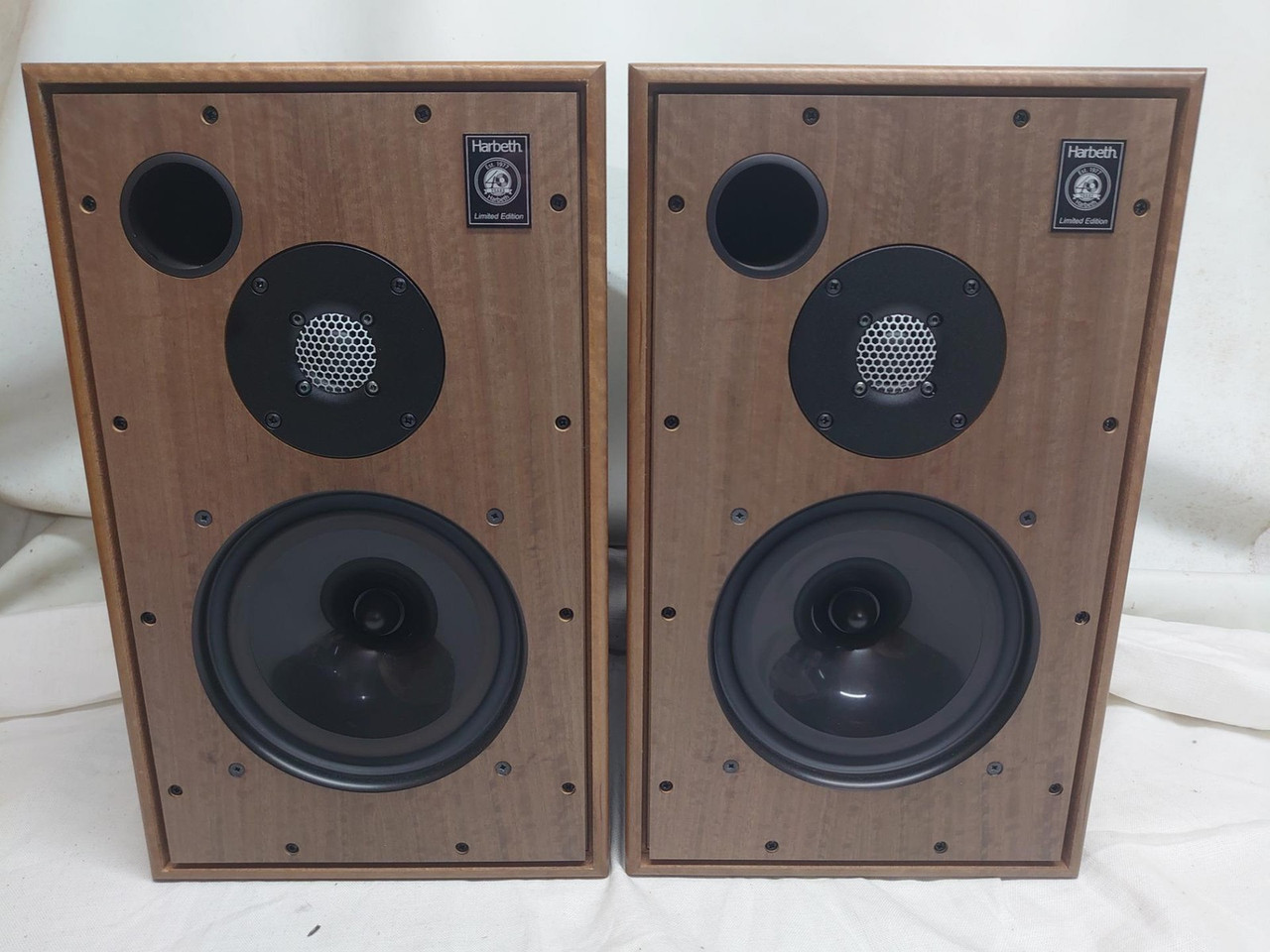
Harbeth Monitor 30.2 40th Anniversary Edition Speakers
Harbeth Monitor 30.2 40th
 113 views last month, 67
 views this month
Last Update On
27.01.2026
 Description
Original Description is in
English, other language texts are translations and can contain errors.
EnglishDeutschSpanishTurkish
Superb.We believe the finish is Eucalyptus.Everything sounds like what it's made of.I'm known for saying that, and to me, it's obvious: box speakers with dome tweeters sound like box speakers with dome tweeters. I can hear their tweeters calling to me when I'm in the next room, making a phone call. I can hear their boxes hissing and groaning even after I turn off the stereo. Many a day, I think Edgar Villchur, inventor of the acoustic-suspension loudspeaker and the dome tweeter, ruined audio, and that audiophiles will never stop denying how artificially colored the sounds of domes and cones in boxes really are.One person I think might agree with this view is Alan Shaw, Managing Director—he took over from founder Dudley Harwood— and chief engineer of Harbeth Loudspeakers, in West Sussex, England. I believe that Shaw will understand, because he singlehandedly fashions speakers that, despite their emphatic old-school, boxy look, sound less like cones and domes in boxes than any others I know.I have long respected Harbeth speakers for their natural, uncolored sound, but this was my first opportunity to study closely the model I most admire: their biggest two-way speaker, the Monitor 30.2 40th Anniversary Edition ($6495/pair).First daysListening to Guo Ya-zhi and his small orchestra on their Sorrow of the River (CD, MA Recordings M074A), I noticed how enormous and powerful the large drum sounded. My mind's eye noted the color of its skin and measured its diameter. I heard the drum's energy emanating in waves that exposed the volume of the recording venue. I perceived the flow and force of air moving through the suona (a Chinese double-reeded horn), and the speech-like utterances of the guzheng (a Chinese zither). I was pleased by how explicitly each instrument was described. Ya-zhi's music made me happy—only his notes were sorrowful.I noticed a text from my friend Sphere: "Have you removed the grillecloths from the Harbeths?" Then another: "You must! Strong bass makes the 30.2s' logos rattle against the enclosure." I texted back: "You're kidding me—right?"318harbeth.4.jpgAmused, I restarted the first track of Sorrow of the River and watched closely. The sound of the large drum shook the logo on the grille. It didn't rattle, but its wiggling made it shimmer in my bunker's dim light.When I tried to remove a grille, it wouldn't just pop off: Its metal frame was fitted tightly into deep grooves between the baffle and the front edges of the speaker's side panels. After a futile struggle, I grabbed the fabric with my fingers and pulled. Both grilles came off. I listened again. The music I'd just enjoyed now sounded not only different, but a little discomforting. Nonetheless, I continued listening with the grilles off for a few days. Then, still frustrated with what I was hearing, I wrote to Alan Shaw: "What's up with your grilles?" I told him I thought the M30.2s sounded better sorted and more balanced with the grilles on. "Am I bonkers?"Shaw's reply was interesting: "We recommend that the grille remain fitted during the life of the speaker and so, obviously, I've taken the grilles' effect into account. If you listen with them off, then you will hear about 0.5dB more 'tweet' and a rather different type of bass, because the bass tuning will have been altered by a couple of dBs or more. You may, of course, like that, but it's not a condition I can comment on as I did not design the speakers that way."From that day forward, I left the Monitor 30.2s' grilles on. I listened to them in the nearfield as they sat on 24"-high TonTräger stands about 3' from the front wall, 6' apart, and 6' from my listening position, toed-in to directly face me, their tweeters precisely at the level of my ears. In those positions, the dual-mono pink noise from John Atkinson's Editor's Choice (CD, Stereophile STPH016-2) sat solidly between the Harbeths like Yosemite's El Capitan. Dispersion was good in both the horizontal and vertical planes. Casual listening revealed no cabinet or port noises; however, when I played the warble tones on Editor's Choice and laid my hands on one speaker's side panels, I felt only a moderate pulse in the 200–250Hz range. But strangely, sitting with my head less than 18" from the port in the upper left corner of the speaker's front baffle, I heard a distinct drop in energy between 80 and 100Hz, followed by a rise at 63Hz.318harbeth.tweet.jpgDescriptionHarbeth Audio's website explains that the Monitor 30.2 40th Anniversary Edition is an electrical and cosmetic refinement of their Monitor 30.1 ($5499/pair and up, depending on finish), which remains in production and is itself an update of the original Monitor 30, described by Harbeth as "a refinement of the classic BBC LS5/9 loudspeaker." The Monitor 30.2 40th Anniversary Edition is upgraded with WBT NextGen binding posts, British-made polypropylene crossover capacitors, and what Harbeth describes as "40th Anniversary ultra-pure OFC internal cable." Visible differences include a restyled tweeter grille, front and rear badges proclaiming limited-edition status, and its exclusive Silver Eucalyptus veneer.The Monitor 30.2 is a well-crafted, elegantly proportioned speaker with a ported cabinet. Hidden behind the speaker's fabric grille is a 7.9" bass-midrange drive-unit with a cone made of Harbeth's proprietary Radial2 polymer, and, under a layer of Harbeth's new protective gauze, a 1" soft-dome, ferro-cooled tweeter from SEAS. The braced and damped cabinet is made of thin layers of MDF. The Monitor 30.2 measures 18.1" tall by 10.9" wide by 10.8" deep and weighs 25.6 lbs. The speaker's specifications include a frequency response of 50Hz–20kHz, ±3dB, a nominal impedance of 6 ohms, and a sensitivity of 85dB/W/m.318harbeth.bac2.jpgListeningIt was one of those late fall days when 5pm feels like 9pm. I was visiting an old friend who had a new shiny expensive hi-fi. He drank single-malt. I drank strong coffee as he played three well-known audiophile LPs that, in a blind test, I would have sworn were high-resolution digital files. All three sounded the same: instruments and voices had a pure but surreally glowing ghostliness, like the look of the hologram of Elvis in Blade Runner 2049. The music felt mechanical. Bloodless.I told my friend the sound was amazing.Back home, I poured hot cider, turned the lights way down, and put on the title track of Miles Davis's Bitches Brew (2 LPs, Columbia CS 9995). The shiniest components in the room were the Silver Eucalyptus–veneered Harbeth M30.2s. My AMG turntable and Koetsu cartridge were barely visible in the darkness. The PrimaLuna ProLogue Premium amplifier and preamplifier were silhouettes displaying forests of radiant tubes. Miles, too, was a silhouette, 5' tall, his trumpet flashing rays of brass-colored light. Miles and his electric band felt tangibly there—unlike those ashen phantoms from my old friend's shiny new system.After Bitches Brew I played Clifton Chenier's Black Snake Blues (LP, Arhoolie 1038) and was surprised—it seemed that Chenier and his Cajun band were trying to generate the same type of musical energy field as Miles and his fusion band. More remarkably, I could hear (and see in my mind's eye) Felix James Benoit's kick drum—its skins, its diameter, the footboard's beater striking the rear head. My mind's eye was simultaneously next to the accordion's bellows and the bottom front of the kick drum—maybe even inside it. Concurrently, and big as life, the Cajun master was singing close to his microphone; he and his squeezebox could hardly have sounded more tangibly real or alive.A small wooden house in Butcher Hollow, in Van Lear, Kentucky, was the birthplace of country-music megastar Loretta Lynn, in 1932. Artist, musician, and record producer Jack White was born in 1975, in Detroit. Van Lear Rose, the album White produced for Lynn in 2004, was nominated for five Grammys and won two (CD, Interscope 80002513-02).Van Lear Rose is the most heart-grabbing recording I've heard in the 21st century. One of its songs, "Women's Prison," begins with Loretta shooting her lover, and ends with her in the electric chair—symbolized by White's guitar solo. The Harbeths excavated every frightening jolt, every electric texture, every remorseful word of this exquisite but morbid soliloquy.Alan Shaw told me that he designs Harbeth speakers to be "stand-, cable-, genre-, and amplifier-agnostic." That might be crazy talk, but his Monitor 30.2s sure let Miles and Loretta be their full jazz and country selves.318harbeth.2.jpgChecking for more examples of genre agnosticism, I provoked the Harbeths with poems, growls, recitations, and prepared piano: pianist Cecil Taylor's In Florescence, with bassist William Parker and Greg Bendian on percussion and vocals (LP, A&M SP5286). This is not easy-flowing cocktail jazz; it's a rabidly powerful, brain-bashing, art-jazz smackdown. In "Anast in Crisis Mouthful of Fresh Cut Flowers," Parker's sawing and plucking tried their best to make the Monitor 30.2s' drivers buckle or wince, but they remained stoic. Taylor's mad prepared-piano explorations shook the room while walking a close edge to audio distortion. Think enormous crashing sounds and machine-gun snare-drum whacks mixed with gurgling drains and explosions. With unshakable clarity, the Harbeths reproduced all of this at peaks of up to 100dB.Amplifier ChangesI replaced PrimaLuna's ProLogue Premium power amp (35Wpc into 8 ohms, $2199) with Pass Laboratories' spectacular new XA25 (25Wpc into 8 ohms, $4900) and put on the premiere recording (1965) of Karlheinz Stockhausen's Momente, with the composer conducting soprano Martina Arroyo, four choral groups drawn from the West German Radio Chorus, and 13 instrumentalists of the West German Radio Orchestra (LP, Nonesuch H-71157). I immediately realized that the dynamic capabilities of the Monitor 30.2s were much greater than I had so far heard. Forget slam and boogie factor—with the Pass XA25 this LP was borderline frightening. Imagine a large chorus suddenly quieted by the voice of a lonely, distant soprano, to be smashed only moments later by an even larger chorus backed by gongs, and Lowrey and Hammond organs! Imagine spine-tingling, gunshot-explosive sound with nary an off tone or fatiguing moment.A few days later I tried Momente again, this time driving the Harbeth M30.2s with Line Magnetic's LM-518 IA integrated amplifier used only as a power amp (22Wpc into 8 ohms, $4450). With the Pass Labs amp the sound had been as transparen, corporeal and hyperdynamic—and oh my lord, with the Line Magnetic the Monitor 30.2s became vivid and textural in a most enticing way.This newly discovered vividness caused the Harbeths to remind me of vintage Quad ESLs. Powered by bright-emitter triode tubes, the M30.2's midrange came into full electrostatic bloom. The Line Magnetic made the Monitor 30.2s' sound more tonally complete, more fully tactile and spatially adept, than did the PrimaLuna or Pass Labs amp. But I doubt the LM-518 will deliver enough power for most audiophiles with these speakers. Turning the volume up and listening for clipping, I heard some, but it was soft, and only on 97dB/2m peaks.318harbeth.bac.jpgRemembering that these low-powered amplifiers might seem a little weak for normal people in regular-size listening rooms, I replaced the Line Magnetic with Bel Canto Design's e.One Ref600M monoblocks (300W into 8 ohms, $4990/pair). Switching from lush, breathy, class-A tubes to an NCore class-D module taught me a lot about audio amplifiers, and even more about Harbeth's Monitor 30.2.With Bel Canto's 300W monos, the Monitor 30.2s' monitor-like clarity and dynamic contrasts were considerably better than with any of the lower-powered amps. More power made the Harbeths lighter on their feet and stronger on the bottom.Best of all, the Ref600Ms added music-enhancing weight to instruments and voices. This extra instrumental mass took Winston Reedy's "What a Feeling," from the reggae compilation A Tribute 2 Studio One & Treasure Isle Records (LP, Cou$ins LP037), to a higher level of listening pleasure. I played this track very loud through the Harbeths, but it flowed easily and never felt loud. Bass guitar, snare-drum whacks, and especially the Hammond organ—all sounded exactly as they should. Easy-flowing power made "What a Feeling" beg to be played three times in a row. So I did.Alan Shaw had told me that Harbeth speakers are "amplifier agnostic," and that I should just "pick anything—as long as it has 80Ws or so." Amp designers often say stuff like that. Usually, I ignore it. But the Harbeth 30.2s responded well to power: The combination of the Harbeths and Bel Cantos was a nonstop pleasure.But! The Pass Labs XA25 exceeded the Bel Cantos in clarity and transparency. Overall, the Nelson Pass–designed XA25 allowed me to engage more with the music, and the Harbeths to reproduce almost everything right. Most important, "What a Feeling" had more, well, feeling. The Pass Labs XA25 is the amp Herb the Reviewer recommends for use with the Monitor 30.2s.But! The amp that Herb, that Monk in the Bunker, most enjoyed with the Harbeths was PrimaLuna's ProLogue Premium. Its 35Wpc were enough power for my type of listening, and its EL34 tubes added an appealing touch of saturated color that kept my focus on the music rather than on the sound.Stands DeliverMy review samples of the Monitor 30.2s came with TonTräger Audio's 24"-tall Reference stands ($1495/pair). These are exquisitely crafted from slender poles of black-stained beech. They sit on bases of polished slate 13.75" square by 1.25" thick. I used the TonTräger stands for the first month of my listening, but then I couldn't stop myself: I replaced the 6-lb TonTrägers with my 57-lb Sound Anchor stands and listened to both sides of Antony and the Johnsons' I Am a Bird Now (LP, Secretly Canadian SC 105).The difference in sound was a lot like stopping down the aperture on a camera lens. With the Sound Anchors (and no Blu-Tack), the musical picture got darker, especially around the edges. Image focus softened in the foreground but reached deeper into the soundfield. The upper bass and lower midrange sounded fuller, and maybe a bit more powerful. But there was some blur and smear that I'd never noticed with the TonTrägers. The effect was similar to reducing the contrast in a photograph.Of the intricate contrast spectrum I'd heard with the Harbeths sitting on the TonTrägers, 80% returned when I inserted pea-sized bits of Blu-Tack between each Harbeth and its Sound Anchor (footnote 1). And bass became more forceful than with the TonTrägers. The heavy Anchors made images seem more solid, but overall, focus wasn't as crisp as with the TonTrägers.318harbeth.3.jpgWhen I returned to the TonTrägers, the musical view became brighter and wider—like opening the aperture on a fast camera lens. Which stand showed me more of what might be on the recordings? I can't say for sure.ConclusionsClearly, Alan Shaw understands that loudspeakers sound like the sum of their parts. He understands that you can't accurately reproduce timbres if the bits of Kevlar, carbon, titanium, or beryllium sing louder than the King's College Choir. Shaw also understands that the secret of making an accurate loudspeaker is not a gaudy cabinet that weighs a quarter of a ton. Harbeth Audio's Monitor 30.2 40th Anniversary Edition demonstrated that the best way to make a reference-quality loudspeaker might be the simplest: use cones and domes and boxes that minimize the aforementioned material colorations. Shaw says that the sound of his Radial2 cone is the least colored of all present-day bass-midrange cones. I believe he is right.I also believe that Harbeth's Monitor 30.2 is the most neutral, accurate, tuneful, fun, and music-loving stand-mounted two-way speaker I've heard.
Hervorragend.
Wir glauben, die Oberfläche ist aus Eukalyptusholz.
Alles klingt so, wie es ist.
Ich bin bekannt dafür, das zu sagen, und für mich ist es offensichtlich: Boxenlautsprecher mit Kalottenhochtönern klingen eben wie Boxenlautsprecher mit Kalottenhochtönern. Ich höre ihre Hochtöner noch, wenn ich im Nebenzimmer telefoniere. Ich höre ihre Gehäuse sogar noch zischen und knarren, nachdem ich die Stereoanlage ausgeschaltet habe. Oft denke ich, Edgar Villchur, der Erfinder des Akustik-Suspension-Lautsprechers und des Kalottenhochtöners, hat die Audiotechnik ruiniert, und Audiophile werden wohl nie aufhören zu leugnen, wie künstlich der Klang von Kalotten und Konen in Boxen tatsächlich ist. Jemand, der dieser Ansicht meiner Meinung nach zustimmen könnte, ist Alan Shaw, Geschäftsführer – er übernahm die Position vom Gründer Dudley Harwood – und Chefingenieur von Harbeth Loudspeakers in West Sussex, England. Ich glaube, Shaw wird das verstehen, denn er baut im Alleingang Lautsprecher, die trotz ihres betont altmodischen, kastenförmigen Aussehens weniger nach Konus- und Kalottenlautsprechern in Gehäusen klingen als alle anderen, die ich kenne.
Ich schätze Harbeth-Lautsprecher seit Langem für ihren natürlichen, unverfälschten Klang, aber dies war meine erste Gelegenheit, das Modell, das ich am meisten bewundere, genauer zu untersuchen: ihren größten Zwei-Wege-Lautsprecher, die Monitor 30.2 40th Anniversary Edition (6495 $/Paar).
Erste Tage
Beim Hören von Guo Ya-zhi und seinem kleinen Orchester auf ihrer CD „Sorrow of the River“ (MA Recordings M074A) fiel mir auf, wie gewaltig und kraftvoll die große Trommel klang. Mein inneres Auge nahm die Farbe ihrer Oberfläche wahr und schätzte ihren Durchmesser. Ich hörte die Energie der Trommel in Wellen ausstrahlen, die die Lautstärke des Aufnahmeraums offenbarten. Ich nahm den Luftstrom und die Kraft der Luft wahr, die durch die Suona (ein chinesisches Doppelrohrblatthorn) strömte, und die sprachähnlichen Klänge der Guzheng (einer chinesischen Zither). Ich war erfreut darüber, wie detailliert jedes Instrument beschrieben wurde. Ya-zhis Musik machte mich glücklich – nur seine Töne waren traurig.
Ich bemerkte eine Nachricht von meinem Freund Sphere: „Hast du die Lautsprecherbespannung von den Harbeths entfernt?“ Dann eine weitere: „Musst du! Starke Bässe lassen die Logos der 30.2er gegen das Gehäuse klappern.“ Ich antwortete: „Das ist doch nicht dein Ernst – oder?“
318harbeth.4.jpg
Amüsiert startete ich den ersten Titel von „Sorrow of the River“ neu und beobachtete genau. Der Klang der großen Trommel ließ das Logo auf der Bespannung erzittern. Es klapperte nicht, aber das Wackeln ließ es im Dämmerlicht meines Bunkers schimmern.
Als ich versuchte, ein Lautsprechergitter zu entfernen, ließ es sich nicht einfach abnehmen: Sein Metallrahmen saß fest in tiefen Nuten zwischen der Schallwand und den Vorderkanten der Seitenwände des Lautsprechers. Nach vergeblichen Versuchen packte ich den Stoff mit den Fingern und zog daran. Beide Gitter lösten sich. Ich hörte erneut zu. Die Musik, die ich eben noch genossen hatte, klang nun nicht nur anders, sondern auch etwas unangenehm. Trotzdem hörte ich einige Tage lang ohne Gitter weiter. Dann, immer noch frustriert von dem, was ich hörte, schrieb ich an Alan Shaw: „Was ist denn mit euren Gittern los?“ Ich sagte ihm, dass ich fand, die M30.2 klängen mit Gittern besser und ausgewogener. „Bin ich verrückt?“
Shaws Antwort war interessant: „Wir empfehlen, die Abdeckung während der gesamten Lebensdauer des Lautsprechers angebracht zu lassen, und daher habe ich deren Einfluss natürlich berücksichtigt. Wenn Sie ohne Abdeckung hören, werden Sie etwa 0,5 dB mehr Höhen und einen etwas anderen Bass wahrnehmen, da die Bassabstimmung um einige Dezibel oder mehr verändert wurde. Das mag Ihnen natürlich gefallen, aber ich kann dazu keine Aussage treffen, da ich die Lautsprecher nicht so konstruiert habe.“
Von diesem Tag an ließ ich die Abdeckungen meiner Monitor 30.2 montiert. Ich hörte die Lautsprecher im Nahfeld, während sie auf 60 cm hohen TonTräger-Ständern standen, etwa 90 cm von der Vorderwand entfernt, 1,80 m voneinander und 1,80 m von meinem Hörplatz entfernt. Sie waren so ausgerichtet, dass sie direkt auf mich gerichtet waren, die Hochtöner exakt auf Ohrhöhe. In dieser Position lag das Dual-Mono-Rosa-Rauschen von John Atkinsons „Editor's Choice“ (CD, Stereophile STPH016-2) so fest zwischen den Harbeth-Lautsprechern wie der El Capitan im Yosemite-Nationalpark. Die Abstrahlung war sowohl horizontal als auch vertikal gut. Beim normalen Hören waren keine Gehäuse- oder Bassreflexgeräusche zu hören. Als ich jedoch die wackeligen Töne von „Editor's Choice“ abspielte und die Hände auf die Seitenwände eines Lautsprechers legte, spürte ich nur ein leichtes Pulsieren im Bereich von 200–250 Hz. Seltsamerweise hörte ich aber, als ich mit dem Kopf weniger als 45 cm vom Bassreflexrohr in der oberen linken Ecke der Frontplatte des Lautsprechers entfernt saß, einen deutlichen Abfall der Energie zwischen 80 und 100 Hz, gefolgt von einem Anstieg bei … 63 Hz.
318harbeth.tweet.jpg
Descripción
El sitio web de Harbeth Audio explica que el Monitor 30.2 Edición 40 Aniversario es una mejora tanto eléctrica como estética del Monitor 30.1 (a partir de 5499 dólares el par, según el acabado), que sigue en producción y es, a su vez, una actualización del Monitor 30 original, descrito por Harbeth como "una mejora del clásico altavoz BBC LS5/9". El Monitor 30.2 Edición 40 Aniversario se ha mejorado con bornes de conexión WBT NextGen, condensadores de cruce de polipropileno de fabricación británica y lo que Harbeth describe como "cable interno OFC ultrapuro 40 Aniversario". Las diferencias visibles incluyen una rejilla de tweeter rediseñada, insignias delanteras y traseras que proclaman su condición de edición limitada y su exclusivo acabado en eucalipto plateado.
El Monitor 30.2 es un altavoz de excelente fabricación y elegantes proporciones con una caja con puerto. Tras la rejilla de tela del altavoz se esconde un altavoz de graves y medios de 7,9" con un cono fabricado con el polímero Radial2 patentado por Harbeth y, bajo una capa de la nueva malla protectora de Harbeth, un tweeter de cúpula blanda de 1" con refrigeración por hierro de SEAS. La caja, reforzada y amortiguada, está fabricada con finas capas de MDF. El Monitor 30.2 mide 46 cm de alto por 27,5 cm de ancho por 27,3 cm de profundidad y pesa 11,5 kg. Las especificaciones del altavoz incluyen una respuesta de frecuencia de 50 Hz a 20 kHz, ±3 dB, una impedancia nominal de 6 ohmios y una sensibilidad de 85 dB/W/m.
318harbeth.bac2.jpg
Escuchando
Era uno de esos días de finales de otoño en los que las 17:00 parecen las 21:00. Estaba visitando a un viejo amigo que tenía un equipo de música nuevo, reluciente y caro. Él bebía whisky de malta. Yo tomaba un café fuerte mientras él ponía tres LPs de audiófilos conocidos que, en una prueba a ciegas, habría jurado que eran archivos digitales de alta resolución. Los tres sonaban igual: los instrumentos y las voces tenían una fantasmalidad pura pero surrealista y brillante, como el holograma de Elvis en Blade Runner 2049. La música se sentía mecánica. Exangüe.
Yo Le dije a mi amigo que el sonido era increíble.
De vuelta en casa, serví sidra caliente, bajé las luces al mínimo y puse la canción principal de Bitches Brew de Miles Davis (2 LP, Columbia CS 9995). Los componentes más brillantes de la sala eran los Harbeth M30.2 chapados en eucalipto plateado. Mi tocadiscos AMG y la cápsula Koetsu apenas se veían en la oscuridad. El amplificador y el preamplificador PrimaLuna ProLogue Premium eran siluetas que mostraban bosques de tubos radiantes. Miles también era una silueta, de 1,50 m, su trompeta destellaba rayos de luz color latón. Miles y su banda eléctrica se sentían tangiblemente allí, a diferencia de esos fantasmas cenicientos del nuevo y brillante sistema de mi viejo amigo.
Después de Bitches Brew, puse Black Snake Blues de Clifton Chenier (LP, Arhoolie 1038) y me sorprendió: parecía que Chenier y su banda cajún intentaban generar el mismo tipo de campo de energía musical que Miles y su Banda de fusión. Más notable aún, podía oír (y ver en mi mente) el bombo de Felix James Benoit: sus pieles, su diámetro, el mazo del pie golpeando el parche trasero. Mi mente estaba simultáneamente junto al fuelle del acordeón y la parte frontal inferior del bombo, tal vez incluso dentro de él. Al mismo tiempo, y con una fuerza impresionante, el maestro cajún cantaba cerca de su micrófono; él y su caja de resonancia difícilmente podrían haber sonado más tangiblemente reales o vivos.
Una pequeña casa de madera en Butcher Hollow, en Van Lear, Kentucky, fue el lugar de nacimiento de la megaestrella de la música country Loretta Lynn, en 1932. El artista, músico y productor discográfico Jack White nació en 1975, en Detroit. Van Lear Rose, el álbum que White produjo para Lynn en 2004, fue nominado a cinco premios Grammy y ganó dos (CD, Interscope 80002513-02).
Van Lear Rose es la grabación más conmovedora que he escuchado en el Siglo XXI. Una de sus canciones, "Women's Prison", comienza con Loretta disparándole a su amante y termina con ella en la silla eléctrica, simbolizada por el solo de guitarra de White. Los Harbeth excavaron en cada sacudida aterradora, cada textura eléctrica, cada palabra de remordimiento de este exquisito pero morboso soliloquio.
Alan Shaw me dijo que diseña los altavoces Harbeth para que sean "agnósticos en cuanto a soporte, cable, género y amplificador". Puede que sea una locura, pero sus Monitor 30.2 sin duda permiten a Miles y Loretta ser plenamente jazz y country.
318harbeth.2.jpg
Buscando más ejemplos de agnosticismo de género, provoqué a los Harbeth con poemas, gruñidos, recitales y piano preparado: In Florescence del pianista Cecil Taylor, con el bajista William Parker y Greg Bendian en la percusión y la voz (LP, A&M SP5286). Este no es un jazz cóctel fluido; es un jazz rabiosamente... Un potente y demoledor choque de jazz artístico. En "Anast in Crisis Mouthful of Fresh Cut Flowers", el corte y punteo de Parker se esforzó al máximo para que los altavoces de los Monitor 30.2 se doblaran o se estremecieran, pero se mantuvieron estoicos. Las locas exploraciones de Taylor con el piano preparado sacudieron la sala, rozando la distorsión del audio. Imagine enormes estruendos y golpes de caja de metralla, mezclados con gorgoteos de desagües y explosiones. Con una claridad inquebrantable, los Harbeths reprodujeron todo esto con picos de hasta 100 dB.
Verstärkerwechsel
Ich ersetzte die PrimaLuna ProLogue Premium Endstufe (35 W pro Kanal an 8 Ohm, 2199 $) durch die spektakuläre neue XA25 von Pass Laboratories (25 W pro Kanal an 8 Ohm, 4900 $) und legte die Ersteinspielung (1965) von Karlheinz Stockhausens „Momente“ auf, bei der der Komponist die Sopranistin Martina Arroyo, vier Chöre des Westdeutschen Rundfunkchors und 13 Instrumentalisten des Westdeutschen Rundfunkorchesters dirigierte (LP, Nonesuch H-71157). Mir wurde sofort klar, dass die Dynamik der Monitor 30.2 weit über das hinausging, was ich bisher gehört hatte. Von Wucht und Groove keine Spur – mit der Pass XA25 war diese LP geradezu atemberaubend. Stellen Sie sich einen großen Chor vor, der plötzlich von der Stimme einer einsamen, fernen Sopranistin verstummt, nur um Augenblicke später von einem noch größeren Chor, untermalt von Gongs und Lowrey- und Hammond-Orgeln, übertönt zu werden! Stellen Sie sich einen Gänsehaut erzeugenden, explosionsartigen Klang vor, ohne einen einzigen Fehlton oder ermüdenden Moment.
Ein paar Tage später testete ich Momente erneut, diesmal mit den Harbeth M30.2s und dem Line Magnetic LM-518 IA Vollverstärker, den ich ausschließlich als Endstufe nutzte (22 W pro Kanal an 8 Ohm, 4450 $). Mit dem Pass Labs Verstärker war der Klang ebenso transparent, körperhaft und hyperdynamisch gewesen – und meine Güte, mit dem Line Magnetic wurden die Monitor 30.2s auf eine überaus verführerische Weise lebendig und nuanciert.
Diese neu entdeckte Lebendigkeit ließ mich die Harbeths an Vintage-Quad-ESLs erinnern. Angetrieben von Trioden mit hellem Emitter, entfaltete der Mitteltonbereich der M30.2 seine volle elektrostatische Brillanz. Der Line Magnetic verlieh dem Klang der Monitor 30.2 eine klanglich vollständigere, haptischere und räumlich präzisere Darstellung als der PrimaLuna- oder der Pass Labs-Verstärker. Ich bezweifle jedoch, dass der LM-518 für die meisten Audiophilen mit diesen Lautsprechern genügend Leistung liefert. Beim Aufdrehen der Lautstärke und dem Achten auf Verzerrungen konnte ich zwar einige feststellen, diese waren aber gering und traten nur bei Spitzenwerten von 97 dB/2 m auf.
318harbeth.bac.jpg Da diese leistungsschwachen Verstärker für normale Hörer in normal großen Räumen etwas schwach erscheinen könnten, ersetzte ich den Line Magnetic durch die Bel Canto Design e.One Ref600M Monoblöcke (300 W an 8 Ohm, 4990 $/Paar). Der Wechsel von üppigen, luftigen Class-A-Röhren zu einem NCore Class-D-Modul lehrte mich viel über Audioverstärker und noch mehr über Harbeths Monitor 30.2.
Mit Bel Cantos 300-Watt-Monoblöcken waren die monitorähnliche Klarheit und die dynamischen Kontraste der Monitor 30.2 deutlich besser als mit allen leistungsschwächeren Verstärkern. Mehr Leistung machte die Harbeths agiler und druckvoller im Bassbereich.
Am besten war jedoch, dass die Ref600Ms Instrumenten und Stimmen mehr Fülle verliehen. Diese zusätzliche Instrumentalmasse hob Winston Reedys „What a Feeling“ von der Reggae-Compilation „A Tribute 2 Studio One & Treasure Isle Records“ (LP, Cou$ins LP037) auf ein neues Niveau des Hörgenusses. Ich spielte diesen Titel sehr laut über die Harbeths, aber er klang flüssig und nie aufdringlich. Bassgitarre, Snare-Drum-Schläge und vor allem die Hammond-Orgel – alles klang genau so, wie es sollte. Die mühelose Kraftentfaltung machte „What a Feeling“ so verlockend, dass man es am liebsten dreimal hintereinander hören wollte. Also tat ich es.
Alan Shaw hatte mir gesagt, Harbeth-Lautsprecher seien „verstärkerunabhängig“ und ich solle einfach „irgendetwas nehmen – solange es ungefähr 80 Watt hat“. Verstärkerentwickler sagen oft so etwas. Normalerweise ignoriere ich es. Aber die Harbeth 30.2 reagierten hervorragend auf Leistung: Die Kombination aus Harbeths und Bel Cantos war ein durchgehender Genuss.
Aber! Die Pass Labs XA25 übertrafen die Bel Cantos in Klarheit und Transparenz. Insgesamt ermöglichten mir die von Nelson Pass entwickelten XA25, mich intensiver mit der Musik auseinanderzusetzen, und die Harbeths gaben nahezu alles korrekt wieder. Am wichtigsten war jedoch, dass „What a Feeling“ mehr Gefühl hatte. Der Pass Labs XA25 ist der Verstärker, den Herb, der Rezensent, für die Monitor 30.2 empfiehlt.
Aber! Der Verstärker, den Herb, dieser Klangkünstler, mit den Harbeths am meisten genoss, war der PrimaLuna ProLogue Premium. Seine 35 Watt pro Kanal reichten für meine Art des Musikhörens völlig aus, und seine EL34-Röhren verliehen dem Klang eine ansprechende, satte Färbung, die meine Aufmerksamkeit ganz auf die Musik und weniger auf den Klang lenkte.
Die Ständer machen den Unterschied
Meine Testexemplare der Monitor 30.2 wurden mit den 61 cm hohen Reference-Ständern von TonTräger Audio (1495 $/Paar) geliefert. Diese sind exquisit aus schlanken, schwarz gebeizten Buchenholzstangen gefertigt. Sie stehen auf Sockeln aus poliertem Schiefer (35 cm x 35 cm x 3,2 cm). Ich nutzte die TonTräger-Ständer den ersten Monat meiner Hörtests, doch dann konnte ich nicht widerstehen: Ich ersetzte die 2,7 kg schweren TonTräger-Ständer durch meine 26 kg schweren Sound Anchor-Ständer und hörte mir beide Seiten von Antony and the Johnsons' Album „I Am a Bird Now“ (LP, Secretly Canadian SC 105) an. Der Klangunterschied war vergleichbar mit dem Abblenden einer Kameralinse. Mit den Sound Anchors (und ohne Blu-Tack) wurde das Klangbild dunkler, insbesondere an den Rändern. Die Abbildung im Vordergrund wurde weicher, reichte aber tiefer in den Klangraum hinein. Der obere Bass und die unteren Mitten klangen voller und vielleicht etwas präsenter. Kraftvoll. Allerdings gab es eine gewisse Unschärfe und Verschmierung, die mir bei den TonTrägern nie aufgefallen war. Der Effekt ähnelte der Reduzierung des Kontrasts in einem Foto.
Von dem feinen Kontrastspektrum, das ich mit den auf den TonTrägern platzierten Harbeth-Lautsprechern gehört hatte, kehrten 80 % zurück, nachdem ich erbsengroße Stücke Blu-Tack zwischen jeden Harbeth-Lautsprecher und seinen Sound Anchor (Fußnote 1) geklebt hatte. Der Bass wurde kräftiger als mit den TonTrägern. Die schweren Anchors ließen das Klangbild solider wirken, aber insgesamt war die Schärfe nicht so präzise wie mit den TonTrägern.
318harbeth.3.jpg
Als ich wieder die TonTräger verwendete, wurde das Klangbild brillanter und umfassender – wie das Öffnen der Blende eines lichtstarken Kameraobjektivs. Welcher Ständer mir mehr von dem zeigte, was auf den Aufnahmen zu hören sein könnte? Ich kann es nicht mit Sicherheit sagen.
Fazit: Alan Shaw versteht ganz klar, dass Lautsprecher wie die Summe ihrer Einzelteile klingen. Er versteht, dass man Klangfarben nicht präzise wiedergeben kann, wenn die einzelnen Komponenten nicht stimmig sind. Lautsprecher aus Kevlar, Carbon, Titan oder Beryllium klingen lauter als der Chor des King’s College. Shaw weiß auch, dass das Geheimnis eines präzisen Lautsprechers nicht in einem protzigen, tonnenschweren Gehäuse liegt. Die Harbeth Monitor 30.2 40th Anniversary Edition hat bewiesen, dass der beste Weg zu einem Referenzlautsprecher der einfachste sein könnte: die Verwendung von Membranen, Kalotten und Gehäusen, die die genannten Materialverfärbungen minimieren. Shaw behauptet, die Radial2-Membran klinge so neutral wie keine andere Bass-Mitteltöner-Membran. Ich glaube, er hat Recht.
Ich bin außerdem überzeugt, dass die Harbeth Monitor 30.2 der neutralste, präziseste, klangvollste, unterhaltsamste und musikalischste Zwei-Wege-Regallautsprecher ist, den ich je gehört habe.
Magnífico.
Creemos que el acabado es de eucalipto.
Todo suena como de lo que está hecho.
Soy conocido por decirlo, y para mí es obvio: los altavoces de caja con tweeters de cúpula suenan como altavoces de caja con tweeters de cúpula. Puedo oír sus tweeters llamándome cuando estoy en la habitación de al lado, haciendo una llamada. Puedo oír sus cajas silbando y gimiendo incluso después de apagar el estéreo. Muchos días pienso que Edgar Villchur, inventor del altavoz de suspensión acústica y del tweeter de cúpula, arruinó el audio, y que los audiófilos nunca dejarán de negar lo artificialmente coloreados que están los sonidos de las cúpulas y los conos en las cajas.
Creo que alguien que podría estar de acuerdo con esta opinión es Alan Shaw, director general —sustituyó al fundador Dudley Harwood— e ingeniero jefe de Harbeth Loudspeakers, en West Sussex, Inglaterra. Creo que Shaw lo entenderá, porque él mismo diseña altavoces que, a pesar de su enfático aspecto clásico y cuadrado, suenan menos como conos y cúpulas en cajas que cualquier otro que conozco.
Hace tiempo que respeto los altavoces Harbeth por su sonido natural y sin colorantes, pero esta fue mi primera oportunidad de estudiar de cerca el modelo que más admiro: su altavoz de dos vías más grande, el Monitor 30.2 Edición 40 Aniversario (6495 $/par).
Primeros días
Al escuchar a Guo Ya-zhi y su pequeña orquesta en Sorrow of the River (CD, MA Recordings M074A), noté lo enorme y potente que sonaba el gran tambor. Mi mente notó el color de su piel y medí su diámetro. Escuché la energía del tambor emanando en ondas que revelaban el volumen del lugar de grabación. Percibí el flujo y la fuerza del aire moviéndose a través del suona (un cuerno chino de doble lengüeta) y las expresiones, similares a las del habla, del guzheng (una cítara china). Me agradó la claridad con la que se describía cada instrumento. La música de Ya-zhi me alegraba; solo sus notas eran tristes.
Vi un mensaje de mi amigo Sphere: "¿Has quitado las telas de la rejilla de los Harbeth?". Luego otro: "¡Debes hacerlo! Los graves potentes hacen que los logotipos de los 30.2 resuenen contra la caja". Le respondí: "¿Es broma, verdad?".
318harbeth.4.jpg
Divertido, volví a poner la primera pista de Sorrow of the River y observé atentamente. El sonido del gran tambor sacudía el logotipo de la rejilla. No resonaba, pero su movimiento lo hacía brillar en la tenue luz de mi búnker.
Cuando intenté quitar una rejilla, no se desprendía así como así: su marco metálico estaba firmemente encajado en ranuras profundas entre el deflector y los bordes frontales de los paneles laterales del altavoz. Tras un esfuerzo inútil, agarré la tela con los dedos y tiré. Ambas rejillas se desprendieron. Volví a escuchar. La música que acababa de disfrutar ahora sonaba no solo diferente, sino un poco incómoda. Aun así, seguí escuchándola sin las rejillas durante unos días. Luego, todavía frustrado con lo que oía, le escribí a Alan Shaw: "¿Qué pasa con tus rejillas?". Le dije que los M30.2 sonaban mejor y más equilibrados con las rejillas puestas. "¿Estoy loco?".
La respuesta de Shaw fue interesante: "Recomendamos que la rejilla permanezca puesta durante la vida útil del altavoz y, por lo tanto, obviamente, he tenido en cuenta su efecto. Si escuchas sin ellas, oirás unos 0,5 dB más de 'tweet' y unos graves bastante diferentes, porque la afinación de graves se habrá alterado un par de dB o más. Puede que, por supuesto, te guste, pero no es una condición sobre la que pueda opinar, ya que no diseñé los altavoces así".
A partir de ese día, dejé puestas las rejillas de los Monitor 30.2. Los escuché en campo cercano, colocados sobre soportes TonTräger de 24" de altura, a aproximadamente 90 cm de la pared frontal, a 1,80 m de distancia y a 1,80 m de mi posición de escucha, con la punta hacia adentro, frente a mí, con los tweeters justo a la altura de mis oídos. En esas posiciones, el ruido rosa dual-mono de Editor's Choice de John Atkinson (CD, Stereophile STPH016-2) se situaba sólidamente entre los Harbeth, como El Capitán de Yosemite. La dispersión era buena tanto en el plano horizontal como en el vertical. Una escucha casual no reveló ruidos de caja ni de puerto; sin embargo, al reproducir los tonos gorjeantes de Editor's Choice y apoyar las manos en los paneles laterales de un altavoz, solo sentí una pulsación moderada en el rango de 200-250 Hz. Pero, curiosamente, sentado con la cabeza a menos de 45 cm del puerto en la esquina superior izquierda del deflector frontal del altavoz, escuché una clara caída de energía entre 80 y 100 Hz, seguida de una Aumento a 63 Hz.
318harbeth.tweet.jpg
Descripción
El sitio web de Harbeth Audio explica que el Monitor 30.2 Edición 40 Aniversario es una mejora tanto eléctrica como estética del Monitor 30.1 (a partir de 5499 dólares el par, según el acabado), que sigue en producción y es, a su vez, una actualización del Monitor 30 original, descrito por Harbeth como "una mejora del clásico altavoz BBC LS5/9". El Monitor 30.2 Edición 40 Aniversario se ha mejorado con bornes de conexión WBT NextGen, condensadores de cruce de polipropileno de fabricación británica y lo que Harbeth describe como "cable interno OFC ultrapuro 40 Aniversario". Las diferencias visibles incluyen una rejilla de tweeter rediseñada, insignias delanteras y traseras que proclaman su condición de edición limitada y su exclusivo acabado en eucalipto plateado.
El Monitor 30.2 es un altavoz de excelente fabricación y elegantes proporciones con una caja con puerto. Tras la rejilla de tela del altavoz se esconde un altavoz de graves y medios de 7,9" con un cono fabricado con el polímero Radial2 patentado por Harbeth y, bajo una capa de la nueva malla protectora de Harbeth, un tweeter de cúpula blanda de 1" con refrigeración por hierro de SEAS. La caja, reforzada y amortiguada, está fabricada con finas capas de MDF. El Monitor 30.2 mide 46 cm de alto por 27,5 cm de ancho por 27,3 cm de profundidad y pesa 11,5 kg. Las especificaciones del altavoz incluyen una respuesta de frecuencia de 50 Hz a 20 kHz, ±3 dB, una impedancia nominal de 6 ohmios y una sensibilidad de 85 dB/W/m.
318harbeth.bac2.jpg
Escuchando
Era uno de esos días de finales de otoño en los que las 17:00 parecen las 21:00. Estaba visitando a un viejo amigo que tenía un equipo de música nuevo, reluciente y caro. Él bebía whisky de malta. Yo tomaba un café fuerte mientras él ponía tres LPs de audiófilos conocidos que, en una prueba a ciegas, habría jurado que eran archivos digitales de alta resolución. Los tres sonaban igual: los instrumentos y las voces tenían una fantasmalidad pura pero surrealista y brillante, como el holograma de Elvis en Blade Runner 2049. La música se sentía mecánica. Exangüe.
Yo Le dije a mi amigo que el sonido era increíble.
De vuelta en casa, serví sidra caliente, bajé las luces al mínimo y puse la canción principal de Bitches Brew de Miles Davis (2 LP, Columbia CS 9995). Los componentes más brillantes de la sala eran los Harbeth M30.2 chapados en eucalipto plateado. Mi tocadiscos AMG y la cápsula Koetsu apenas se veían en la oscuridad. El amplificador y el preamplificador PrimaLuna ProLogue Premium eran siluetas que mostraban bosques de tubos radiantes. Miles también era una silueta, de 1,50 m, su trompeta destellaba rayos de luz color latón. Miles y su banda eléctrica se sentían tangiblemente allí, a diferencia de esos fantasmas cenicientos del nuevo y brillante sistema de mi viejo amigo.
Después de Bitches Brew, puse Black Snake Blues de Clifton Chenier (LP, Arhoolie 1038) y me sorprendió: parecía que Chenier y su banda cajún intentaban generar el mismo tipo de campo de energía musical que Miles y su Banda de fusión. Más notable aún, podía oír (y ver en mi mente) el bombo de Felix James Benoit: sus pieles, su diámetro, el mazo del pie golpeando el parche trasero. Mi mente estaba simultáneamente junto al fuelle del acordeón y la parte frontal inferior del bombo, tal vez incluso dentro de él. Al mismo tiempo, y con una fuerza impresionante, el maestro cajún cantaba cerca de su micrófono; él y su caja de resonancia difícilmente podrían haber sonado más tangiblemente reales o vivos.
Una pequeña casa de madera en Butcher Hollow, en Van Lear, Kentucky, fue el lugar de nacimiento de la megaestrella de la música country Loretta Lynn, en 1932. El artista, músico y productor discográfico Jack White nació en 1975, en Detroit. Van Lear Rose, el álbum que White produjo para Lynn en 2004, fue nominado a cinco premios Grammy y ganó dos (CD, Interscope 80002513-02).
Van Lear Rose es la grabación más conmovedora que he escuchado en el Siglo XXI. Una de sus canciones, "Women's Prison", comienza con Loretta disparándole a su amante y termina con ella en la silla eléctrica, simbolizada por el solo de guitarra de White. Los Harbeth excavaron en cada sacudida aterradora, cada textura eléctrica, cada palabra de remordimiento de este exquisito pero morboso soliloquio.
Alan Shaw me dijo que diseña los altavoces Harbeth para que sean "agnósticos en cuanto a soporte, cable, género y amplificador". Puede que sea una locura, pero sus Monitor 30.2 sin duda permiten a Miles y Loretta ser plenamente jazz y country.
318harbeth.2.jpg
Buscando más ejemplos de agnosticismo de género, provoqué a los Harbeth con poemas, gruñidos, recitales y piano preparado: In Florescence del pianista Cecil Taylor, con el bajista William Parker y Greg Bendian en la percusión y la voz (LP, A&M SP5286). Este no es un jazz cóctel fluido; es un jazz rabiosamente... Un potente y demoledor choque de jazz artístico. En "Anast in Crisis Mouthful of Fresh Cut Flowers", el corte y punteo de Parker se esforzó al máximo para que los altavoces de los Monitor 30.2 se doblaran o se estremecieran, pero se mantuvieron estoicos. Las locas exploraciones de Taylor con el piano preparado sacudieron la sala, rozando la distorsión del audio. Imagine enormes estruendos y golpes de caja de metralla, mezclados con gorgoteos de desagües y explosiones. Con una claridad inquebrantable, los Harbeths reprodujeron todo esto con picos de hasta 100 dB.
Cambios de amplificador
Reemplacé el amplificador ProLogue Premium de PrimaLuna (35 Wpc a 8 ohmios, $2199) por el nuevo y espectacular XA25 de Pass Laboratories (25 Wpc a 8 ohmios, $4900) y grabé la primera grabación (1965) de Momente de Karlheinz Stockhausen, con el compositor dirigiendo a la soprano Martina Arroyo, cuatro grupos corales del Coro de la Radio de Alemania Occidental y 13 instrumentistas de la Orquesta de la Radio de Alemania Occidental (LP, Nonesuch H-71157). Inmediatamente me di cuenta de que la capacidad dinámica de los Monitor 30.2 era mucho mayor de lo que había escuchado hasta entonces. Olvídense del slam y el efecto boogie: con el Pass XA25, este LP era casi aterrador. ¡Imagínense un gran coro silenciado repentinamente por la voz de una soprano solitaria y distante, para ser aplastado momentos después por un coro aún más grande respaldado por gongs y órganos Lowrey y Hammond! Imagina un sonido escalofriante, explosivo y sin un solo momento de desafinación o fatiga.
Unos días después, volví a probar Momente, esta vez usando los Harbeth M30.2 con el amplificador integrado LM-518 IA de Line Magnetic, usado solo como etapa de potencia (22 Wpc a 8 ohmios, $4450). Con el amplificador Pass Labs, el sonido había sido igual de transparente, corpóreo e hiperdinámico, y ¡ay, Dios mío!, con el Line Magnetic, los Monitor 30.2 se volvieron vívidos y texturizados de una manera muy atractiva.
Esta intensidad recién descubierta hizo que los Harbeth me recordaran a los Quad ESL clásicos. Alimentados por válvulas de triodo de emisor brillante, los medios de los M30.2 alcanzaron su máximo esplendor electrostático. El Line Magnetic hizo que el sonido de los Monitor 30.2 fuera más completo tonalmente, más táctil y espacialmente hábil que el de los amplificadores PrimaLuna o Pass Labs. Pero dudo que el LM-518 ofrezca suficiente potencia para la mayoría de los audiófilos con estos altavoces. Subiendo el volumen y buscando saturación, escuché algo, pero era suave, y solo en picos de 97 dB/2 m.
318harbeth.bac.jpg
Recordando que estos amplificadores de baja potencia podrían parecer algo débiles para el público normal en salas de escucha de tamaño regular, sustituí el Line Magnetic por los monobloques e.One Ref600M de Bel Canto Design (300 W a 8 ohmios, $4990/par). Cambiar de válvulas de clase A, exuberantes y potentes, a un módulo NCore de clase D me enseñó mucho sobre amplificadores de audio, y aún más sobre el Monitor 30.2 de Harbeth.
Con los monos de 300 W de Bel Canto, la claridad y los contrastes dinámicos de los Monitor 30.2, similares a los de un monitor, fueron considerablemente mejores que con cualquiera de los amplificadores de menor potencia. Más potencia hizo que los Harbeth fueran más ligeros y más potentes en los graves.
Lo mejor de todo es que los Ref600M añadieron un peso que realzaba la música a instrumentos y voces. Esta masa instrumental adicional elevó el placer auditivo de "What a Feeling" de Winston Reedy, del recopilatorio de reggae A Tribute 2 Studio One & Treasure Isle Records (LP, Cou$ins LP037). Reproduje esta canción a todo volumen con los Harbeth, pero fluía con facilidad y nunca se sintió demasiado fuerte. El bajo, los golpes de caja y, sobre todo, el órgano Hammond sonaban exactamente como debían. La potencia fluida hizo que "What a Feeling" pidiera ser reproducido tres veces seguidas. Y así lo hice.
Alan Shaw me había dicho que los altavoces Harbeth son "agnósticos con respecto al amplificador" y que simplemente "elija cualquier cosa, siempre que tenga unos 80 W". Los diseñadores de amplificadores suelen decir cosas así. Normalmente, no les hago caso. Pero los Harbeth 30.2 respondieron bien a la potencia: la combinación de los Harbeth y los Bel Canto fue un placer inagotable.
¡Pero! El Pass Labs XA25 superó a los Bel Canto en claridad y transparencia. En general, el XA25, diseñado por Nelson Pass, me permitió conectar más con la música, y los Harbeth reprodujeron casi todo correctamente. Y lo más importante, "What a Feeling" tenía más, bueno, sentimiento. El Pass Labs XA25 es el amplificador que Herb, el crítico, recomienda para usar con los Monitor 30.2.
¡Pero! El amplificador que Herb, ese Monje en el Búnker, más disfrutó con los Harbeth fue el ProLogue Premium de PrimaLuna. Sus 35 Wpc eran suficientes para mi tipo de escucha, y sus válvulas EL34 añadían un atractivo toque de color saturado que me mantuvo concentrado en la música en lugar del sonido.
Los soportes cumplen
Mis muestras de prueba de los Monitor 30.2 incluían los soportes Reference de 24" de TonTräger Audio (1495 dólares el par). Estos están exquisitamente elaborados con finos postes de haya teñida de negro. Se asientan sobre bases de pizarra pulida de 35 cm cuadrados por 3,1 cm de grosor. Usé los soportes TonTräger durante el primer mes, pero luego no pude contenerme: sustituí los TonTräger de 2,7 kg por mis soportes Sound Anchor de 25 kg y escuché ambas caras de I Am a Bird Now (LP, Secretly Canadian SC 105) de Antony and the Johnsons.
La diferencia de sonido era muy similar a cerrar la apertura del objetivo de una cámara. Con los Sound Anchor (y sin Blu-Tack), la imagen musical se oscureció, especialmente en los bordes. El enfoque de la imagen se suavizó en primer plano, pero se adentró más en el campo sonoro. Los graves agudos y los medios graves sonaban Más completo y quizás un poco más potente. Pero había algo de desenfoque y borrosidad que nunca había notado con los TonTräger. El efecto era similar a reducir el contraste en una fotografía.
Del intrincado espectro de contraste que había escuchado con los Harbeth sobre los TonTräger, el 80% regresó al insertar pequeños trozos de Blu-Tack entre cada Harbeth y su Sound Anchor (nota al pie 1). Y los graves se volvieron más potentes que con los TonTräger. Los pesados Anchors hicieron que las imágenes parecieran más sólidas, pero en general, el enfoque no era tan nítido como con los TonTräger.
318harbeth.3.jpg
Cuando volví a los TonTräger, la visión musical se volvió más brillante y amplia, como abrir la apertura de una lente de cámara rápida. ¿Qué soporte me mostró más de lo que podría haber en las grabaciones? No puedo asegurarlo.
Conclusiones
Claramente, Alan Shaw lo entiende Los altavoces suenan como la suma de sus partes. Entiende que no se pueden reproducir timbres con precisión si las piezas de Kevlar, carbono, titanio o berilio cantan más fuerte que el coro del King's College. Shaw también entiende que el secreto para fabricar un altavoz preciso no reside en una caja llamativa que pese un cuarto de tonelada. El Monitor 30.2 Edición 40 Aniversario de Harbeth Audio demostró que la mejor manera de fabricar un altavoz de calidad de referencia podría ser la más sencilla: usar conos, cúpulas y cajas que minimicen las coloraciones de los materiales mencionadas. Shaw afirma que el sonido de su cono Radial2 es el menos coloreado de todos los conos de graves y medios actuales. Creo que tiene razón.
También creo que el Monitor 30.2 de Harbeth es el altavoz de dos vías para montaje en soporte más neutral, preciso, melodioso, divertido y musical que he escuchado.
Mükemmel.
Kaplamanın okaliptüs olduğuna inanıyoruz.
Her şey yapıldığı malzeme gibi ses çıkarıyor.
Bunu sık sık söylerim ve bana göre bu çok açık: kubbeli tiz hoparlörlü kutu hoparlörler, kubbeli tiz hoparlörlü kutu hoparlörler gibi ses çıkarıyor. Yan odada telefon görüşmesi yaparken bile tiz hoparlörlerinin bana seslendiğini duyabiliyorum. Stereo sistemi kapattıktan sonra bile kutularının tıslama ve inleme seslerini duyabiliyorum. Birçok gün, akustik süspansiyonlu hoparlörün ve kubbeli tiz hoparlörün mucidi Edgar Villchur'un sesi mahvettiğini ve ses tutkunlarının, kutulardaki kubbe ve konilerin seslerinin ne kadar yapay olarak renklendirildiğini asla inkar etmeyeceklerini düşünüyorum.
Bu görüşe katılabilecek bir kişi de, kurucu Dudley Harwood'dan görevi devralan ve İngiltere'nin Batı Sussex bölgesindeki Harbeth Loudspeakers'ın Genel Müdürü ve baş mühendisi olan Alan Shaw olabilir. Shaw'ın anlayacağından eminim, çünkü o, eski tarz, kutu gibi görünümlerine rağmen, bildiğim diğer hoparlörlerden daha az kutu içindeki koni ve kubbe gibi ses çıkaran hoparlörler tasarlıyor.
Harbeth hoparlörlerine uzun zamandır doğal, renksiz sesleri nedeniyle saygı duyuyorum, ancak bu, en çok hayran olduğum modeli yakından inceleme fırsatım oldu: en büyük iki yollu hoparlörleri olan Monitor 30.2 40. Yıldönümü Sürümü (çifti 6495 dolar).
İlk günler
Guo Ya-zhi ve küçük orkestrasının Sorrow of the River (CD, MA Recordings M074A) albümünü dinlerken, büyük davulun ne kadar muazzam ve güçlü ses çıkardığını fark ettim. Zihnimde davulun derisinin rengini ve çapını ölçtüm. Davulun enerjisinin, kayıt mekanının hacmini ortaya koyan dalgalar halinde yayıldığını duydum. Suona'dan (Çin çift kamışlı bir boru) geçen havanın akışını ve gücünü ve guzheng'in (Çin zitheri) konuşma benzeri seslerini algıladım. Her bir enstrümanın ne kadar açık bir şekilde tanımlandığına memnun oldum. Ya-zhi'nin müziği beni mutlu etti; sadece notaları hüzünlüydü.
Arkadaşım Sphere'den bir mesaj gördüm: "Harbeth'lerin ızgara kumaşlarını çıkardın mı?" Sonra bir tane daha: "Çıkarmalısın! Güçlü bas, 30.2'lerin logolarının kasaya sürtünerek titremesine neden oluyor." Cevap yazdım: "Şaka yapıyorsun, değil mi?"
318harbeth.4.jpg
Eğlenerek, Sorrow of the River'ın ilk parçasını yeniden başlattım ve dikkatlice izledim. Büyük davulun sesi ızgaradaki logoyu salladı. Titremedi, ama kıpırdaması sığınaktaki loş ışıkta parıldamasına neden oldu.
Bir ızgarayı çıkarmaya çalıştığımda, öylece çıkmadı: Metal çerçevesi, bölme ile hoparlörün yan panellerinin ön kenarları arasındaki derin oluklara sıkıca oturmuştu. Boşuna bir mücadeleden sonra, kumaşı parmaklarımla kavrayıp çektim. Her iki ızgara da çıktı. Tekrar dinledim. Az önce keyifle dinlediğim müzik şimdi sadece farklı değil, biraz da rahatsız edici geliyordu. Yine de, birkaç gün boyunca hoparlör ızgaralarını çıkararak dinlemeye devam ettim. Sonra, duyduklarımdan hala hayal kırıklığına uğramış bir şekilde Alan Shaw'a yazdım: "Pijama ızgaralarınızda ne var?" Ona M30.2'lerin ızgaralar takılıyken daha iyi ve daha dengeli ses verdiğini düşündüğümü söyledim. "Çıldırmış mıyım?"
Shaw'ın cevabı ilginçti: "Hoparlörün kullanım ömrü boyunca ızgaraların takılı kalmasını öneriyoruz ve bu nedenle, açıkçası, ızgaraların etkisini hesaba kattım. Izgaraları çıkararak dinlerseniz, yaklaşık 0,5 dB daha fazla 'tiz' ve oldukça farklı bir bas türü duyacaksınız, çünkü bas ayarı birkaç dB veya daha fazla değişmiş olacaktır. Elbette bunu beğenebilirsiniz, ancak hoparlörleri bu şekilde tasarlamadığım için bu konuda yorum yapamam."
O günden itibaren Monitor 30.2'lerin ızgaralarını takılı bıraktım. Hoparlörleri, ön duvardan yaklaşık 90 cm uzaklıkta, birbirinden 180 cm ve dinleme konumumdan 180 cm uzakta, 60 cm yüksekliğindeki TonTräger standlar üzerinde, doğrudan bana dönük şekilde, tiz hoparlörleri tam kulak hizamda olacak şekilde yakın alanda dinledim. Bu konumlarda, John Atkinson'ın Editor's Choice (CD, Stereophile STPH016-2) albümünden gelen çift mono pembe gürültü, Harbeth hoparlörlerinin arasında Yosemite'nin El Capitan'ı gibi sağlam bir şekilde yerleşti. Dağılım hem yatay hem de dikey düzlemlerde iyiydi. Sıradan dinlemede kabin veya port gürültüsü duyulmadı; ancak Editor's Choice'daki titreşimli tonları çalarken ve bir hoparlörün yan panellerine elimi koyduğumda, 200-250 Hz aralığında yalnızca orta derecede bir titreşim hissettim. Ancak garip bir şekilde, başımı hoparlörün ön panelinin sol üst köşesindeki porttan 45 cm'den daha az bir mesafede tutarak oturduğumda, 80 ile 100 Hz arasında belirgin bir enerji düşüşü ve ardından bir yükseliş duydum. 63 Hz'de.
318harbeth.tweet.jpg
Açıklama
Harbeth Audio'nun web sitesinde, Monitor 30.2 40. Yıldönümü Sürümü'nün, üretimde olan ve Harbeth tarafından "klasik BBC LS5/9 hoparlörünün geliştirilmiş bir versiyonu" olarak tanımlanan orijinal Monitor 30'un güncellenmiş bir versiyonu olan Monitor 30.1'in (çifti 5499$ ve üzeri, kaplamaya bağlı olarak) elektriksel ve kozmetik olarak iyileştirilmiş bir versiyonu olduğu açıklanmaktadır. Monitor 30.2 40. Yıldönümü Sürümü, WBT NextGen bağlantı terminalleri, İngiliz yapımı polipropilen geçiş kondansatörleri ve Harbeth'in "40. Yıldönümü ultra saf OFC dahili kablo" olarak tanımladığı özelliklerle yükseltilmiştir. Görünür farklılıklar arasında yeniden tasarlanmış tweeter ızgarası, sınırlı sayıda üretildiğini belirten ön ve arka logolar ve özel Gümüş Okaliptüs kaplama yer almaktadır.
Monitor 30.2, portlu kabine sahip, iyi işlenmiş, zarif oranlara sahip bir hoparlördür. Hoparlörün kumaş ızgarasının arkasında, Harbeth'in tescilli Radial2 polimerinden yapılmış bir koniye sahip 7,9 inçlik bir bas-orta frekans sürücü ünitesi ve Harbeth'in yeni koruyucu tül tabakasının altında, SEAS'tan 1 inçlik yumuşak kubbeli, ferro soğutmalı bir tweeter bulunmaktadır. Destekli ve sönümlü kabin, ince MDF katmanlarından yapılmıştır. Monitor 30.2, 18,1 inç yüksekliğinde, 10,9 inç genişliğinde ve 10,8 inç derinliğinde olup 25,6 lbs ağırlığındadır. Hoparlörün teknik özellikleri arasında 50Hz–20kHz, ±3dB frekans tepkisi, 6 ohm nominal empedans ve 85dB/W/m hassasiyet yer almaktadır.
318harbeth.bac2.jpg
Dinleme
Sonbaharın son günlerinden biriydi, saat 17:00 sanki 21:00 gibiydi. Yeni, parlak ve pahalı bir hi-fi sistemine sahip eski bir arkadaşımı ziyaret ediyordum. O tek malt viski içiyordu. Ben de sert kahve içerken, kör bir testte yüksek çözünürlüklü dijital dosyalar olduğuna yemin edebileceğim üç ünlü audiophile LP'yi çaldı. Üçü de aynı ses veriyordu: Enstrümanlar ve sesler, Blade Runner 2049'daki Elvis hologramının görünümü gibi, saf ama gerçeküstü bir şekilde parlayan hayaletimsi bir görünüme sahipti. Müzik mekanik hissettiriyordu. Kanı yoktu.
Arkadaşlarıma söyledim Arkadaşım, ses inanılmazdı.
Eve döndüğümde sıcak elma şarabı doldurdum, ışıkları iyice kıstım ve Miles Davis'in Bitches Brew albümünün (2 LP, Columbia CS 9995) başlık parçasını açtım. Odadaki en parlak bileşenler, gümüş okaliptüs kaplamalı Harbeth M30.2'lerdi. AMG pikapım ve Koetsu kartuşum karanlıkta zar zor görünüyordu. PrimaLuna ProLogue Premium amplifikatör ve ön amplifikatör, ışıldayan tüplerden oluşan ormanlar sergileyen silüetlerdi. Miles da bir silüetti, 1,5 metre boyunda, trompeti pirinç rengi ışık huzmeleri saçıyordu. Miles ve elektrikli grubu, eski arkadaşımın parlak yeni sistemindeki o kül rengi hayaletlerin aksine, elle tutulur bir şekilde oradaydı.
Bitches Brew'dan sonra Clifton Chenier'in Black Snake Blues albümünü (LP, Arhoolie 1038) çaldım ve şaşırdım; Chenier ve Cajun grubu, Miles ve grubunun yarattığı türden bir müzikal enerji alanı oluşturmaya çalışıyor gibiydi. Bir füzyon grubu. Daha da dikkat çekici olanı, Felix James Benoit'nin bas davulunun sesini (ve zihnimde canlandırdığım görüntüyü) duyabiliyordum; derisini, çapını, ayak tahtasının tokmağının arka deriye vuruşunu. Zihnim aynı anda akordeonun körüğünün ve bas davulunun alt ön kısmının yanındaydı - belki de içindeydi. Eş zamanlı olarak ve canlı bir şekilde, Cajun ustası mikrofonuna yakın bir şekilde şarkı söylüyordu; o ve akordeonu daha somut, gerçek veya canlı ses çıkaramazdı.
Kentucky, Van Lear'daki Butcher Hollow'da küçük bir ahşap ev, 1932'de country müziğinin mega yıldızı Loretta Lynn'in doğum yeriydi. Sanatçı, müzisyen ve plak yapımcısı Jack White, 1975'te Detroit'te doğdu. White'ın 2004'te Lynn için yapımcılığını üstlendiği Van Lear Rose albümü, beş Grammy'ye aday gösterildi ve ikisini kazandı (CD, Interscope 80002513-02).
Van Lear Rose, en yürek burkan kayıttır. 21. yüzyılda duydum. Şarkılarından biri olan "Kadınlar Hapishanesi", Loretta'nın sevgilisini vurmasıyla başlıyor ve White'ın gitar solosuyla sembolize edilen elektrikli sandalyede bitiyor. Harbeth'ler, bu enfes ama kasvetli monologun her korkutucu sarsıntısını, her elektrikli dokusunu, her pişmanlık dolu kelimesini ortaya çıkardı.
Alan Shaw bana Harbeth hoparlörlerini "ayaklık, kablo, tür ve amplifikatörden bağımsız" olacak şekilde tasarladığını söyledi. Bu çılgınca bir konuşma olabilir, ancak Monitor 30.2'leri Miles ve Loretta'nın tam anlamıyla caz ve country kimliklerini sergilemelerine izin veriyor.
318harbeth.2.jpg
Tür bağımsızlığının daha fazla örneğini ararken, Harbeth'leri şiirler, hırıltılar, okumalar ve hazırlanmış piyano ile kışkırttım: piyanist Cecil Taylor'ın basçı William Parker ve perküsyon ve vokalde Greg Bendian ile birlikte In Florescence'ı (LP, A&M SP5286). Bu değil Akıcı kokteyl cazı; son derece güçlü, beyinleri zorlayan, sanat cazı kapışması. "Anast in Crisis Mouthful of Fresh Cut Flowers"da Parker'ın testere gibi keskin ve telleri tıngırdatarak Monitor 30.2'lerin sürücülerini zorlamaya çalıştı, ancak sürücüler metanetlerini korudular. Taylor'ın çılgın piyano keşifleri, ses bozulmasının eşiğinde yürürken odayı salladı. Devasa çarpma sesleri ve makineli tüfek gibi trampet vuruşları, gurgur eden giderler ve patlamalarla karışmış halde düşünün. Sarsılmaz bir netlikle, Harbeth'ler tüm bunları 100 dB'ye varan tepe noktalarında yeniden üretti.
Amplifikatör Değişiklikleri
PrimaLuna'nın ProLogue Premium güç amplifikatörünü (8 ohm'a 35Wpc, 2199$) Pass Laboratories'in muhteşem yeni XA25'i (8 ohm'a 25Wpc, 4900$) ile değiştirdim ve besteci Karlheinz Stockhausen'in soprano Martina Arroyo, Batı Alman Radyo Korosu'ndan dört koro grubu ve Batı Alman Radyo Orkestrası'ndan 13 enstrümanistin yer aldığı Momente'nin (1965) ilk kaydını (LP, Nonesuch H-71157) çaldım. Monitor 30.2'lerin dinamik yeteneklerinin şimdiye kadar duyduklarımdan çok daha büyük olduğunu hemen fark ettim. Vuruş ve coşku faktörünü unutun—Pass XA25 ile bu LP neredeyse korkutucu derecede güçlüydü. Hayal edin ki, büyük bir koro aniden yalnız, uzak bir sopranonun sesiyle susuyor, birkaç dakika sonra ise gonglar, Lowrey ve Hammond orglarıyla desteklenen daha da büyük bir koro tarafından paramparça ediliyor! Tüyler ürpertici, patlama sesine benzer bir ses, tek bir yanlış ton veya yorucu an olmadan!
Birkaç gün sonra Momente'yi tekrar denedim, bu sefer Harbeth M30.2'leri Line Magnetic'in LM-518 IA entegre amplifikatörüyle (8 ohm'a 22Wpc, 4450$) sadece güç amplifikatörü olarak kullanarak çalıştırdım. Pass Labs amplifikatörüyle ses aynı derecede şeffaf, somut ve hiperdinamikti - ve aman Tanrım, Line Magnetic ile Monitor 30.2'ler son derece çekici bir şekilde canlı ve dokulu hale geldi.
Bu yeni keşfedilen canlılık, Harbeth'lerin bana eski Quad ESL'leri hatırlatmasına neden oldu. Parlak emitörlü triyot tüplerle beslenen M30.2'lerin orta frekansları tam anlamıyla elektrostatik bir şekilde çiçek açtı. Line Magnetic, Monitor 30.2'lerin sesini PrimaLuna veya Pass Labs amfisinden daha tonal olarak eksiksiz, daha dokunsal ve uzamsal olarak daha yetenekli hale getirdi. Ancak LM-518'in bu hoparlörlerle çoğu odyofil için yeterli gücü sağlayacağından şüpheliyim. Sesi yükseltip kırpılma olup olmadığını dinlediğimde, biraz kırpılma duydum, ancak yumuşaktı ve sadece 97dB/2m tepe noktalarındaydı.
318harbeth.bac.jpg
Bu düşük güçlü amplifikatörlerin normal büyüklükteki dinleme odalarında normal insanlar için biraz zayıf görünebileceğini hatırlayarak, Line Magnetic'i Bel Canto Design'ın e.One Ref600M monobloklarıyla (8 ohm'a 300W, çifti 4990$) değiştirdim. Gür, nefesli, A sınıfı tüplerden bir NCore D sınıfı modüle geçmek bana ses amplifikatörleri hakkında ve Harbeth'in Monitor 30.2'si hakkında çok şey öğretti.
Bel Canto'nun 300W mono amfileriyle, Monitor 30.2'lerin monitör benzeri netliği ve dinamik kontrastları, daha düşük güçlü amfilere kıyasla önemli ölçüde daha iyiydi. Daha fazla güç, Harbeth'leri daha çevik ve daha güçlü bir bas performansına kavuşturdu.
En önemlisi, Ref600M'ler enstrümanlara ve seslere müzik zenginleştirici bir ağırlık kattı. Bu ekstra enstrümantal kütle, Winston Reedy'nin "What a Feeling" adlı parçasını (reggae derlemesi A Tribute 2 Studio One & Treasure Isle Records'tan, LP, Cou$ins LP037) daha yüksek bir dinleme zevki seviyesine taşıdı. Bu parçayı Harbeth'ler aracılığıyla çok yüksek sesle çaldım, ancak akıcı bir şekilde ilerledi ve asla yüksek sesli hissettirmedi. Bas gitar, trampet vuruşları ve özellikle Hammond orgu - hepsi tam olması gerektiği gibi ses çıkardı. Akıcı güç, "What a Feeling"in art arda üç kez çalınmasını istedirdi. Ben de öyle yaptım.
Alan Shaw bana Harbeth hoparlörlerin "amplifikatörden bağımsız" olduğunu ve "80W civarında bir güce sahip olduğu sürece herhangi birini seçmem gerektiğini" söylemişti. Amplifikatör tasarımcıları sık sık böyle şeyler söyler. Genellikle bunları dikkate almam. Ancak Harbeth 30.2'ler güce iyi tepki verdi: Harbeth'ler ve Bel Canto'ların kombinasyonu kesintisiz bir zevkti.
Ama! Pass Labs XA25, netlik ve şeffaflık açısından Bel Canto'ları geride bıraktı. Genel olarak, Nelson Pass tarafından tasarlanan XA25, müzikle daha fazla etkileşim kurmamı sağladı ve Harbeth'ler neredeyse her şeyi doğru bir şekilde yeniden üretti. En önemlisi, "What a Feeling" daha fazla, evet, duyguya sahipti. Pass Labs XA25, incelemeci Herb'ün Monitor 30.2'lerle kullanım için önerdiği amplifikatördür.
Ama! Sığınaktaki Keşiş Herb'ün Harbeth'lerle en çok keyif aldığı amplifikatör ise PrimaLuna'nın ProLogue Premium'uydu. 35Wpc'lik gücü benim dinleme tarzım için yeterliydi ve EL34 lambaları, dikkatimi sesten ziyade müziğe odaklamamı sağlayan, çekici ve doygun bir renk dokunuşu kattı.
Hoparlör Sehpaları Mükemmel Sonuç Veriyor
Monitor 30.2'lerin inceleme örneklerim, TonTräger Audio'nun 24 inç yüksekliğindeki Reference sehpalarıyla (çifti 1495 dolar) birlikte geldi. Bunlar, siyah boyalı kayın ağacından yapılmış ince direklerden mükemmel bir şekilde üretilmiş. 13,75 inç kare ve 1,25 inç kalınlığında cilalı arduvazdan yapılmış tabanlar üzerinde duruyorlar. Dinleme sürecimin ilk ayında TonTräger sehpalarını kullandım, ancak sonra kendimi tutamadım: 6 lb'lik TonTräger'leri 57 lb'lik Sound Anchor sehpalarımla değiştirdim ve Antony and the Johnsons'ın I Am a Bird Now (LP, Secretly Canadian SC 105) albümünün her iki yüzünü de dinledim.
Sesteki fark, bir kamera lensinin diyaframını kısmaya çok benziyordu. Sound Anchor'larla (ve Blu-Tack olmadan), müzikal görüntü özellikle kenarlarda daha karanlık hale geldi. Görüntü odağı ön planda yumuşadı ancak ses alanının daha derinlerine ulaştı. Üst bas ve alt orta frekanslar daha net duyuldu. Daha dolgun ve belki biraz daha güçlüydü. Ancak TonTräger'lerle hiç fark etmediğim bir bulanıklık ve lekelenme vardı. Etki, bir fotoğraftaki kontrastı azaltmaya benziyordu.
TonTräger'lerin üzerinde duran Harbeth'lerle duyduğum karmaşık kontrast spektrumunun %80'i, her Harbeth ile Ses Çapa'sı (dipnot 1) arasına bezelye büyüklüğünde Blu-Tack parçaları yerleştirdiğimde geri döndü. Ve bas, TonTräger'lere göre daha güçlü hale geldi. Ağır Çapalar, görüntülerin daha sağlam görünmesini sağladı, ancak genel olarak, odak TonTräger'lerdeki kadar net değildi.
318harbeth.3.jpg
TonTräger'lere geri döndüğümde, müzikal görüş daha parlak ve daha geniş hale geldi - hızlı bir kamera lensinin diyaframını açmak gibi. Hangi stand bana kayıtlarda olabileceklerin daha fazlasını gösterdi? Emin olamıyorum.
Sonuçlar
Açıkça, Alan Shaw hoparlörlerin parçalarının toplamı gibi ses çıkardığını anlıyor. Shaw, Kevlar, karbon, titanyum veya berilyum parçalarının King's College Korosu'ndan daha yüksek sesle şarkı söylemesi durumunda tınıları doğru bir şekilde yeniden üretemeyeceğinizi anlıyor. Shaw ayrıca, doğru bir hoparlör yapmanın sırrının çeyrek ton ağırlığında gösterişli bir kabin olmadığını da anlıyor. Harbeth Audio'nun Monitor 30.2 40. Yıldönümü Sürümü, referans kalitesinde bir hoparlör yapmanın en iyi yolunun en basit yol olabileceğini gösterdi: yukarıda bahsedilen malzeme renklenmelerini en aza indiren koniler, kubbeler ve kutular kullanmak. Shaw, Radial2 konisinin sesinin, günümüzdeki tüm bas-orta frekans konileri arasında en az renklendirilmiş ses olduğunu söylüyor. Bence haklı.
Ayrıca Harbeth'in Monitor 30.2'sinin duyduğum en nötr, doğru, melodik, eğlenceli ve müziksever stand tipi iki yollu hoparlör olduğuna inanıyorum.