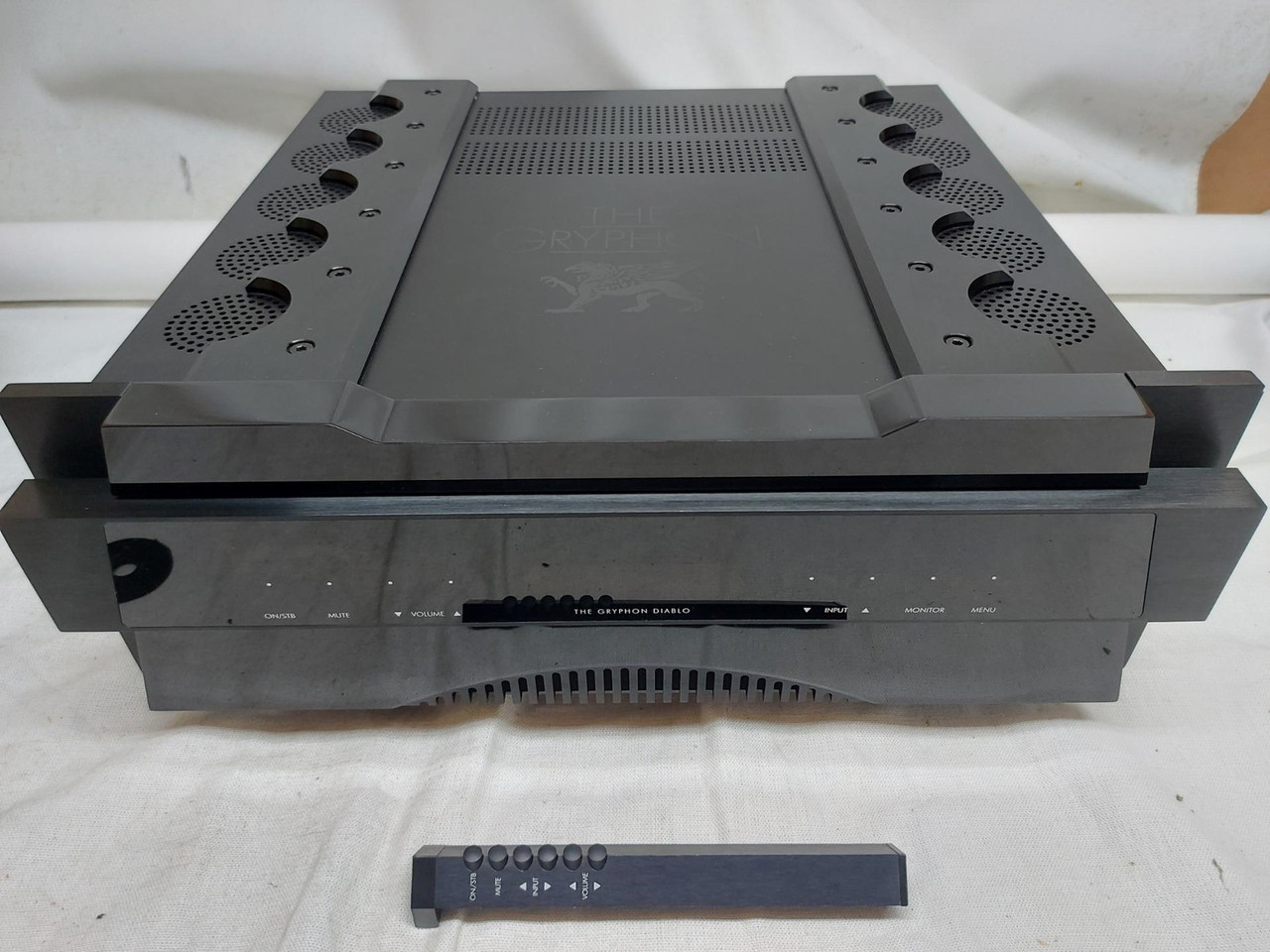
Gryphon Diablo 250 Class A Integrated Amp Boxed
 274 views last month, 105
 views this month
Last Update On
3.04.2026
 Description
Original Description is in
English, other language texts are translations and can contain errors.
EnglishDeutschSpanishTurkish
Excellent condition with remote and packaging. On paper, Gryphon's amplifier recipe is very simple: true dual mono operation for perfect channel separation; true class A operation for perfect linearity and an absence of switching distortion; massive heat sinks and even more massive power supplies for unlimited dynamics; and balanced circuitry for lowest possible noise. Obviously there must be a few secrets to this mix as otherwise anybody could/would design a Gryphon Colosseum. Nonetheless the fundamentals remain well known. What sets the brand apart from the few others who’d even venture into high-power true class A amplification is the ultimate level of refined execution.Because of its more manageable footprint, higher power and targeted price, the Gryphon Diablo had to forego pure class A operation for class A/B yet its very significant heat dissipation has me suspect that it operates in class A well beyond the first 7 of its 250 watts (250 watts into 8, 500 into 4 and 800 into 2 ohms – impressive for a one-box integrated). The rest of the core recipe remains unaltered with double mono, balanced circuits, zero negative feedback and an oversized power supply. The beast’s front panel offers a very legible alphanumeric screen displaying the input (each can be independently named) and output level; and touch buttons to changing source and volume, mute and monitor and to access the setup menu. Amongst the menu’s hidden features is the ability to assign max and turn-on volumes (0 is default which is where I left it to avoid potentially loud surprises). The menu also allows for setting the third input as HT bypass to drive the Diablo’s power section directly from an A/V processor.The back panel provides one balanced input, four RCA inputs, one set of fixed outputs and one set of variable outputs to connect to either subwoofers or a second amp. One of the inputs can be fitted with an optional MM/MC phono module but the review loaner was not so equipped (all phono comments were thus based on using either the Esoteric E03 or Nagra BPS phono preamplifiers). The speaker binding posts are massive custom affairs accepting spades or bananas without issue.This review page is supported in part by the sponsors whose ad banners are displayed belowFor a reviewer it’s very easy to claim that a given component competes with or surpasses others twice as expensive whilst conveniently failing to identify the references. I have fallen for that trick too. For one thing it avoids unpleasant phone calls and emails. Although I won’t return to this, the Diablo in my system did best separates twice as expensive - not by much and valid only for listeners with my inclinations but very real nonetheless. On paper, Gryphon's amplifier recipe is very simple: true dual mono operation for perfect channel separation; true class A operation for perfect linearity and an absence of switching distortion; massive heat sinks and even more massive power supplies for unlimited dynamics; and balanced circuitry for lowest possible noise. Obviously there must be a few secrets to this mix as otherwise anybody could/would design a Gryphon Colosseum. Nonetheless the fundamentals remain well known. What sets the brand apart from the few others who’d even venture into high-power true class A amplification is the ultimate level of refined execution.Because of its more manageable footprint, higher power and targeted price, the Gryphon Diablo had to forego pure class A operation for class A/B yet its very significant heat dissipation has me suspect that it operates in class A well beyond the first 7 of its 250 watts (250 watts into 8, 500 into 4 and 800 into 2 ohms – impressive for a one-box integrated). The rest of the core recipe remains unaltered with double mono, balanced circuits, zero negative feedback and an oversized power supply. The beast’s front panel offers a very legible alphanumeric screen displaying the input (each can be independently named) and output level; and touch buttons to changing source and volume, mute and monitor and to access the setup menu. Amongst the menu’s hidden features is the ability to assign max and turn-on volumes (0 is default which is where I left it to avoid potentially loud surprises). The menu also allows for setting the third input as HT bypass to drive the Diablo’s power section directly from an A/V processor.The back panel provides one balanced input, four RCA inputs, one set of fixed outputs and one set of variable outputs to connect to either subwoofers or a second amp. One of the inputs can be fitted with an optional MM/MC phono module but the review loaner was not so equipped (all phono comments were thus based on using either the Esoteric E03 or Nagra BPS phono preamplifiers). The speaker binding posts are massive custom affairs accepting spades or bananas without issue.The Diablo proved absolutely foolproof in use, the elegant remote allowing easy change of volume and source whilst controlling also mute and standby functions. Speaking of standby, here is my only practical caution. This amplifier sounds good out of standby but much better after 45 minutes of warm-up. I found it consistently better after 24 hours yet. By not running pure class A, it is conceivable to leave it powered up continuously for best sound even though that’s not the environmentally friendliest thing to do and certainly can make for cozy summer sessions since the Diablo runs warmer than my pure class A low-power FirstWatt F5. At minimum you’ll want to place the Diablo on a tall shelf with plenty of surrounding breathing room rather than build it into a wall or tight rack. The review loaner sat on an ASI HeartSong amp stand fronting all other gear and I would not put it inside the rack itself.Not being a recent product release, I had the advantage over my fellow reviewers. I could peruse their findings before reporting mine. What struck me was thinking that we weren’t reviewing the same amplifier at all. One writer described the Diablo as cold and lacking in emotion. Another called it warm and organic, yet another neutral and fluid. The only thing we all seem to agree on is the phenomenal level of resolution, detail retrieval, ambience recreation and dynamics this amplifier is capable of. In an attempt perhaps to reconcile seemingly opposing views, I’ll add that the Diablo is utterly transparent to the rest of your system, chosen playback material included. This admittedly is something reviewers often say when otherwise feeling at a loss to describe a component’s sound more specifically. Even so, the Diablo had this quality more than any other component I reviewed to date. Everything and anything mattered when it came to the overall voicing of my system. Beware that if you fall for the Diablo's charms, you might spend a lot of time tweaking your system not because you need to but because you now can hear these often small differences so very clearly.here are some aspects of the Diablo's sound that are its own. Starting with dynamics from massive explosions to the finest of micro fluctuations, this amplifier had the most explosive unrestricted range I have heard. 6moons regulars know that for two of our writers, one of our absolute references for low-level dynamics is FirstWatt’s F5 whenever a mere 25 watts aren’t a practical limitation. Microdynamically the Diablo was at least as nimble.Muted string pizzicatos from Britten's Playful Pizzicato bristle no matter how low you listen over either amplifier. This translates into amazingly clear transients that are sharp in a good way. A harpsichord is probably one of the most challenging instruments to reproduce. Dull its needle-like attacks and it will sound like a dead toy piano. Over-sharpen them and get holes drilled into your temples. Switching to Padre Soler's Fandango and Sonatas with Scott Ross, a long-time favorite, the instrument was in the room no matter how low I turned down the volume.The dynamic qualities of Scott Ross' playing remained intact. At very low levels his music eventually scaled down in size but the sharp pinch of the strings never dulled or rounded over as it does sooner or later over all amplifiers - even the F5.Production line of Gryphon Colosseum amplifiersWhere the Diablo then simply trounced the Nelson Pass design was with macrodynamic explosions. The rise of both amplifiers seemed equally fast (a tad faster for the Diablo perhaps) but the Dane could differentiate dynamic levels to an even greater extent especially on the most massive of orchestral pieces. That was easy to hear. Take the last minutes of Saint-Saëns’ Symphony with Organ, an utter orchestral mayhem with the organ going pretty much all out yet at the very end still adding the kettle drums for the final thunder. With the F5, the drums entered. With the Diablo they exploded. There seemed no limit to where this amplifier could go.Blasé readers will protest that 250 watts into 8 ohms versus 25 will typically do that. I would generally concur if it hadn’t been 97dB speakers and if the Diablo hadn’t simultaneously nailed the dynamic micro range. Excelling at the macro and micro both was unique in my book. The pure class A 50wpc Esoteric A03 into the same speakers for example struggled with low-levels rhythmic cues and even the 360wpc Genesis GR360 with its external MDHR power supply couldn’t quite match the Diablo at either end of the dynamic range. Percussive rise times weren’t quite as startling and micro detail blurred a little sooner than over the Gryphon.I will spare you a disc-by-disc account of how much new detail I discovered. That list would be far too long. Scary to me was how I’d owned some of these discs for over twenty years and knew them over electronics costing upward of three times the Diablo. Still I heard new information especially on ambiance retrieval. The Diablo also gave me a renewed appreciation for the Esoteric X03SE. While I'd love to hear a good Firewire DAC and computer with this amp, based on how the Diablo responded to this source, I would not count out the X03SE disc player quite yet.Pretending at more detail is easy with some strategic treble contouring. Where such acts usually fall apart is being faced with a live recording’s huge amount of ambience information. Recreating a credible impression of the recording venue takes true transparency across the entire frequency range plus impeccable phase and timing. Otherwise the illusion falls apart. This ability to recreate the event venue in your room as long as the information was recorded is probably the Diablo's second strongest virtue. The soundstage was huge left to right but also front to back. The Diablo projected about a quarter of the stage in front of the speakers. This took a little getting used to. Imaging was precise and defined but not in a systematic or overblown fashion.Gardiner's recording of Bizet's Symphony with the Lyon orchestra is a perfect example of concert hall acoustics. The Lyon venue is slightly warm and reverberant and the Gryphon preserved all the small reverb that defines the hall boundaries to render the overall sonic balance quite warm. Switching to Saint Saëns' Urbs Roma Symphony recorded by Martinon at the La Madeleine church in Paris, one could also hear the hall acoustics and echoes but this time the old EMI mastering exhibited all the digital glare and brightness we've come to hate over the years. Two CDs from the eighties, two radically different sounds, one warm, one brash - the Diablo's only ‘fault’ was to not fix your or my collection of vintage recordings. If they are bright and brash, that's how the Gryphon will render them.The Yamamoto A08s with its mighty two watts of direct-heated 45 triode goodness soundstaged just as well as the Dane and created the same 3D impression but in the end the Japanese SET was far more systematic in how it slightly overblew size and proportions and created a gentle cloud around the performers. The Diablo did not editorialize. If a cloud or blur were recorded, it would play it as such but if the musicians were recorded as discrete entities, it rendered them distinctly to a fault. On Yoyo Ma's Sony recording of Vivaldi's Cello Concerti which pushes multi miking to the point of having the various instruments not play in the same acoustic or partition at times, the Yamamoto A08s would recreate some cohesiveness that’s not really on the disc. The Diablo played it as disjointed as it is.Why I stress this aspect—far from any fault to my ears—is because many readers have other expectations. They don’t necessarily want the truth if it renders their recordings less enjoyable. That's a perfectly valid and respectable endeavor. It’s simply not one the Diablo will support. The Diablo brings the concert into your room warts and bleached tones included. On the upside, that type of reproduction is absolutely thrilling when the recording is suitably brilliant.I like Srajan's image of the woodblock to talk about imaging where different electronics carve out images in different ways, sometimes just as a 2D sketch, often as a slight relief, rarely as a true 3D figure that emerges from the block but never as a completely free entity whose back no longer connects to the wooden log. In this visual the Diablo was as close to a fully separated figure as I’ve heard. The FirstWatt F5 gave a good showing with fleshed-out living images but the Diablo went further by adding textures, which the F5 did not quite convey. The Genesis GR360 was more two-dimensional than either, not bad at all as far as amplifiers go. The other two and especially the Diablo simply operated in another league to be a delight for any visual listener.The notion of textures segues into the Diablo's third virtue, which as the previous two stems from its amazing transparency to the recorded event. The Gryphon integrated could reveal instrumental textures like few others to provide tonal hues that were both vivid and nuanced. The Yamamoto A08s enhanced the tonal qualities of instruments and voices.In my mind there’s no question that if you want that sound, the Diablo will not compete. Neither is it trying to. With the Diablo there are no enhancements. The qualities of a superior direct-heated triode cannot be beat in that realm. Conversely, the 45 triode enhances tonal qualities of everything in exactly the same manner whether you want it to or not. I still pull out the A08s whenever listening to especially older soprano recordings (older recordings that is as the singer’s age usually correlates less to listener fatigue even though the later Callas recordings do make a valid counter argument). When the recordings aren’t of the greatest quality, the Diablo's truthfulness could go too far over long listening sessions. That said, I have a similar response in lively concert halls and usually faster than at home where I can control the volume for personal comfort.The Genesis GR360 came quite close to the Diablo on textures and truthfulness, was ever so slightly warmer and almost as resolved by clearly leaning in the same direction. The F5 too had the same gestalt and honesty while the Yamamoto obviously took the opposite direction of making music sound good even if it meant taking liberties and in some cases obscuring the qualities of the very best recordings. If the Yamamoto won on poorly recorded sopranos, the comparison brutally stopped when speaking of well-recorded voices. There the Diablo again rose above the fray. Whenever subtle nuances and inflections were recorded, the Gryphon amplifier would reproduce them more truthfully than any amplifier I know. Such a degree of transparency is quite amazing.Maxime Le Forestier’s Plutot Guitar is a disc with closely captured voices and acoustic guitars. I always thought that the A08s gave the very best rendition possible and in many ways it does but the Diablo conveyed even more information about the recording venue with small echoes and decays whilst simultaneously sharpening guitar transients and not losing anything in vocal intensity. It was actually while listening to this disc that I understood how the Diablo combined the best qualities of each of my amplifiers into one single event. Not that it sounded like a 45 SET but it gave up nothing in midrange intensity and credibility while doing so much else so much better - an F5 with A08s traits + unlimited power.The first question to anybody's mind when talking about electronics with a focus on absolute truth to how the event was recorded (which may be very different from how it was played) is whether emotions remain preserved or whether they get lost in an overdose of irrelevant data. Your mileage may vary but in my experience electronics that achieve a facsimile of utmost transparency through clever voicing, treble games and transient emphasis always fail the emotion test.Those with true transparency to the signal preserve whatever emotion was encoded by not altering anything. Whenever the master tape captured a special moment, it will be heard probably more clearly than ever. Spicing with second-order harmonic distortion adds flavor but it won't be the original flavor. In this continuum, I found the Diablo to be tremendously expressive and involved when emotions were present. I always use two radically different albums to assess this very elusive quality. If at the end of this test I do not feel like crying, the gear failed me (which of course requires the right mind set to start off with and being available to utterly submerge in the music). The first one is the second movement of Vivaldi's Concerto for Cello KV419. Each time I hear it, I can't help wonder what occurred in Vivaldi's life at that juncture. The music is so deep and sad and unlike his other work.The second is the Prayer Cycle by Jonathan Elias which in addition to being a tremendously well-recorded New Age vocal and instrumental piece carries all the weight of war and pain in its lyrics. Alanis Morisette’s and Nusrat Fateh Ali Khan’s poignant voices add to the haunting children choirs for an experience you won’t want to have when depressed. The Diablo passed the tear test by creating as deep a connection as I have ever experienced. When done right, transparency does not kill emotions. Au contraire. I experienced the same when reviewing Steve McCormack’s SMc Audio VRE-1 preamplifier, a component probably closest to the Diablo in being revelatory.I came into this review with some preconceived ideas. The first one was simply that I had always loved what I heard from Gryphon at shows. That expectation was only reinforced by the time I now spent with the Diablo. The second was that while I expected a great component, the cynic in me also envisioned little chance that I would actually hear enough of a difference to justify the price delta with my $2.000 Wyred4Sound STP-SE preamp and $3.000 FirstWatt F5. Here I was wrong. The Diablo was not only the better-looking component with the superior finish but also sonically even more accomplished. The gestalt of the two systems was very close but the Diablo with its real-life power almost always went beyond what my pre/power duo could do - more speed, more decay, more realism, more macrodynamics, greater instrumental textures and deeper and more controlled bass.Where I know the FirstWatt F5 for the amazing value it is and while I factor in how steep the curve of diminishing returns tends to get in hifi, I still must admit that the Diablo is worth its price of admission and then some. This makes it neither affordable nor best deal but here one encounters one of the few very high-end propositions where I would not be afraid to insist that you very much hear what you pay for. When you consider that a Vitus integrated is far dearer yet only offers 20 watts; or think of the relatively higher price of darTZeel's integrated or Behold's or Boulder's; then the Diablo does seem to offer a lot for the euro (and hopefully one day again also for the $). It certainly demonstrated how my MA2275 integrated was not even close. I had initially thought to run the two integrateds face to face but very quickly gave up on the notion. The McIntosh is simply not in the same league.That said and money aside which will be the biggest hurdle for most—yours truly included— the Diablo is not for everybody. A component that is this transparent, linear and undistorted requires very careful matching both with the source and the speaker. Compatible sources are probably easier to come by as low-distortion high-resolution tonally saturated players are not that rare (think Gryphon's own or Cary and Esoteric to name a few obvious choices). The choice of speakers will be more critical. I was lucky that my Zu Audio Essence is tonally dense yet extremely dynamic to showcase those qualities of the Diablo. Even so, this clearly was no example of a common association. You will want speakers capable of great dynamics and transparency but not too bright or forward to avoid fatigue. You will want speakers capable of infinite midrange nuance to do the Diablo full justice. That's where my Zu falls a little short. Some of the newer Rockport designs would probably be a better match. You will also want speakers capable of deep and solid bass because the Diablo is extremely linear and lean by providing no upper bass reinforcement whatsoever. I suspect that when paired with monitor or bass-shy speakers, the overall tonal balance could quickly become top heavy (in those situations the Attila's more forgiving voicing might become preferable).For the past year our editor has looked for an amplifier he could call a high-power FirstWatt F5. The Diablo is that and more. No, it does not ooze amazing value like the F5. Perhaps one fine day he or I will find that unique amp which is affordable, phenomenal and powerful. For now the Diablo has become my reference in that quest. If you know Franck Tchang’s LiveLine cables from personal experience or reviews, think of the Diablo as a LiveLine interconnect with gain and drive. The Danish amp had the same transparency, the same unrestrained sense of dynamics and nuances, the same lean deep articulated bass, the same deep connection to the recorded event’s vitality. The Diablo is music on hyper drive - exhilarating yet amazingly refined and nuanced. At any price, that’s a very rare combination.I wish I’d heard more of the very high-end integrateds to make a final judgment call. I suspect that if I had, Gryphon’s Diablo might have walked off with a Lunar Eclipse award. It certainly eclipsed anything I knew before. Since I’m a little shy on relevant references, for now a Blue Moon Award will have to do. My highest recommendations go with it keeping in mind that the little Attila stable mate costs a third less, offers less power but is rumored to offer many of the Diablo's qualities with a touch of added warmth and forgiveness. That sounds like another winning recipe. For now though and a few more short weeks, I am savoring the amazing Diablo before it gets on its way again and joins the very short list of components I truly regretted to see depart.
Hervorragender Zustand, inklusive Fernbedienung und Originalverpackung.
Das Verstärkerkonzept von Gryphon ist auf dem Papier denkbar einfach: echter Dual-Mono-Betrieb für perfekte Kanaltrennung; echter Class-A-Betrieb für optimale Linearität und verzerrungsfreie Schaltvorgänge; massive Kühlkörper und noch massivere Netzteile für unbegrenzte Dynamik; und symmetrische Schaltungen für minimalstes Rauschen. Natürlich stecken hinter dieser Kombination einige Geheimnisse, sonst könnte ja jeder einen Gryphon Colosseum entwickeln. Die Grundlagen sind jedoch allgemein bekannt. Was die Marke von den wenigen anderen Anbietern im Bereich der leistungsstarken Class-A-Verstärker abhebt, ist die höchste Perfektion in der Verarbeitung.
Aufgrund seiner kompakteren Bauweise, der höheren Leistung und des angestrebten Preises musste der Gryphon Diablo auf reinen Class-A-Betrieb verzichten und arbeitet stattdessen im Class-A/B-Modus. Seine beachtliche Wärmeentwicklung lässt mich jedoch vermuten, dass er weit über die ersten 7 Watt seiner 250 Watt hinaus im Class-A-Modus arbeitet (250 Watt an 8 Ohm, 500 Watt an 4 Ohm und 800 Watt an 2 Ohm – beeindruckend für einen Vollverstärker in einem Gehäuse). Die übrige Kernkonstruktion bleibt unverändert: Doppelmono-Schaltung, symmetrische Schaltungen, keine Gegenkopplung und ein überdimensioniertes Netzteil. Die Frontplatte des Verstärkers verfügt über ein gut lesbares alphanumerisches Display, das den Eingangspegel (jeweils individuell benennbar) und den Ausgangspegel anzeigt, sowie über Touch-Tasten zum Umschalten von Quelle und Lautstärke, zum Stummschalten und Monitoring sowie zum Aufrufen des Setup-Menüs. Zu den versteckten Funktionen des Menüs gehört die Möglichkeit, maximale und Einschaltlautstärke festzulegen (Standardwert: 0, den ich beibehalten habe, um potenziell laute Überraschungen zu vermeiden). Das Menü ermöglicht es außerdem, den dritten Eingang als HT-Bypass zu konfigurieren, um die Endstufe des Diablo direkt von einem AV-Prozessor anzusteuern.
Die Rückseite bietet einen symmetrischen Eingang, vier Cinch-Eingänge, einen Satz fester und einen Satz variabler Ausgänge zum Anschluss von Subwoofern oder einer zweiten Endstufe. Einer der Eingänge kann mit einem optionalen MM/MC-Phono-Modul ausgestattet werden, das Testgerät war jedoch nicht damit bestückt (alle Phono-Kommentare basieren daher auf der Verwendung der Phono-Vorverstärker Esoteric E03 oder Nagra BPS). Die Lautsprecherklemmen sind massiv und speziell angefertigt und nehmen problemlos Gabelschuhe oder Bananenstecker auf. Diese Testseite wird teilweise von den Sponsoren unterstützt, deren Werbebanner unten angezeigt werden.
Für einen Tester ist es sehr einfach zu behaupten, dass eine bestimmte Komponente mit anderen, doppelt so teuren Geräten mithalten oder diese sogar übertreffen kann, ohne die Referenzen zu nennen. Auch ich bin schon auf diesen Trick hereingefallen. Unter anderem erspart er unangenehme Anrufe und E-Mails. Obwohl ich darauf nicht zurückkommen werde, schnitt der Diablo in meiner Anlage besser ab als doppelt so teure Komponenten – der Unterschied war zwar gering und gilt nur für Hörer mit meiner Anlage, aber dennoch beachtlich. Auf dem Papier ist Gryphons Verstärkerrezept sehr einfach: echter Dual-Mono-Betrieb für perfekte Kanaltrennung; echter Class-A-Betrieb für perfekte Linearität und keine Schaltverzerrungen; massive Kühlkörper und noch massivere Netzteile für unbegrenzte Dynamik; und symmetrische Schaltungen für minimalstes Rauschen. Natürlich muss es einige Geheimnisse in dieser Kombination geben, sonst könnte ja jeder einen Gryphon Colosseum entwickeln. Die Grundlagen sind jedoch bekannt. Was die Marke von den wenigen anderen unterscheidet, die sich überhaupt an Hochleistungs-Class-A-Verstärker wagen, ist die höchste Perfektion in der Verarbeitung.
Aufgrund seiner kompakteren Bauweise, der höheren Leistung und des angestrebten Preises musste der Gryphon Diablo auf reinen Class-A-Betrieb verzichten und arbeitet stattdessen im Class-A/B-Modus. Seine beachtliche Wärmeentwicklung lässt mich jedoch vermuten, dass er weit über die ersten 7 Watt seiner 250 Watt hinaus im Class-A-Modus arbeitet (250 Watt an 8 Ohm, 500 Watt an 4 Ohm und 800 Watt an 2 Ohm – beeindruckend für einen Vollverstärker in einem Gehäuse). Die übrige Kernkonstruktion bleibt unverändert: Doppelmono-Schaltung, symmetrische Schaltungen, keine Gegenkopplung und ein überdimensioniertes Netzteil. Die Frontplatte des Verstärkers verfügt über ein gut lesbares alphanumerisches Display, das den Eingangspegel (jeweils individuell benennbar) und den Ausgangspegel anzeigt, sowie über Touch-Tasten zum Umschalten von Quelle und Lautstärke, zum Stummschalten und Monitoring sowie zum Aufrufen des Setup-Menüs. Zu den versteckten Funktionen des Menüs gehört die Möglichkeit, maximale und Einschaltlautstärke festzulegen (Standardwert: 0, den ich beibehalten habe, um potenziell laute Überraschungen zu vermeiden). Das Menü ermöglicht es außerdem, den dritten Eingang als HT-Bypass einzustellen, um die Endstufe des Diablo direkt von einem A/V-Prozessor aus anzusteuern.
Die Rückseite bietet einen symmetrischen Eingang, vier Cinch-Eingänge, einen Satz fester Ausgänge und einen Satz variabler Ausgänge zum Anschluss von Subwoofern oder einer zweiten Endstufe. Einer der Eingänge kann mit einem optionalen MM/MC-Phono-Modul ausgestattet werden, das Testgerät war jedoch nicht damit bestückt (alle Phono-Kommentare basieren daher auf der Verwendung der Phono-Vorverstärker Esoteric E03 oder Nagra BPS). Die Lautsprecherklemmen sind massiv und speziell angefertigt und nehmen problemlos Gabelschuhe oder Bananenstecker auf.
Der Diablo erwies sich in der Bedienung als absolut narrensicher. Die elegante Fernbedienung ermöglicht die einfache Änderung von Lautstärke und Quelle sowie die Steuerung von Stummschaltung und Standby-Funktion. Apropos Standby: Hier mein einziger praktischer Hinweis. Dieser Verstärker klingt im Standby-Modus gut, aber nach 45 Minuten Aufwärmzeit deutlich besser. Nach 24 Stunden war er meiner Meinung nach durchgehend besser. Da der Diablo nicht im reinen Class-A-Betrieb läuft, kann er theoretisch für optimalen Klang dauerhaft eingeschaltet bleiben, auch wenn dies nicht gerade umweltfreundlich ist und im Sommer für etwas wärmere Temperaturen sorgen kann als mein FirstWatt F5 im reinen Class-A-Betrieb mit geringer Leistung. Man sollte den Diablo mindestens auf einem hohen Regal mit ausreichend Platz drumherum platzieren, anstatt ihn in eine Wand oder ein enges Rack einzubauen. Das Testgerät stand auf einem ASI HeartSong Verstärkerständer vor allen anderen Geräten, und ich würde ihn nicht direkt ins Rack stellen.
Da es sich nicht um ein neues Produkt handelt, hatte ich gegenüber meinen Mitrezensenten einen Vorteil. Ich konnte ihre Ergebnisse einsehen, bevor ich meine veröffentlichte. Was mich dabei überraschte, war der Eindruck, dass wir gar nicht denselben Verstärker testeten. Ein Rezensent beschrieb den Diablo als kühl und emotionslos, ein anderer als warm und organisch, wieder ein anderer als neutral und fließend. Einig sind wir uns lediglich in der phänomenalen Auflösung, Detailwiedergabe, Raumklangwiedergabe und Dynamik, zu der dieser Verstärker fähig ist. Um vielleicht gegensätzliche Meinungen zu versöhnen, möchte ich hinzufügen, dass der Diablo für den Rest Ihrer Anlage, einschließlich des gewählten Wiedergabematerials, absolut transparent ist. Zugegebenermaßen ist dies eine Aussage, die Rezensenten oft verwenden, wenn sie den Klang einer Komponente nicht genauer beschreiben können. Dennoch besaß der Diablo diese Eigenschaft mehr als jede andere Komponente, die ich bisher getestet habe. Jedes noch so kleine Detail trug zum Gesamtklang meiner Anlage bei. Seien Sie sich bewusst: Wenn Sie dem Charme des Diablo erliegen, werden Sie möglicherweise viel Zeit mit der Feinabstimmung Ihrer Anlage verbringen – nicht etwa, weil es nötig ist, sondern weil Sie diese oft subtilen Unterschiede nun so deutlich hören können.
Hier sind einige Aspekte des einzigartigen Klangs des Diablo: Von gewaltigen Explosionen bis hin zu feinsten Mikrofluktuationen bietet dieser Verstärker die explosivste und uneingeschränkte Bandbreite, die ich je gehört habe. Die Stammleser von 6moons wissen, dass für zwei unserer Autoren der FirstWatt F5 eine unserer absoluten Referenzen für Dynamik bei niedrigen Lautstärken ist, sofern 25 Watt nicht praktisch das Problem darstellen. Mikrodynamisch war der Diablo mindestens genauso agil.
Gedämpfte Streicher-Pizzicati aus Brittens „Playful Pizzicato“ klingen brillant, egal wie leise man über die beiden Verstärker hört. Das Ergebnis sind erstaunlich klare Transienten, die angenehm präzise sind. Ein Cembalo ist wohl eines der am schwierigsten zu reproduzierenden Instrumente. Dämpft man seine nadelartigen Anschläge, klingt es wie ein lebloses Spielzeugklavier. Übertreibt man es, klingt es schrill. Beim Wechsel zu Padre Solers „Fandango und Sonaten“ mit Scott Ross, einem langjährigen Favoriten, war das Instrument immer präsent, egal wie leise ich die Lautstärke drehte.
Die dynamischen Qualitäten von Scott Ross' Spiel blieben vollständig erhalten. Bei sehr geringer Lautstärke wurde seine Musik zwar allmählich leiser, doch der prägnante Klang der Streicher verlor nie an Schärfe oder Fülle, wie es früher oder später bei allen Verstärkern der Fall ist – selbst beim F5.
Produktionslinie der Gryphon Colosseum-Verstärker
Wo der Diablo den Nelson Pass-Verstärker dann aber deutlich übertraf, waren die dynamischen Klangexplosionen. Der Anstieg beider Verstärker schien gleich schnell zu sein (vielleicht einen Tick schneller beim Diablo), doch der Däne konnte die Dynamik noch feiner differenzieren, insbesondere bei den gewaltigsten Orchesterwerken. Das war deutlich hörbar. Man nehme die letzten Minuten von Saint-Saëns' Orgelsinfonie, ein wahres Orchesterchaos, bei dem die Orgel fast ihr volles Potenzial ausschöpft und am Ende noch die Pauken für den finalen Donnerschlag hinzufügt. Beim F5 setzten die Pauken ein. Beim Diablo explodierten sie förmlich. Die Möglichkeiten dieses Verstärkers schienen grenzenlos.Blasé-Leser werden einwenden, dass 250 Watt an 8 Ohm im Vergleich zu 25 Watt typischerweise denselben Effekt erzielen. Dem würde ich im Allgemeinen zustimmen, wären es nicht 97-dB-Lautsprecher gewesen und hätte der Diablo nicht gleichzeitig den dynamischen Mikrobereich so präzise abgedeckt. Die Kombination aus Makro- und Mikrodynamik war für mich einzigartig. Der reine Class-A-Verstärker Esoteric A03 mit 50 Watt pro Kanal hatte beispielsweise an denselben Lautsprechern Schwierigkeiten mit leisen rhythmischen Details, und selbst der Genesis GR360 mit 360 Watt pro Kanal und seinem externen MDHR-Netzteil konnte dem Diablo in keinem der beiden Bereiche des Dynamikbereichs das Wasser reichen. Perkussive Anstiege waren nicht ganz so druckvoll, und Mikrodetails verschwammen etwas schneller als beim Gryphon.
Ich erspare Ihnen eine detaillierte Auflistung aller neu entdeckten Details auf jeder einzelnen CD. Diese Liste wäre viel zu lang. Erschreckend war für mich, dass ich einige dieser CDs schon über zwanzig Jahre besaß und sie über Elektronik kannte, die mehr als dreimal so viel kostete wie der Diablo. Dennoch entdeckte ich neue Details, insbesondere in Bezug auf die Raumklangwiedergabe. Der Diablo ließ mich auch den Esoteric X03SE neu schätzen. Obwohl ich diesen Verstärker gerne mit einem guten FireWire-DAC und Computer testen würde, würde ich den X03SE-Disc-Player aufgrund der Reaktion des Diablo auf diese Quelle noch nicht abschreiben.
Mit etwas strategischer Höhenanhebung lässt sich leicht mehr Detailreichtum vortäuschen. Wo solche Versuche jedoch meist scheitern, ist die enorme Menge an Raumklanginformationen einer Live-Aufnahme. Um einen glaubwürdigen Eindruck des Aufnahmeortes zu erzeugen, bedarf es absoluter Transparenz über den gesamten Frequenzbereich sowie makelloser Phasenlage und Timing. Andernfalls zerfällt die Illusion. Diese Fähigkeit, den Veranstaltungsort im eigenen Raum nachzubilden, sofern die entsprechenden Informationen aufgenommen wurden, ist wohl die zweitgrößte Stärke des Diablo. Die Klangbühne war sowohl horizontal als auch vertikal enorm. Der Diablo projizierte etwa ein Viertel der Bühne vor die Lautsprecher. Daran musste ich mich erst gewöhnen. Die Abbildung war präzise und definiert, aber nicht systematisch oder übertrieben.
Gardiners Aufnahme von Bizets Sinfonie mit dem Orchester von Lyon ist ein Paradebeispiel für Konzertsaalakustik. Der Raum in Lyon ist leicht warm und hallig, und der Gryphon bewahrt den feinen Nachhall, der die Raumgrenzen definiert, und sorgt so für eine insgesamt warme Klangbalance. Beim Wechsel zu Saint-Saëns' Urbs Roma Symphony, aufgenommen von Martinon in der Pariser Kirche La Madeleine, sind die Raumakustik und die Echos ebenfalls hörbar, doch diesmal offenbart das alte EMI-Mastering all die digitale Brillanz und Helligkeit, die wir im Laufe der Jahre so verabscheut haben. Zwei CDs aus den Achtzigern, zwei radikal unterschiedliche Klänge – der eine warm, der andere schrill – der einzige „Fehler“ des Diablo war, dass er unsere Sammlung von Vintage-Aufnahmen nicht retten konnte. Wenn sie schrill und schrill klingen, gibt der Gryphon sie auch so wieder.
Die Yamamoto A08 mit ihren kraftvollen zwei Watt direkt beheizter 45-kHz-Triodenleistung boten eine ebenso gute Räumlichkeit wie die dänischen Lautsprecher und erzeugten denselben 3D-Eindruck. Letztendlich war der japanische Single-Ended-Triodenverstärker jedoch deutlich systematischer darin, Größe und Proportionen leicht zu übertreiben und einen sanften Schleier um die Musiker zu legen. Der Diablo nahm keine solchen Verzerrungen vor. Wurde ein Schleier oder eine Unschärfe aufgenommen, gab er dies auch so wieder. Waren die Musiker jedoch als einzelne Einheiten aufgenommen, stellte er sie bisweilen übertrieben deutlich dar. Auf Yoyo Mas Sony-Aufnahme von Vivaldis Cellokonzerten, die die Mehrfachmikrofonierung so weit treibt, dass die verschiedenen Instrumente zeitweise nicht im selben akustischen Raum oder in derselben Raumaufteilung spielen, erzeugten die Yamamoto A08 eine gewisse Kohärenz, die auf der CD nicht wirklich vorhanden ist. Der Diablo gab die Aufnahme so unzusammenhängend wieder, wie sie ist.
Warum ich diesen Aspekt betone – der für meine Ohren keineswegs ein Fehler ist –, liegt daran, dass viele Leser andere Erwartungen haben. Sie wollen nicht unbedingt die Wahrheit, wenn sie ihre Aufnahmen weniger genussvoll macht. Das ist ein durchaus legitimes und respektables Anliegen. Nur eben nicht eines, das der Diablo unterstützen wird. Der Diablo holt das Konzert mit allen Ecken und Kanten, inklusive aller Unvollkommenheiten und verwaschenen Töne, direkt ins Zimmer. Positiv ist jedoch, dass diese Art der Wiedergabe absolut mitreißend ist, wenn die Aufnahme entsprechend brillant ist.
Mir gefällt Srajans Bild des Holzblocks, um die Klangabbildung zu veranschaulichen. Unterschiedliche Elektronik erzeugt Klangbilder auf unterschiedliche Weise: manchmal nur als zweidimensionale Skizze, oft als leichtes Relief, selten als echte dreidimensionale Figur, die aus dem Block hervortritt, aber niemals als völlig eigenständiges Gebilde, dessen Rückseite nicht mehr mit dem Holzstamm verbunden ist. In diesem Bild kam der Diablo einer vollständig freistehenden Figur so nahe wie kein anderer Verstärker, den ich je gehört habe. Der FirstWatt F5 lieferte eine gute Leistung mit lebendigen, plastisch wirkenden Klangbildern, aber der Diablo ging noch einen Schritt weiter und fügte Texturen hinzu, die der F5 nicht ganz so gut wiedergab. Der Genesis GR360 war zweidimensionaler als beide, aber für einen Verstärker durchaus beachtlich. Die anderen beiden, und insbesondere der Diablo, spielten einfach in einer anderen Liga und waren ein Genuss für jeden visuellen Hörer.
Die Idee der Klangtexturen führt uns zur dritten Stärke des Diablo, die wie die beiden vorherigen auf seiner erstaunlichen Transparenz gegenüber dem aufgenommenen Ereignis beruht. Der Gryphon-Vollverstärker konnte Instrumentaltexturen wie kaum ein anderer offenbaren und so lebendige und nuancierte Klangfarben erzeugen. Die Yamamoto A08-Röhren verstärkten die Klangqualität von Instrumenten und Stimmen.
Für mich steht außer Frage: Wenn Sie diesen Klang suchen, kann der Diablo nicht mithalten. Und das will er auch gar nicht. Der Diablo bietet keine Klangverfälschungen. Die Qualitäten einer überlegenen, direkt beheizten Triode sind in diesem Bereich unübertroffen. Umgekehrt verstärkt die 45er-Triode die Klangqualität aller Instrumente und Stimmen auf exakt dieselbe Weise, ob man es nun möchte oder nicht. Ich greife immer noch gerne zu den A08-Röhren, insbesondere bei älteren Sopranaufnahmen (ältere Aufnahmen, da das Alter der Sängerin in der Regel weniger mit Hörermüdung korreliert, auch wenn die späteren Callas-Aufnahmen ein stichhaltiges Gegenargument liefern). Bei Aufnahmen minderer Qualität kann die Authentizität des Diablo bei längeren Hörsessions etwas zu viel werden. Allerdings reagiere ich in lebhaften Konzertsälen ähnlich, meist sogar schneller als zu Hause, wo ich die Lautstärke individuell anpassen kann.
Der Genesis GR360 kam dem Diablo in puncto Klangfarbe und Authentizität sehr nahe, klang einen Hauch wärmer und war beinahe genauso detailreich, tendierte aber eindeutig in dieselbe Richtung. Auch der F5 besaß dieselbe Klangfülle und Authentizität, während der Yamamoto offensichtlich den entgegengesetzten Weg einschlug und Musik gut klingen lassen wollte, selbst wenn dies bedeutete, sich Freiheiten zu erlauben und in manchen Fällen die Qualitäten der besten Aufnahmen zu verschleiern. Während der Yamamoto bei schlecht aufgenommenen Sopranen punktete, endete der Vergleich abrupt bei gut aufgenommenen Stimmen. Hier übertraf der Diablo erneut alle Erwartungen. Wann immer subtile Nuancen und Klangfarben aufgenommen wurden, gab der Gryphon-Verstärker sie authentischer wieder als jeder andere mir bekannte Verstärker. Ein solches Maß an Transparenz ist schlichtweg erstaunlich.
Maxime Le Forestiers „Plutot Guitar“ ist eine CD mit detailreichen Aufnahmen von Gesang und Akustikgitarren. Ich war immer der Meinung, dass die A08s die bestmögliche Wiedergabe lieferten, und in vielerlei Hinsicht stimmt das auch. Doch der Diablo vermittelte noch mehr Details über den Aufnahmeort, mit feinen Echos und Ausklängen, während er gleichzeitig die Gitarrentransienten schärfte und die Gesangsintensität nicht beeinträchtigte. Erst beim Hören dieser CD verstand ich, wie der Diablo die besten Eigenschaften meiner Verstärker in einem einzigen Klangerlebnis vereinte. Nicht, dass es wie ein Single-Ended-Setup klang, aber es büßte nichts an Intensität und Glaubwürdigkeit im Mitteltonbereich ein und machte so vieles andere so viel besser – ein F5 mit den Eigenschaften der A08s plus unbegrenzter Leistung.
Die erste Frage, die sich jedem stellt, wenn man über Elektronik mit dem Fokus auf absolute Authentizität der Aufnahme spricht (die sich stark von der Wiedergabe unterscheiden kann), ist, ob Emotionen erhalten bleiben oder in einer Überdosis irrelevanter Daten verloren gehen. Ihre Erfahrungen mögen anders sein, aber meiner Erfahrung nach versagen elektronische Geräte, die durch geschickte Klanggestaltung, Höhenmanipulation und Transientenbetonung eine Illusion von Transparenz erzeugen, im emotionalen Test.
Geräte mit echter Signaltransparenz bewahren die kodierte Emotion, indem sie nichts verändern. Wann immer das Masterband einen besonderen Moment eingefangen hat, wird er wahrscheinlich klarer denn je zu hören sein. Das Hinzufügen von harmonischen Verzerrungen zweiter Ordnung verleiht dem Klang zwar Würze, aber es ist nicht der ursprüngliche Klang. In diesem Spektrum empfand ich den Diablo als enorm ausdrucksstark und mitreißend, wenn Emotionen im Spiel waren. Ich verwende stets zwei grundverschiedene Alben, um diese schwer fassbare Qualität zu beurteilen. Wenn ich am Ende dieses Tests nicht zum Weinen gebracht bin, hat mich das Gerät enttäuscht (was natürlich die richtige Einstellung und die Bereitschaft voraussetzt, völlig in die Musik einzutauchen). Das erste Album ist der zweite Satz von Vivaldis Cellokonzert KV 419. Jedes Mal, wenn ich es höre, frage ich mich, was in Vivaldis Leben zu diesem Zeitpunkt geschah. Die Musik ist so tiefgründig und traurig und ganz anders als seine anderen Werke.
Das zweite Stück ist der „Prayer Cycle“ von Jonathan Elias. Es ist nicht nur ein hervorragend aufgenommenes New-Age-Werk mit Gesang und Instrumentalstücken, sondern trägt auch die ganze Schwere von Krieg und Schmerz in seinen Texten. Die ergreifenden Stimmen von Alanis Morissette und Nusrat Fateh Ali Khan ergänzen die eindringlichen Kinderchöre zu einem Hörerlebnis, das man in depressiven Phasen besser nicht haben möchte. Der Diablo hat mich zu Tränen gerührt und eine so tiefe Verbindung geschaffen, wie ich sie noch nie erlebt habe. Wenn Transparenz richtig eingesetzt wird, erstickt sie die Emotionen nicht. Im Gegenteil. Dasselbe erlebte ich beim Testen des SMc Audio VRE-1 Vorverstärkers von Steve McCormack, einem Gerät, das dem Diablo in seiner Offenbarungswirkung wohl am nächsten kommt.
Ich ging mit einigen vorgefassten Meinungen an diesen Test heran. Erstens war ich von den Gryphon-Produkten auf Messen immer begeistert gewesen. Diese Erwartung wurde durch die Zeit, die ich nun mit dem Diablo verbrachte, nur noch bestärkt. Zweitens erwartete ich zwar eine großartige Komponente, aber mein innerer Skeptiker bezweifelte, dass ich tatsächlich einen so großen Unterschied hören würde, dass er den Preisunterschied zu meinem 2.000 Dollar teuren Wyred4Sound STP-SE Vorverstärker und dem 3.000 Dollar teuren FirstWatt F5 rechtfertigen würde. Hier irrte ich mich. Der Diablo war nicht nur die optisch ansprechendere Komponente mit der hochwertigeren Verarbeitung, sondern klanglich auch noch überlegen. Die Gesamtklangqualität beider Systeme war sehr ähnlich, aber der Diablo übertraf mit seiner tatsächlichen Leistung fast immer das, was mein Vor-/Endstufen-Duo leisten konnte – mehr Schnelligkeit, mehr Ausklang, mehr Realismus, mehr Makrodynamik, feinere Instrumentaltexturen und einen tieferen und kontrollierteren Bass.
Ich kenne den FirstWatt F5 für sein hervorragendes Preis-Leistungs-Verhältnis und berücksichtige, wie schnell sich Investitionen in HiFi-Geräte verteuern und wie steil die Kurve des abnehmenden Grenznutzens verläuft. Dennoch muss ich zugeben, dass der Diablo seinen Preis mehr als wert ist. Er ist zwar weder besonders günstig noch ein Schnäppchen, aber er gehört zu den wenigen High-End-Geräten, bei denen man ohne Zögern behaupten kann: Man hört wirklich, wofür man bezahlt. Bedenkt man, dass ein Vitus-Vollverstärker deutlich teurer ist und nur 20 Watt leistet, oder den vergleichsweise höheren Preis der Vollverstärker von darTZeel, Behold oder Boulder, dann bietet der Diablo tatsächlich viel fürs Geld (und hoffentlich eines Tages auch wieder fürs Geld). Er hat mir deutlich vor Augen geführt, wie weit mein MA2275-Vollverstärker von ihm entfernt ist. Ich hatte zunächst überlegt, die beiden Vollverstärker direkt miteinander zu vergleichen, habe den Gedanken aber schnell verworfen. Der McIntosh spielt einfach in einer anderen Liga.
Abgesehen vom Preis, der für die meisten – mich eingeschlossen – die größte Hürde darstellt, ist der Diablo nicht für jeden geeignet. Ein so transparentes, lineares und verzerrungsfreies Gerät erfordert eine sehr sorgfältige Abstimmung von Quelle und Lautsprecher. Kompatible Quellen sind wahrscheinlich leichter zu finden, da verzerrungsarme, hochauflösende und klanglich satte Player nicht so selten sind (man denke beispielsweise an Gryphon oder Cary und Esoteric). Die Wahl der Lautsprecher ist entscheidender. Ich hatte das Glück, dass meine Zu Audio Essence klanglich dicht und gleichzeitig extrem dynamisch ist, um diese Qualitäten des Diablo optimal zur Geltung zu bringen. Dennoch ist dies natürlich kein typisches Beispiel. Sie benötigen Lautsprecher mit hoher Dynamik und Transparenz, die aber nicht zu hell oder aufdringlich klingen, um Ermüdungserscheinungen zu vermeiden. Sie benötigen Lautsprecher mit unendlicher Nuancierung im Mitteltonbereich, um dem Diablo vollends gerecht zu werden. Hier stößt meine Zu Audio etwas an ihre Grenzen. Einige der neueren Rockport-Modelle wären wahrscheinlich besser geeignet. Sie benötigen außerdem Lautsprecher mit tiefem und sattem Bass, da der Diablo extrem linear und schlank klingt und keinerlei Oberbassverstärkung bietet. Ich vermute, dass die Klangbalance in Kombination mit Monitor- oder bassschwachen Lautsprechern schnell höhenlastig werden könnte (in solchen Fällen wäre die etwas fehlerverzeihendere Klangcharakteristik des Attila möglicherweise von Vorteil).
Seit einem Jahr sucht unser Redakteur nach einem Verstärker, den er als leistungsstarken FirstWatt F5 bezeichnen könnte. Der Diablo ist genau das und noch viel mehr. Nein, er bietet nicht das gleiche unglaubliche Preis-Leistungs-Verhältnis wie der F5. Vielleicht finden wir eines Tages den perfekten Verstärker, der erschwinglich, phänomenal und leistungsstark ist. Bis dahin ist der Diablo meine Referenz auf dieser Suche. Wer Franck Tchangs LiveLine-Kabel aus eigener Erfahrung oder aus Testberichten kennt, kann sich den Diablo als LiveLine-Verbindungskabel mit mehr Gain und Drive vorstellen. Der dänische Verstärker bot dieselbe Transparenz, dieselbe ungezügelte Dynamik und Nuancenvielfalt, denselben schlanken, tiefen und präzisen Bass, dieselbe tiefe Verbindung zur Lebendigkeit der Aufnahme. Der Diablo ist Musik im Hyper-Drive – mitreißend und gleichzeitig erstaunlich raffiniert und nuanciert. In jeder Preisklasse ist das eine äußerst seltene Kombination.
Ich wünschte, ich hätte mehr von den absoluten High-End-Vollverstärkern gehört, um mir ein endgültiges Urteil bilden zu können. Ich vermute, wenn dem so gewesen wäre, hätte der Gryphon Diablo den Lunar Eclipse Award gewonnen. Er hat jedenfalls alles, was ich bisher kannte, in den Schatten gestellt. Da mir einige vergleichbare Geräte fehlen, muss vorerst der Blue Moon Award genügen. Meine uneingeschränkte Empfehlung gilt ihm, wohl wissend, dass sein kleiner Bruder von Attila ein Drittel weniger kostet, weniger Leistung bietet, aber Gerüchten zufolge viele der Qualitäten des Diablo mit einem Hauch von zusätzlicher Wärme und Fehlertoleranz vereint. Das klingt nach einer weiteren vielversprechenden Kombination. Doch jetzt, und für ein paar kurze Wochen, genieße ich den fantastischen Diablo, bevor er wieder auf Reisen geht und sich in die kurze Liste der Komponenten einreiht, deren Abschied ich wirklich bedauere.
Excelente estado, con control remoto y embalaje original.
En teoría, la fórmula de los amplificadores Gryphon es muy sencilla: funcionamiento dual mono real para una separación de canales perfecta; funcionamiento en clase A real para una linealidad perfecta y ausencia de distorsión por conmutación; disipadores de calor enormes y fuentes de alimentación aún más potentes para una dinámica ilimitada; y circuitos balanceados para el menor ruido posible. Obviamente, debe haber algunos secretos en esta combinación, ya que de lo contrario cualquiera podría diseñar un Gryphon Colosseum. Sin embargo, los fundamentos son bien conocidos. Lo que distingue a la marca de las pocas que se aventuran en la amplificación de alta potencia en clase A real es el máximo nivel de refinamiento en la ejecución.
Debido a su tamaño más compacto, mayor potencia y precio objetivo, el Gryphon Diablo tuvo que renunciar al funcionamiento en clase A pura en favor de la clase A/B, pero su considerable disipación de calor me hace sospechar que funciona en clase A mucho más allá de los primeros 7 de sus 250 vatios (250 vatios a 8 ohmios, 500 a 4 y 800 a 2 ohmios; impresionante para un amplificador integrado compacto). El resto de la configuración básica permanece inalterada, con circuitos balanceados de doble mono, sin retroalimentación negativa y una fuente de alimentación sobredimensionada. El panel frontal ofrece una pantalla alfanumérica muy legible que muestra la entrada (cada una con nombre propio) y el nivel de salida; además de botones táctiles para cambiar la fuente y el volumen, silenciar y monitorizar, y acceder al menú de configuración. Entre las funciones ocultas del menú se encuentra la posibilidad de asignar volúmenes máximo y de encendido (0 es el valor predeterminado, que es donde lo dejé para evitar sorpresas desagradables). El menú también permite configurar la tercera entrada como bypass HT para alimentar la sección de potencia del Diablo directamente desde un procesador de audio/vídeo.
El panel trasero ofrece una entrada balanceada, cuatro entradas RCA, un conjunto de salidas fijas y un conjunto de salidas variables para conectar subwoofers o un segundo amplificador. Una de las entradas puede equiparse con un módulo de fono MM/MC opcional, pero la unidad prestada para la reseña no lo tenía (por lo tanto, todos los comentarios sobre fono se basaron en el uso de los preamplificadores de fono Esoteric E03 o Nagra BPS). Los bornes de conexión de los altavoces son robustos y personalizados, y aceptan terminales de pala o banana sin problema. Esta página de reseña está financiada en parte por los patrocinadores cuyos banners publicitarios se muestran a continuación.
Para un crítico, es muy fácil afirmar que un componente determinado compite o supera a otros que cuestan el doble, sin mencionar las referencias. Yo también he caído en esa trampa. Para empezar, evita llamadas y correos electrónicos desagradables. Aunque no volveré sobre este tema, el Diablo en mi sistema superó a componentes separados que costaban el doble; la diferencia fue mínima y válida solo para oyentes con mis componentes, pero es una realidad. En teoría, la fórmula del amplificador Gryphon es muy simple: funcionamiento dual mono real para una separación de canales perfecta; funcionamiento de clase A real para una linealidad perfecta y ausencia de distorsión por conmutación; Disipadores de calor enormes y fuentes de alimentación aún más potentes para una dinámica ilimitada; y circuitos balanceados para el mínimo ruido posible. Obviamente, debe haber algunos secretos en esta combinación, ya que de lo contrario cualquiera podría diseñar un Gryphon Colosseum. Sin embargo, los fundamentos siguen siendo bien conocidos. Lo que distingue a la marca de las pocas que se aventuran en la amplificación de alta potencia en verdadera clase A es el máximo nivel de refinamiento en la ejecución.
Debido a su tamaño más manejable, mayor potencia y precio objetivo, el Gryphon Diablo tuvo que renunciar a la operación en clase A pura en favor de la clase A/B, pero su considerable disipación de calor me hace sospechar que opera en clase A mucho más allá de los primeros 7 de sus 250 vatios (250 vatios a 8 ohmios, 500 a 4 y 800 a 2 ohmios, impresionante para un amplificador integrado de una sola caja). El resto de la receta básica permanece inalterada con doble mono, circuitos balanceados, cero retroalimentación negativa y una fuente de alimentación sobredimensionada. El panel frontal del dispositivo cuenta con una pantalla alfanumérica muy legible que muestra la entrada (cada una con nombre independiente) y el nivel de salida; además de botones táctiles para cambiar la fuente y el volumen, silenciar y monitorizar, y acceder al menú de configuración. Entre las funciones ocultas del menú se encuentra la posibilidad de asignar volúmenes máximo y de encendido (el valor predeterminado es 0, que es donde lo dejé para evitar sorpresas desagradables). El menú también permite configurar la tercera entrada como bypass HT para alimentar la sección de potencia del Diablo directamente desde un procesador de audio/vídeo.
El panel trasero ofrece una entrada balanceada, cuatro entradas RCA, un conjunto de salidas fijas y un conjunto de salidas variables para conectar subwoofers o un segundo amplificador. Una de las entradas puede equiparse con un módulo de fono MM/MC opcional, pero la unidad de prueba no lo incluía (por lo tanto, todos los comentarios sobre fono se basaron en el uso de los preamplificadores de fono Esoteric E03 o Nagra BPS). Los bornes de conexión de los altavoces son robustos y personalizados, y admiten conectores tipo pala o banana sin problemas.
El Diablo demostró ser absolutamente infalible en su uso; el elegante mando a distancia permite cambiar fácilmente el volumen y la fuente, además de controlar las funciones de silencio y espera. Hablando de la espera, aquí va mi única advertencia práctica: este amplificador suena bien en modo de espera, pero mucho mejor después de 45 minutos de calentamiento. Incluso después de 24 horas, noté una mejora constante. Al no funcionar en clase A pura, es posible dejarlo encendido continuamente para obtener el mejor sonido, aunque no sea lo más ecológico y, sin duda, puede resultar en sesiones de verano calurosas, ya que el Diablo se calienta más que mi FirstWatt F5 de baja potencia en clase A pura. Como mínimo, conviene colocar el Diablo en una estantería alta con suficiente espacio a su alrededor, en lugar de empotrarlo en la pared o en un rack estrecho. La unidad de prueba estaba sobre un soporte para amplificadores ASI HeartSong, frente al resto del equipo, y no la colocaría dentro del rack.
Al no ser un producto de reciente lanzamiento, tenía ventaja sobre mis compañeros críticos. Pude consultar sus conclusiones antes de publicar las mías. Lo que me sorprendió fue darme cuenta de que no estábamos analizando el mismo amplificador. Un crítico describió el Diablo como frío y falto de emoción. Otro lo calificó de cálido y orgánico, y otro de neutro y fluido. En lo único que todos parecemos estar de acuerdo es en el nivel fenomenal de resolución, recuperación de detalles, recreación de ambiente y dinámica que este amplificador es capaz de ofrecer. Quizás para intentar conciliar opiniones divergentes, añadiré que el Diablo es totalmente transparente para el resto de tu sistema, incluyendo el material de reproducción seleccionado. Es cierto que los críticos suelen decir esto cuando no saben cómo describir el sonido de un componente con mayor precisión. Aun así, el Diablo poseía esta cualidad más que cualquier otro componente que haya analizado hasta la fecha. Todo, absolutamente todo, influía en la sonoridad general de mi sistema. Ten en cuenta que si te dejas seducir por el Diablo, podrías pasar mucho tiempo ajustando tu sistema, no porque lo necesites, sino porque ahora puedes percibir con total claridad estas pequeñas diferencias.
Aquí tienes algunos aspectos del sonido único del Diablo. Desde la dinámica de explosiones masivas hasta las más sutiles microfluctuaciones, este amplificador tenía el rango dinámico más explosivo y sin restricciones que jamás haya escuchado. Los lectores habituales de 6moons saben que, para dos de nuestros redactores, una de nuestras referencias absolutas en dinámica de bajo nivel es el FirstWatt F5, siempre que 25 vatios no representen una limitación práctica. Microdinámicamente, el Diablo demostró ser igual de ágil.
Los pizzicatos de cuerdas apagadas del "Playful Pizzicato" de Britten resuenan con fuerza, independientemente del volumen, en cualquiera de los dos amplificadores. Esto se traduce en transitorios increíblemente claros y nítidos, en el buen sentido. El clavecín es probablemente uno de los instrumentos más difíciles de reproducir. Si se suavizan sus ataques agudos, sonará como un piano de juguete sin vida. Si se agudizan demasiado, el resultado será ensordecedor. Al escuchar el "Fandango" y las "Sonatas" de Padre Soler con Scott Ross, una obra que siempre me ha gustado, el instrumento se sentía presente en la sala, sin importar el volumen.
Las cualidades dinámicas de la interpretación de Scott Ross se mantuvieron intactas. A niveles muy bajos, su música se fue atenuando gradualmente, pero la nitidez de las cuerdas nunca se desvaneció ni se suavizó, como suele ocurrir tarde o temprano con todos los amplificadores, incluso con el F5.
Línea de producción de amplificadores Gryphon Colosseum
Donde el Diablo superó con creces al diseño de Nelson Pass fue en la explosión macrodinámica. El aumento de volumen de ambos amplificadores parecía igual de rápido (quizás un poco más rápido en el Diablo), pero el Dane podía diferenciar los niveles dinámicos con mayor precisión, especialmente en las piezas orquestales más imponentes. Esto era fácil de apreciar. Tomemos como ejemplo los últimos minutos de la Sinfonía con Órgano de Saint-Saëns, un auténtico caos orquestal con el órgano a pleno rendimiento, pero que al final añade los timbales para un estruendo final. Con el F5, los timbales entraban. Con el Diablo, explotaban. Parecía no haber límites para el potencial de este amplificador.Los lectores más escépticos protestarán diciendo que 250 vatios a 8 ohmios, en comparación con 25, suelen producir ese efecto. En general, estaría de acuerdo si no se tratara de altavoces de 97 dB y si el Diablo no hubiera alcanzado simultáneamente el rango microdinámico. Su excelente desempeño tanto en el rango macro como en el micro era, en mi opinión, único. El Esoteric A03 de 50 W por canal, de clase A pura, conectado a los mismos altavoces, por ejemplo, tenía dificultades con los ritmos de bajo nivel, e incluso el Genesis GR360 de 360 W por canal con su fuente de alimentación externa MDHR no lograba igualar al Diablo en ninguno de los extremos del rango dinámico. Los tiempos de subida de la percusión no eran tan rápidos y los detalles micro se difuminaban un poco antes que con el Gryphon.
Les ahorraré una descripción detallada de cada disco sobre la cantidad de detalles nuevos que descubrí. Esa lista sería demasiado larga. Lo que me asustó fue darme cuenta de que había tenido algunos de estos discos durante más de veinte años y los conocía mejor que equipos electrónicos que costaban más del triple que el Diablo. Aun así, descubrí información nueva, especialmente sobre la recuperación del ambiente sonoro. El Diablo también me hizo apreciar aún más el Esoteric X03SE. Si bien me encantaría escuchar un buen DAC Firewire y una computadora con este amplificador, basándome en cómo respondió el Diablo a esta fuente, no descartaría todavía el reproductor de discos X03SE.
Es fácil simular mayor detalle con una ecualización estratégica de los agudos. Sin embargo, este tipo de intentos suelen fracasar al enfrentarse a la enorme cantidad de información ambiental de una grabación en vivo. Crear una impresión creíble del lugar de la grabación requiere una transparencia absoluta en todo el rango de frecuencias, además de una fase y una sincronización impecables. De lo contrario, la ilusión se desvanece. Esta capacidad de recrear el lugar del evento en tu habitación, siempre que la información se haya grabado, es probablemente la segunda mayor virtud del Diablo. La escena sonora era enorme tanto de izquierda a derecha como de adelante hacia atrás. El Diablo proyectaba aproximadamente una cuarta parte del escenario frente a los altavoces. Esto requirió un poco de adaptación. La imagen sonora era precisa y definida, pero no de forma sistemática ni exagerada.
La grabación de Gardiner de la Sinfonía de Bizet con la Orquesta de Lyon es un ejemplo perfecto de la acústica de una sala de conciertos. La sala de Lyon es ligeramente cálida y reverberante, y el Gryphon conservó toda la reverberación sutil que define los límites de la sala, logrando un equilibrio sonoro general bastante cálido. Al pasar a la Sinfonía Urbs Roma de Saint-Saëns, grabada por Martinon en la iglesia de la Madeleine en París, también se podían apreciar la acústica de la sala y los ecos, pero esta vez la antigua masterización de EMI exhibía todo el brillo y la saturación digital que hemos llegado a detestar con el paso de los años. Dos CD de los ochenta, dos sonidos radicalmente diferentes: uno cálido, otro estridente. El único «defecto» del Diablo fue no corregir la acústica de tu colección de grabaciones antiguas, ni la mía ni la tuya. Si son brillantes y estridentes, así es como el Gryphon las reproducirá.
El Yamamoto A08, con sus dos potentes vatios de triodo de calentamiento directo de 45 W, ofrecía una escena sonora tan buena como el Dane y creaba la misma impresión tridimensional, pero al final, el SET japonés era mucho más sistemático al exagerar ligeramente el tamaño y las proporciones, creando una suave nube alrededor de los intérpretes. El Diablo no intervenía. Si se grababa una nube o un sonido borroso, lo reproducía como tal, pero si los músicos se grababan como entidades discretas, los reproducía con una claridad excesiva. En la grabación de Yoyo Ma para Sony de los Conciertos para violonchelo de Vivaldi, que lleva la microfonía múltiple al extremo de que los distintos instrumentos no suenen en la misma acústica o partición en ocasiones, el Yamamoto A08 recreaba una cohesión que no está realmente presente en el disco. El Diablo lo reproducía tal como era, sin ninguna cohesión.
Hago hincapié en este aspecto —que, a mi parecer, no es ningún defecto— porque muchos lectores tienen otras expectativas. No necesariamente buscan la verdad si esta hace que sus grabaciones sean menos disfrutables. Es un esfuerzo perfectamente válido y respetable. Simplemente, el Diablo no lo admite. El Diablo trae el concierto a tu habitación con sus imperfecciones y tonos apagados incluidos. Por otro lado, ese tipo de reproducción es absolutamente emocionante cuando la grabación es lo suficientemente brillante.
Me gusta la metáfora de Srajan del bloque de madera para hablar de la imagen sonora, donde los diferentes componentes electrónicos la crean de distintas maneras: a veces como un simple boceto en 2D, a menudo como un ligero relieve, rara vez como una verdadera figura en 3D que emerge del bloque, pero nunca como una entidad completamente libre cuya parte posterior ya no está conectada al tronco de madera. En esta imagen, el Diablo se acercaba más a una figura totalmente separada que cualquier otro que haya escuchado. El FirstWatt F5 ofreció un buen rendimiento con imágenes sonoras vívidas y bien definidas, pero el Diablo fue más allá al añadir texturas, algo que el F5 no logró transmitir del todo. El Genesis GR360 era más bidimensional que ambos, lo cual no está nada mal para ser un amplificador. Los otros dos, y especialmente el Diablo, simplemente operaban en otra liga, para deleite de cualquier oyente visual.
La noción de texturas nos lleva a la tercera virtud del Diablo, que, al igual que las dos anteriores, radica en su asombrosa transparencia al sonido grabado. El amplificador integrado Gryphon podía revelar texturas instrumentales como pocos, proporcionando matices tonales vívidos y llenos de matices. Los Yamamoto A08 realzaban las cualidades tonales de instrumentos y voces.
En mi opinión, no cabe duda de que si buscas ese sonido, el Diablo no tiene rival. Ni siquiera lo intenta. Con el Diablo no hay mejoras. Las cualidades de un triodo de calentamiento directo superior son insuperables en ese aspecto. Por el contrario, el triodo 45 realza las cualidades tonales de todo exactamente de la misma manera, lo quieras o no. Sigo utilizando los A08 cuando escucho grabaciones de soprano, especialmente las más antiguas (grabaciones antiguas, ya que la edad de la cantante suele estar menos relacionada con la fatiga auditiva, aunque las grabaciones posteriores de Callas presenten un argumento válido en contra). Cuando las grabaciones no son de la mejor calidad, la fidelidad del Diablo podría resultar excesiva en largas sesiones de escucha. Dicho esto, obtengo una respuesta similar en salas de conciertos con buena acústica, y generalmente más rápida que en casa, donde puedo controlar el volumen a mi gusto.
El Genesis GR360 se acercó bastante al Diablo en texturas y fidelidad, con un sonido ligeramente más cálido y casi igual de resuelto, inclinándose claramente en la misma dirección. El F5 también tenía la misma esencia y honestidad, mientras que el Yamamoto obviamente tomó la dirección opuesta para hacer que la música sonara bien, incluso si eso significaba tomarse ciertas libertades y, en algunos casos, ocultar las cualidades de las mejores grabaciones. Si el Yamamoto ganó con sopranos mal grabadas, la comparación se detuvo abruptamente al hablar de voces bien grabadas. Ahí, el Diablo volvió a destacar. Siempre que se grababan matices e inflexiones sutiles, el amplificador Gryphon los reproducía con más fidelidad que cualquier otro amplificador que conozca. Tal grado de transparencia es realmente asombroso.
El disco Plutot Guitar de Maxime Le Forestier presenta voces y guitarras acústicas grabadas con gran fidelidad. Siempre pensé que los A08 ofrecían la mejor reproducción posible, y en muchos sentidos así es, pero el Diablo transmitió aún más información sobre el lugar de grabación, con pequeños ecos y reverberaciones, a la vez que realzaba los transitorios de la guitarra sin perder intensidad vocal. Fue precisamente al escuchar este disco cuando comprendí cómo el Diablo combinaba las mejores cualidades de cada uno de mis amplificadores en una sola experiencia. No es que sonara como un SET de 45 rpm, pero no sacrificó intensidad ni credibilidad en los medios, sino que mejoró notablemente en muchos otros aspectos: un F5 con las características de los A08 y potencia ilimitada.
La primera pregunta que surge al hablar de electrónica, centrándose en la fidelidad absoluta a la grabación (que puede ser muy diferente de la reproducción), es si las emociones se conservan o si se pierden en una sobredosis de información irrelevante. Puede que tu experiencia varíe, pero en mi caso, los equipos electrónicos que logran una imitación de máxima transparencia mediante una ecualización ingeniosa, juegos de agudos y énfasis en transitorios siempre fallan en la prueba de la emoción.
Aquellos con verdadera transparencia a la señal preservan la emoción codificada sin alterar nada. Cuando la cinta maestra capturó un momento especial, probablemente se escuchará con más claridad que nunca. Añadir distorsión armónica de segundo orden le da un toque especial, pero no será el sabor original. En este sentido, encontré que el Diablo era tremendamente expresivo y envolvente cuando había emoción presente. Siempre uso dos álbumes radicalmente diferentes para evaluar esta cualidad tan esquiva. Si al final de esta prueba no siento ganas de llorar, el equipo me ha fallado (lo cual, por supuesto, requiere la disposición mental adecuada desde el principio y estar dispuesto a sumergirse por completo en la música). El primero es el segundo movimiento del Concierto para violonchelo KV419 de Vivaldi. Cada vez que lo escucho, no puedo evitar preguntarme qué ocurrió en la vida de Vivaldi en ese momento. La música es profunda y melancólica, muy diferente a su trabajo anterior.
La segunda pieza es Prayer Cycle de Jonathan Elias, que además de ser una obra vocal e instrumental de New Age con una grabación excepcional, transmite todo el peso de la guerra y el dolor en sus letras. Las conmovedoras voces de Alanis Morissette y Nusrat Fateh Ali Khan se suman a los evocadores coros infantiles, creando una experiencia que no querrás vivir cuando estés deprimido. El Diablo superó la prueba de las lágrimas, logrando una conexión tan profunda como nunca antes había experimentado. Cuando se hace bien, la transparencia no mata las emociones. Al contrario. Experimenté lo mismo al reseñar el preamplificador SMc Audio VRE-1 de Steve McCormack, un componente probablemente el más revelador que el Diablo.
Comencé esta reseña con algunas ideas preconcebidas. La primera era, sencillamente, que siempre me había encantado lo que escuchaba de Gryphon en las ferias. Esa expectativa se vio reforzada tras pasar tiempo con el Diablo. La segunda era que, si bien esperaba un componente excelente, mi lado cínico también me decía que era poco probable que notara una diferencia lo suficientemente significativa como para justificar la diferencia de precio con mi preamplificador Wyred4Sound STP-SE de 2000 dólares y mi amplificador FirstWatt F5 de 3000 dólares. En esto me equivoqué. El Diablo no solo era el componente más atractivo, con un acabado superior, sino que también ofrecía un sonido aún más logrado. La imagen general de ambos sistemas era muy similar, pero el Diablo, con su potencia real, casi siempre superaba lo que mi dúo de preamplificador y amplificador podía ofrecer: mayor velocidad, mayor resonancia, mayor realismo, mayor macrodinámica, texturas instrumentales más ricas y unos graves más profundos y controlados.
Si bien conozco el FirstWatt F5 por su increíble relación calidad-precio y tengo en cuenta la tendencia a la baja en el mundo del audio de alta fidelidad, debo admitir que el Diablo vale su precio, e incluso más. Esto no lo convierte en una opción asequible ni en la mejor compra, pero se trata de una de las pocas propuestas de gama alta donde no dudaría en afirmar que se obtiene un sonido que justifica el precio. Si consideramos que un amplificador integrado Vitus es mucho más caro y solo ofrece 20 vatios; o pensamos en el precio relativamente elevado de los integrados de darTZeel, Behold o Boulder; entonces el Diablo ofrece mucho por su precio (y ojalá algún día también por su precio). Sin duda, demostró que mi integrado MA2275 no se le acercaba ni de lejos. Inicialmente pensé en comparar ambos integrados directamente, pero rápidamente descarté la idea. El McIntosh simplemente no está a su altura.
Dicho esto, y dejando de lado el dinero, que será el mayor obstáculo para la mayoría —incluido yo mismo—, el Diablo no es para todos. Un componente tan transparente, lineal y sin distorsión requiere una combinación muy cuidadosa tanto con la fuente como con los altavoces. Probablemente sea más fácil encontrar fuentes compatibles, ya que los reproductores de baja distorsión, alta resolución y saturación tonal no son tan raros (piense en los de Gryphon o en Cary y Esoteric, por nombrar algunas opciones obvias). La elección de los altavoces será más crucial. Tuve la suerte de que mi Zu Audio Essence es tonalmente denso pero extremadamente dinámico para mostrar esas cualidades del Diablo. Aun así, claramente no fue un ejemplo de asociación común. Necesitará altavoces capaces de una gran dinámica y transparencia, pero no demasiado brillantes o estridentes para evitar la fatiga auditiva. Necesitará altavoces capaces de un infinito matiz en los medios para hacerle justicia al Diablo. Ahí es donde mi Zu se queda un poco corto. Algunos de los diseños más recientes de Rockport probablemente serían una mejor opción. También necesitará altavoces capaces de graves profundos y sólidos, porque el Diablo es extremadamente lineal y delgado al no proporcionar ningún refuerzo de graves superiores. Sospecho que, al combinarlo con monitores o altavoces con poca presencia de graves, el equilibrio tonal general podría desequilibrarse rápidamente (en esos casos, la sonoridad más indulgente del Attila podría resultar preferible).
Durante el último año, nuestro editor ha buscado un amplificador que pudiera considerar un FirstWatt F5 de alta potencia. El Diablo es eso y mucho más. No, no ofrece una relación calidad-precio tan excepcional como el F5. Quizás algún día él o yo encontremos ese amplificador único que sea asequible, fenomenal y potente. Por ahora, el Diablo se ha convertido en mi referencia en esa búsqueda. Si conocen los cables LiveLine de Franck Tchang por experiencia propia o por reseñas, piensen en el Diablo como un cable de interconexión LiveLine con mayor ganancia y potencia. El amplificador danés tenía la misma transparencia, la misma sensación de dinámica y matices sin restricciones, los mismos graves profundos y definidos, la misma conexión profunda con la vitalidad de la grabación. El Diablo es música a toda velocidad: emocionante, pero a la vez increíblemente refinada y llena de matices. A cualquier precio, esa es una combinación muy rara.
Ojalá hubiera escuchado más sobre los amplificadores integrados de gama alta para poder emitir un juicio definitivo. Sospecho que, de haberlo hecho, el Diablo de Gryphon se habría llevado el premio Lunar Eclipse. Sin duda, superó con creces todo lo que conocía hasta entonces. Como me faltan algunas referencias relevantes, por ahora le daré el premio Blue Moon. Lo recomiendo ampliamente, teniendo en cuenta que el Attila, su compañero de gama, cuesta un tercio menos, ofrece menos potencia, pero se rumorea que ofrece muchas de las cualidades del Diablo con un toque extra de calidez y tolerancia. Parece una fórmula ganadora. Por ahora, y durante las próximas semanas, estoy disfrutando del increíble Diablo antes de que vuelva a estar disponible y se una a la corta lista de componentes que realmente lamento haber dejado ir.
Uzaktan kumandası ve ambalajıyla birlikte mükemmel durumda.
Kağıt üzerinde, Gryphon'un amplifikatör formülü çok basit: mükemmel kanal ayrımı için gerçek çift mono çalışma; mükemmel doğrusallık ve anahtarlama bozulmasının olmaması için gerçek A sınıfı çalışma; sınırsız dinamikler için devasa ısı dağıtıcıları ve daha da devasa güç kaynakları; ve mümkün olan en düşük gürültü için dengeli devre. Açıkçası, bu karışımın birkaç sırrı olmalı, aksi takdirde herkes bir Gryphon Colosseum tasarlayabilirdi/tasarlardı. Bununla birlikte, temeller iyi bilinmektedir. Markayı, yüksek güçlü gerçek A sınıfı amplifikasyona bile girişen diğer birkaç markadan ayıran şey, en üst düzeyde rafine edilmiş uygulamadır.
Daha yönetilebilir ayak izi, daha yüksek güç ve hedeflenen fiyat nedeniyle, Gryphon Diablo, saf A sınıfı çalışmadan vazgeçerek A/B sınıfına geçmek zorunda kaldı, ancak çok önemli ısı dağılımı, 250 watt'ın (8 ohm'da 250 watt, 4 ohm'da 500 watt ve 2 ohm'da 800 watt - tek kutulu entegre bir amplifikatör için etkileyici) ilk 7 ohm'undan çok sonra A sınıfında çalıştığından şüphelenmeme neden oluyor. Çift mono, dengeli devreler, sıfır negatif geri besleme ve aşırı büyük bir güç kaynağı ile temel tarifin geri kalanı değiştirilmeden kalıyor. Canavarın ön paneli, giriş (her biri bağımsız olarak adlandırılabilir) ve çıkış seviyesini gösteren çok okunaklı bir alfanümerik ekran sunuyor; ayrıca kaynak ve ses seviyesini değiştirmek, sesi kapatmak ve izlemek ve kurulum menüsüne erişmek için dokunmatik düğmeler bulunuyor. Menünün gizli özelliklerinden biri, maksimum ve açılış ses seviyelerini atama yeteneğidir (varsayılan olarak 0'dır ve potansiyel olarak yüksek sesli sürprizlerden kaçınmak için orada bıraktım). Menü ayrıca, Diablo'nun güç bölümünü doğrudan bir A/V işlemcisinden çalıştırmak için üçüncü girişi HT bypass olarak ayarlamaya da olanak tanır.
Arka panel, subwoofer'lara veya ikinci bir amplifikatöre bağlanmak için bir dengeli giriş, dört RCA girişi, bir set sabit çıkış ve bir set değişken çıkış sağlar. Girişlerden birine isteğe bağlı bir MM/MC fono modülü takılabilir, ancak inceleme için bize verilen cihazda bu özellik yoktu (bu nedenle tüm fono yorumları Esoteric E03 veya Nagra BPS fono preamplifikatörleri kullanılarak yapılmıştır). Hoparlör bağlantı terminalleri, sorunsuz bir şekilde spade veya banana fişleri kabul eden büyük, özel tasarımlardır. Bu inceleme sayfası kısmen, aşağıda reklam afişleri gösterilen sponsorlar tarafından desteklenmektedir.
Bir incelemeci için, belirli bir bileşenin iki kat daha pahalı olan diğerleriyle rekabet ettiğini veya onları geçtiğini iddia etmek, ancak referansları belirtmemek çok kolaydır. Ben de bu numarayı denedim. Birincisi, hoş olmayan telefon görüşmelerinden ve e-postalardan kaçınılmasını sağlar. Buna geri dönmeyecek olsam da, sistemimdeki Diablo, iki kat daha pahalı olan diğer bileşenlerden daha iyi performans gösterdi - çok az bir farkla ve sadece benim eğilimlerime sahip dinleyiciler için geçerli olsa da, yine de çok gerçek bir sonuç. Kağıt üzerinde, Gryphon'un amplifikatör formülü çok basittir: mükemmel kanal ayrımı için gerçek çift mono çalışma; mükemmel doğrusallık ve anahtarlama bozulmasının olmaması için gerçek A sınıfı çalışma; Sınırsız dinamikler için devasa ısı dağıtıcıları ve daha da büyük güç kaynakları; ve mümkün olan en düşük gürültü için dengeli devreler. Açıkçası, bu karışımın birkaç sırrı olmalı, aksi takdirde herkes bir Gryphon Colosseum tasarlayabilirdi/tasarlardı. Bununla birlikte, temeller iyi biliniyor. Markayı, yüksek güçlü gerçek A sınıfı amplifikasyona girişen diğer birkaç markadan ayıran şey, en üst düzeyde rafine edilmiş uygulamadır.
Daha yönetilebilir ayak izi, daha yüksek güç ve hedeflenen fiyat nedeniyle, Gryphon Diablo saf A sınıfı çalışma yerine A/B sınıfı çalışmayı tercih etmek zorunda kaldı, ancak çok önemli ısı dağılımı, 250 watt'ın (8 ohm'da 250 watt, 4 ohm'da 500 watt ve 2 ohm'da 800 watt - tek kutulu entegre bir amplifikatör için etkileyici) ilk 7 ohm'undan çok sonra A sınıfında çalıştığından şüphelenmeme neden oluyor. Çift mono, dengeli devreler, sıfır negatif geri besleme ve büyük boyutlu bir güç kaynağı ile temel tarifin geri kalanı değişmeden kalıyor. Cihazın ön panelinde, giriş (her biri bağımsız olarak adlandırılabilir) ve çıkış seviyesini gösteren oldukça okunaklı bir alfanümerik ekran; kaynak ve ses seviyesini değiştirmek, sesi kapatmak ve izlemek ve kurulum menüsüne erişmek için dokunmatik düğmeler bulunur. Menünün gizli özelliklerinden biri de maksimum ve açılış ses seviyelerini atama yeteneğidir (varsayılan değer 0'dır ve olası yüksek sesli sürprizlerden kaçınmak için bu değeri bıraktım). Menü ayrıca, Diablo'nun güç bölümünü doğrudan bir A/V işlemcisinden çalıştırmak için üçüncü girişi HT bypass olarak ayarlamaya da olanak tanır.
Arka panelde bir adet balanslı giriş, dört adet RCA girişi, bir adet sabit çıkış seti ve subwoofer'lara veya ikinci bir amplifikatöre bağlanmak için bir adet değişken çıkış seti bulunmaktadır. Girişlerden birine isteğe bağlı bir MM/MC fono modülü takılabilir, ancak inceleme için kullanılan cihazda bu modül bulunmuyordu (bu nedenle tüm fono yorumları Esoteric E03 veya Nagra BPS fono preamplifikatörleri kullanılarak yapılmıştır). Hoparlör bağlantı terminalleri, spade veya banana fişlerini sorunsuz bir şekilde kabul eden büyük, özel tasarımlı bağlantı noktalarıdır.
Diablo, kullanımda kesinlikle hatasızdı; zarif uzaktan kumanda, ses seviyesini ve kaynağı kolayca değiştirmenin yanı sıra sessize alma ve bekleme fonksiyonlarını da kontrol etmeyi sağlıyordu. Bekleme modundan bahsetmişken, tek pratik uyarım şu: Bu amplifikatör bekleme modunda iyi ses veriyor, ancak 45 dakika ısındıktan sonra çok daha iyi performans gösteriyor. 24 saat sonra bile sürekli olarak daha iyi olduğunu gördüm. Saf A sınıfı olarak çalışmadığı için, en iyi ses için sürekli açık bırakmak mümkün olsa da, bu çevre dostu bir davranış değil ve kesinlikle yaz aylarında keyifli anlar yaşamanıza neden olabilir, çünkü Diablo, saf A sınıfı düşük güçlü FirstWatt F5'imden daha sıcak çalışıyor. En azından Diablo'yu duvara veya dar bir rafa yerleştirmek yerine, etrafında bolca hava alma alanı olan yüksek bir rafa yerleştirmek isteyeceksiniz. İnceleme için ödünç alınan cihaz, diğer tüm ekipmanların önünde bir ASI HeartSong amfi standı üzerinde duruyordu ve onu rafın içine koymazdım.
Yeni bir ürün olmadığı için, diğer incelemecilerden daha avantajlıydım. Kendi bulgularımı bildirmeden önce onların bulgularını inceleyebildim. Beni şaşırtan şey, aynı amfiyi incelemiyor olmamızdı. Bir yazar Diablo'yu soğuk ve duygusuz olarak tanımladı. Bir diğeri onu sıcak ve organik, bir diğeri ise nötr ve akıcı olarak nitelendirdi. Hepimizin hemfikir olduğu tek şey, bu amfinin sahip olduğu olağanüstü çözünürlük, detay yakalama, ambiyans yaratma ve dinamik seviyesidir. Görünüşte birbirine zıt görüşleri uzlaştırma girişiminde bulunarak, Diablo'nun, seçilen çalma materyali de dahil olmak üzere sisteminizin geri kalanına tamamen şeffaf olduğunu ekleyeceğim. Bu, bir bileşenin sesini daha spesifik olarak tanımlamakta zorlandıklarında eleştirmenlerin sıklıkla söylediği bir şeydir. Yine de, Diablo bu özelliğe bugüne kadar incelediğim diğer tüm bileşenlerden daha fazla sahipti. Sistemimin genel seslendirmesi söz konusu olduğunda her şey ve her şey önemliydi. Diablo'nun cazibesine kapılırsanız, sisteminizi ince ayar yapmak için çok zaman harcayabilirsiniz; bunu yapmanız gerektiği için değil, artık bu genellikle küçük farklılıkları çok net bir şekilde duyabildiğiniz için yaparsınız.
İşte Diablo'nun kendine özgü sesinin bazı yönleri. Büyük patlamalardan en ince mikro dalgalanmalara kadar dinamiklerden başlayarak, bu amplifikatör duyduğum en patlayıcı ve sınırsız aralığa sahipti. 6moons'un müdavimleri bilir ki, yazarlarımızdan ikisi için, 25 watt'lık bir gücün pratik bir sınırlama olmadığı durumlarda, düşük seviye dinamikler için mutlak referanslarımızdan biri FirstWatt'ın F5'idir. Mikrodinamik olarak Diablo en az onun kadar çevikti.
Britten'ın Playful Pizzicato'sundan gelen susturulmuş yaylı pizzicatolar, her iki amplifikatörde de ne kadar kısık sesle dinlerseniz dinleyin, her zaman keskin bir şekilde duyuluyor. Bu, inanılmaz derecede net ve iyi anlamda keskin geçişlere dönüşüyor. Bir klavsen muhtemelen yeniden üretilmesi en zor enstrümanlardan biridir. İğne gibi keskin vuruşlarını köreltirseniz, ölü bir oyuncak piyano gibi ses çıkarır. Aşırı keskinleştirirseniz, şakaklarınıza delikler açılır. Uzun zamandır favorim olan Padre Soler'in Fandango ve Scott Ross ile Sonatalarına geçince, sesi ne kadar kısarsam kısayım, enstrüman her zaman odadaydı.
Scott Ross'un çalmasının dinamik nitelikleri bozulmadan kaldı. Çok düşük seviyelerde, müziği sonunda boyut olarak küçülse de, tellerin keskin tınısı, tüm amplifikatörlerde - hatta F5'te bile - er ya da geç olduğu gibi asla körelmedi veya yuvarlaklaşmadı.
Gryphon Colosseum amplifikatörlerinin üretim hattı
Diablo'nun Nelson Pass tasarımını ezdiği nokta ise makrodinamik patlamalardı. Her iki amplifikatörün de yükselişi eşit derecede hızlı görünüyordu (belki Diablo biraz daha hızlıydı), ancak Danimarkalı amplifikatör, özellikle en büyük orkestra eserlerinde dinamik seviyeleri daha da büyük ölçüde ayırt edebiliyordu. Bunu duymak kolaydı. Saint-Saëns'in Orglu Senfonisinin son dakikalarını ele alalım; orgun neredeyse sonuna kadar çaldığı, ancak en sonunda son bir gürleme için timpani davullarının da eklendiği tam bir orkestra karmaşası. F5 ile davullar devreye girdi. Diablo ile ise patladılar. Bu amplifikatörün gidebileceği yerin bir sınırı yok gibiydi.Kayıtsız okuyucular, 8 ohm'a 250 watt güç vermenin, 25 watt'a kıyasla tipik olarak böyle bir etki yaratacağını iddia edebilirler. Eğer hoparlörler 97 dB olmasaydı ve Diablo aynı anda dinamik mikro aralığı da mükemmel bir şekilde yakalamasaydı, genel olarak katılırdım. Hem makro hem de mikro aralıkta mükemmel performans göstermesi benim gözümde eşsizdi. Örneğin, aynı hoparlörlere bağlı saf A sınıfı 50 watt'lık Esoteric A03, düşük seviyeli ritmik ipuçlarında zorlandı ve hatta harici MDHR güç kaynağına sahip 360 watt'lık Genesis GR360 bile dinamik aralığın her iki ucunda da Diablo'ya tam olarak yetişemedi. Vurmalı çalgıların yükselme süreleri o kadar çarpıcı değildi ve mikro detaylar Gryphon'a göre biraz daha erken bulanıklaştı.
Yeni keşfettiğim detayların disk disk anlatımından sizi kurtaracağım. Bu liste çok uzun olurdu. Beni korkutan şey, bu disklerin bazılarına yirmi yıldan fazla süredir sahip olmam ve Diablo'nun üç katından fazla fiyatlı elektronik cihazlardan daha iyi bilmemdi. Yine de özellikle ortam seslerinin geri kazanılması konusunda yeni bilgiler edindim. Diablo ayrıca Esoteric X03SE'ye olan takdirimi de tazeledi. Bu amfiyle iyi bir Firewire DAC ve bilgisayar kullanmayı çok isterdim, ancak Diablo'nun bu kaynağa verdiği tepkiye dayanarak, X03SE disk oynatıcısını henüz tamamen göz ardı etmem.
Daha fazla ayrıntı elde etme taklidi, stratejik tiz konturlamasıyla kolaydır. Bu tür uygulamaların genellikle başarısız olduğu nokta, canlı bir kaydın muazzam miktardaki ortam sesi bilgisiyle karşı karşıya kalmaktır. Kayıt mekanının inandırıcı bir izlenimini yeniden yaratmak, tüm frekans aralığında gerçek şeffaflık ve kusursuz faz ve zamanlama gerektirir. Aksi takdirde illüzyon bozulur. Bilgiler kaydedildiği sürece, etkinlik mekanını odanızda yeniden yaratma yeteneği muhtemelen Diablo'nun ikinci en güçlü erdemidir. Ses sahnesi soldan sağa, önden arkaya da çok büyüktü. Diablo, sahnenin yaklaşık dörtte birini hoparlörlerin önüne yansıttı. Buna alışmak biraz zaman aldı. Görüntüleme hassas ve tanımlıydı, ancak sistematik veya abartılı bir şekilde değildi.
Gardiner'ın Lyon orkestrasıyla Bizet'nin Senfonisi kaydı, konser salonu akustiğinin mükemmel bir örneğidir. Lyon mekanı hafif sıcak ve yankılıdır ve Gryphon, salon sınırlarını belirleyen tüm küçük yankıları koruyarak genel ses dengesini oldukça sıcak hale getirmiştir. Martinon'un Paris'teki La Madeleine kilisesinde kaydettiği Saint Saëns'in Urbs Roma Senfonisi'ne geçildiğinde, salon akustiği ve yankıları da duyulabiliyordu, ancak bu sefer eski EMI mastering'i, yıllar içinde nefret ettiğimiz tüm dijital parıltı ve parlaklığı sergiliyordu. Seksenlerden iki CD, iki radikal olarak farklı ses, biri sıcak, biri sert - Diablo'nun tek 'kusuru', sizin veya benim eski kayıt koleksiyonumu düzeltmemesiydi. Eğer parlak ve sertlerse, Gryphon onları öyle işleyecektir.
Güçlü iki watt'lık doğrudan ısıtmalı 45 triyotlu Yamamoto A08'ler, Danimarkalı cihaz kadar iyi bir ses sahnesi oluşturdu ve aynı 3 boyutlu izlenimi yarattı, ancak sonuçta Japon SET, boyut ve oranları biraz abartarak ve icracıların etrafında nazik bir bulut oluşturarak çok daha sistematik bir yaklaşım sergiledi. Diablo yorum yapmadı. Bir bulut veya bulanıklık kaydedilmişse, onu olduğu gibi çaldı, ancak müzisyenler ayrı varlıklar olarak kaydedilmişse, onları kusursuz bir şekilde belirginleştirdi. Yoyo Ma'nın Vivaldi'nin Çello Konçertoları'nın Sony kaydında, çeşitli enstrümanların zaman zaman aynı akustikte veya bölmede çalmadığı noktaya kadar çoklu mikrofonlama yapıldığı durumlarda, Yamamoto A08'ler diskte gerçekten olmayan bir bütünlük yarattı. Diablo ise bunu olduğu gibi kopuk bir şekilde çaldı.
Bu yönü vurgulamamın nedeni -kulaklarıma göre hiçbir kusur olmamasından ziyade- birçok okuyucunun farklı beklentilere sahip olmasıdır. Kayıtlarının keyfini azaltacaksa, gerçeği mutlaka istemeyebilirler. Bu tamamen geçerli ve saygıdeğer bir çaba. Ancak Diablo bunu desteklemeyecek. Diablo, konseri kusurları ve soluk tonları da dahil olmak üzere odanıza getiriyor. Olumlu tarafı ise, kayıt yeterince parlak olduğunda bu tür bir yeniden üretim kesinlikle heyecan verici.
Srajan'ın tahta blok imgesini, farklı elektroniklerin farklı şekillerde görüntüler oyduğu, bazen sadece 2 boyutlu bir çizim, genellikle hafif bir kabartma, nadiren bloktan çıkan gerçek bir 3 boyutlu figür, ancak asla sırtı artık tahta kütüğe bağlı olmayan tamamen özgür bir varlık olarak değil, görüntüleme hakkında konuşmak için seviyorum. Bu görselde Diablo, duyduğum en tamamen ayrılmış figüre en yakın olanıydı. FirstWatt F5, canlı ve dolgun görüntülerle iyi bir performans sergiledi, ancak Diablo, F5'in tam olarak aktaramadığı dokuları ekleyerek daha da ileri gitti. Genesis GR360 ise her ikisinden de daha iki boyutluydu, amplifikatörler açısından hiç de fena değil. Diğer ikisi ve özellikle Diablo, görsel zevke sahip herkes için bambaşka bir seviyede performans sergileyerek tam bir keyif kaynağıydı.
Doku kavramı, Diablo'nun üçüncü erdemine geçiş yapıyor; bu da önceki iki erdem gibi, kaydedilen olaya olan inanılmaz şeffaflığından kaynaklanıyor. Gryphon entegre amplifikatör, enstrümantal dokuları diğer birçok amplifikatör gibi ortaya çıkararak hem canlı hem de incelikli tonlar sunuyordu. Yamamoto A08'ler ise enstrümanların ve seslerin ton kalitesini artırıyordu.
Bence, o sesi istiyorsanız, Diablo'nun rekabet edemeyeceğinden şüphe yok. Zaten rekabet etmeye de çalışmıyor. Diablo'da hiçbir iyileştirme yok. Üstün bir doğrudan ısıtmalı triyodun nitelikleri bu alanda geçilemez. Tersine, 45'lik triyod, isteseniz de istemeseniz de her şeyin ton kalitesini aynı şekilde artırıyor. Özellikle eski soprano kayıtlarını dinlerken (eski kayıtlar diyorum çünkü şarkıcının yaşı genellikle dinleyici yorgunluğuyla daha az ilişkilidir, ancak daha sonraki Callas kayıtları geçerli bir karşı argüman sunuyor) hala A08'leri çıkarıyorum. Kayıtların kalitesi en iyi olmadığında, Diablo'nun gerçekçiliği uzun dinleme seanslarında fazla ileri gidebilir. Bununla birlikte, canlı konser salonlarında benzer bir tepki alıyorum ve genellikle evde kişisel rahatlığım için ses seviyesini kontrol edebildiğimden daha hızlı tepki veriyorum.
Genesis GR360, dokular ve gerçekçilik açısından Diablo'ya oldukça yaklaştı, biraz daha sıcaktı ve aynı yöne doğru eğilerek neredeyse aynı çözünürlükteydi. F5 de aynı bütünselliğe ve dürüstlüğe sahipti, Yamamoto ise açıkça tam tersi yönde ilerleyerek müziği iyi göstermeyi amaçlamış, hatta bazı durumlarda en iyi kayıtların niteliklerini gizlemişti. Yamamoto kötü kaydedilmiş soprano seslerinde kazandıysa, iyi kaydedilmiş seslerden bahsedildiğinde karşılaştırma acımasızca sona erdi. Orada Şeytan yine üstün geldi. Ne zaman ince nüanslar ve tonlamalar kaydedilmiş olsa, Gryphon amplifikatör bunları bildiğim herhangi bir amplifikatörden daha doğru bir şekilde yeniden üretiyordu. Bu kadar şeffaflık derecesi oldukça şaşırtıcı.
Maxime Le Forestier'in Plutot Guitar albümü, yakından kaydedilmiş vokaller ve akustik gitarlar içeren bir kayıttır. A08'lerin mümkün olan en iyi yorumu verdiğini her zaman düşünmüşümdür ve birçok yönden de öyledir, ancak Diablo, küçük yankılar ve sönmelerle kayıt mekanına dair daha fazla bilgi aktarırken aynı zamanda gitar geçişlerini keskinleştirmiş ve vokal yoğunluğundan hiçbir şey kaybetmemiştir. Aslında bu albümü dinlerken, Diablo'nun amplifikatörlerimin her birinin en iyi özelliklerini tek bir olayda nasıl birleştirdiğini anladım. 45 SET gibi ses çıkarmadı, ancak orta frekans yoğunluğundan ve inandırıcılığından hiçbir şey kaybetmeden çok daha fazlasını çok daha iyi yaptı - A08 özelliklerine sahip bir F5 + sınırsız güç.
Olayın nasıl kaydedildiğine (ki bu çalınma şeklinden çok farklı olabilir) odaklanarak elektronik hakkında konuşurken herkesin aklına gelen ilk soru, duyguların korunup korunmadığı veya alakasız verilerin aşırı dozunda kaybolup kaybolmadığıdır. Deneyimleriniz farklılık gösterebilir, ancak benim tecrübeme göre, zekice seslendirme, tiz oyunları ve geçici vurgulama yoluyla en üst düzeyde şeffaflık sağlayan elektronik cihazlar, duygu testinde her zaman başarısız oluyor.
Sinyale gerçek şeffaflık sağlayanlar, hiçbir şeyi değiştirmeyerek kodlanmış olan duyguyu koruyor. Ana kayıt bandı özel bir anı yakaladığında, muhtemelen her zamankinden daha net duyulacaktır. İkinci dereceden harmonik bozulma ile tatlandırmak lezzet katar, ancak orijinal lezzet olmayacaktır. Bu süreklilikte, Diablo'nun duygular mevcut olduğunda son derece etkileyici ve içine çekici olduğunu gördüm. Bu çok zor yakalanan niteliği değerlendirmek için her zaman iki tamamen farklı albüm kullanıyorum. Bu testin sonunda ağlamak istemezsem, ekipman beni hayal kırıklığına uğratmıştır (ki bu elbette doğru zihniyetle başlamayı ve müziğe tamamen dalmayı gerektirir). İlki, Vivaldi'nin Çello Konçertosu KV419'un ikinci bölümü. Her dinlediğimde, Vivaldi'nin hayatında o noktada neler olduğunu merak etmekten kendimi alamıyorum. Müzik çok derin ve hüzünlü ve diğer çalışmalarından farklı.
İkincisi, Jonathan Elias'ın "Prayer Cycle" adlı eseri; son derece iyi kaydedilmiş bir New Age vokal ve enstrümantal parça olmasının yanı sıra, sözlerinde savaşın ve acının tüm ağırlığını taşıyor. Alanis Morisette ve Nusrat Fateh Ali Khan'ın dokunaklı sesleri, hüzünlü çocuk korolarıyla birleşerek, depresyondayken yaşamak istemeyeceğiniz bir deneyim sunuyor. Diablo, şimdiye kadar deneyimlediğim en derin bağlantıyı kurarak gözyaşı testini geçti. Doğru yapıldığında, şeffaflık duyguları öldürmez. Tam tersine. Steve McCormack'ın SMc Audio VRE-1 ön amplifikatörünü incelerken de aynı şeyi deneyimledim; bu bileşen, Diablo'ya en çok benzeyen ve en etkileyici olan parça olabilir.
Bu incelemeye bazı ön yargılarla başladım. İlki, Gryphon'dan fuarlarda duyduklarıma her zaman hayran kalmış olmamdı. Diablo ile geçirdiğim zaman bu beklentimi daha da güçlendirdi. İkincisi ise, harika bir bileşen beklerken, içimdeki şüpheci taraf, 2.000 dolarlık Wyred4Sound STP-SE preamplifikatörüm ve 3.000 dolarlık FirstWatt F5'imle fiyat farkını haklı çıkaracak kadar büyük bir fark duyma ihtimalimin çok düşük olduğunu düşünüyordu. Burada yanılmışım. Diablo sadece daha iyi görünen ve üstün bir yüzeye sahip bileşen olmakla kalmadı, aynı zamanda ses açısından da çok daha başarılıydı. İki sistemin bütünü birbirine çok yakındı, ancak Diablo gerçek hayattaki gücüyle neredeyse her zaman pre/güç amplifikatörü ikilimin yapabildiklerinin ötesine geçti - daha fazla hız, daha fazla yankı, daha fazla gerçekçilik, daha fazla makrodinamik, daha zengin enstrümantal dokular ve daha derin ve daha kontrollü bas.
FirstWatt F5'in inanılmaz fiyat/performans oranını biliyorum ve hifi'da azalan getiri eğrisinin ne kadar dikleştiğini hesaba katarken, Diablo'nun fiyatına fazlasıyla değdiğini kabul etmeliyim. Bu onu ne uygun fiyatlı ne de en iyi fırsat yapıyor, ancak burada, ödediğinizin karşılığını fazlasıyla alacağınız konusunda ısrar etmekten çekinmeyeceğim birkaç çok üst düzey tekliften biriyle karşılaşıyorsunuz. Vitus entegre amplifikatörünün çok daha pahalı olmasına rağmen sadece 20 watt sunduğunu; veya darTZeel'in, Behold'un veya Boulder'ın entegre amplifikatörlerinin nispeten daha yüksek fiyatını düşündüğünüzde; Diablo, euro için (ve umarım bir gün dolar için de) çok şey sunuyor gibi görünüyor. MA2275 entegre amplifikatörümün yanına bile yaklaşamadığını kesinlikle gösterdi. Başlangıçta iki entegre amplifikatörü yüz yüze çalıştırmayı düşünmüştüm, ancak bu fikirden çok çabuk vazgeçtim. McIntosh kesinlikle aynı ligde değil.
Bununla birlikte, çoğu kişi için (ben de dahil) en büyük engel olacak olan parayı bir kenara bırakırsak, Diablo herkes için uygun değil. Bu kadar şeffaf, doğrusal ve bozulmamış bir bileşen, hem kaynak hem de hoparlörle çok dikkatli bir eşleştirme gerektiriyor. Uyumlu kaynaklara ulaşmak muhtemelen daha kolay, çünkü düşük bozulmalı, yüksek çözünürlüklü, ton açısından doygun oynatıcılar o kadar nadir değil (Gryphon'un kendi ürünlerini veya Cary ve Esoteric'i birkaç bariz seçenek olarak düşünün). Hoparlör seçimi daha kritik olacaktır. Benim Zu Audio Essence'ım, Diablo'nun bu özelliklerini sergilemek için ton açısından yoğun ancak son derece dinamik olduğu için şanslıydım. Yine de, bu açıkça yaygın bir eşleşme örneği değildi. Yorgunluğu önlemek için çok parlak veya öne çıkan değil, harika dinamiklere ve şeffaflığa sahip hoparlörler isteyeceksiniz. Diablo'ya tam anlamıyla hakkını vermek için sonsuz orta frekans nüansına sahip hoparlörler isteyeceksiniz. İşte Zu'm burada biraz yetersiz kalıyor. Yeni Rockport tasarımlarından bazıları muhtemelen daha iyi bir eşleşme olacaktır. Ayrıca, derin ve sağlam bas üretebilen hoparlörlere de ihtiyacınız olacak çünkü Diablo, üst bas takviyesi sağlamadığı için son derece doğrusal ve yalın bir ses sunuyor. Monitör veya bas konusunda zayıf hoparlörlerle eşleştirildiğinde, genel ton dengesinin hızla üst frekans ağırlıklı hale gelebileceğini düşünüyorum (bu durumlarda Attila'nın daha affedici seslendirmesi tercih edilebilir hale gelebilir).
Son bir yıldır editörümüz, yüksek güçlü bir FirstWatt F5 diyebileceği bir amplifikatör arıyordu. Diablo, bu ve daha fazlasını sunuyor. Hayır, F5 gibi inanılmaz bir fiyat/performans oranı sunmuyor. Belki bir gün o veya ben, uygun fiyatlı, olağanüstü ve güçlü olan o eşsiz amplifikatörü buluruz. Şimdilik Diablo, bu arayışta benim referansım oldu. Franck Tchang'ın LiveLine kablolarını kişisel deneyiminizden veya incelemelerden biliyorsanız, Diablo'yu kazanç ve sürücüye sahip bir LiveLine ara bağlantı kablosu olarak düşünün. Danimarkalı amplifikatör aynı şeffaflığa, aynı sınırsız dinamik ve nüans hissine, aynı yalın, derin ve belirgin basa, kaydedilen olayın canlılığına aynı derin bağlantıya sahipti. Diablo, hiper hızda müzik sunuyor - heyecan verici ama aynı zamanda inanılmaz derecede rafine ve incelikli. Herhangi bir fiyatta, bu çok nadir bir kombinasyon.
Son bir karar verebilmek için çok üst düzey entegre amplifikatörlerin daha fazlasını dinlemiş olmayı dilerdim. Eğer dinlemiş olsaydım, Gryphon'un Diablo'su Ay Tutulması ödülünü kazanabilirdi diye düşünüyorum. Kesinlikle daha önce bildiğim her şeyi gölgede bıraktı. İlgili referanslar konusunda biraz çekingen olduğum için, şimdilik Mavi Ay Ödülü yeterli olacaktır. Küçük Attila kardeş amplifikatörünün üçte bir daha ucuz olduğunu, daha az güç sunduğunu ancak Diablo'nun birçok özelliğini biraz daha sıcaklık ve hoşgörüyle sunduğu söylendiğini göz önünde bulundurarak, en yüksek tavsiyelerim Diablo'dan yana. Bu da başka bir kazanan formül gibi görünüyor. Ancak şimdilik ve birkaç hafta daha, Diablo'nun muhteşemliğini tadını çıkarıyorum, çünkü o da tekrar yola koyulacak ve gerçekten ayrılmasına üzüldüğüm bileşenlerin çok kısa listesine katılacak.