EMT 128 Valve Phonostage Boxed
EMT 128
 161 views last month, 61
 views this month
Last Update On
12.04.2026
 Description
Original Description is in
English, other language texts are translations and can contain errors.
EnglishDeutschSpanishTurkish
Excellent and boxed.
In 2018, Micha Huber's HiFiction AG, manufacturer of Thales tonearms and turntables, assumed control of EMT Tontechnik, taking over EMT's cartridge business including development, production, repair, and international distribution—with the exception of the EMT broadcast cartridge line for the EU market, which is still distributed by EMT Studiotechnik out of the company's original Black Forest home in Mahlberg, Germany.
The backstory—or parts of it—is important to fully understand the front story: this review. So stick with me. Founded by Wilhelm Franz in Berlin in 1940, EMT began as a manufacturer of measurement equipment for broadcasters. In 1956, Wilhelm's brother Walter founded Gerätewerk Lahr, which began manufacturing EMT's products.
Fast-forward to the decade's end, shortly after EMT developed its famous "plate reverb." EMT's 927 and 930 broadcast turntables are in use in studios around the world, fitted with Ortofon-supplied tonearms, soon to be replaced by the famous EMT 997 "banana" tonearm—a story unto itself. The platters of these idler-wheel–driven, industrial-grade turntables were large enough to accommodate the 16" transcription discs then in broadcasting use. The 930 turntable, which at first was mono, incorporated a built-in vacuum tube–based phono preamplifier, the 139.
In 1959, EMT entered the cartridge market for obvious reasons and a year later developed a stereo moving coil pickup. In 1966, Gerätewerk Lahr took over production of Thorens—not relevant to this review, but an interesting aside. Wilhelm Franz passed away in 1971, but the company, run by his wife, continued.
From that time until 1989, when EMT was sold to the Belgian Barco group, cartridge design, development, and manufacturing continued at the original Mahlberg, Germany, location. Then in 2003, Barco sold EMT Studiotechnik to Walter Derrer. In 2005, Jules Limon joined the company, heading up product development as well as sales and marketing. A year later, EMT launched a high-end "Jubilee Series" cartridge line and introduced the dazzling JPA 66 phono preamp.
In 2007, Derrer died in a plane crash, and Mr. Limon took the helm of EMT Studiotechnik. A year later, he founded EMT International GmbH, which assumed control of the EMT trademarks as well as sales and production, including the JPA 66.
422emt.ins
Limon met Micha Huber in 2009, and the two mapped out plans for collaborative, high-precision mechanical development projects. In 2014, following the retirement of the EMT cartridge production team—some having worked there for 45 years—EMT cartridge production, including all equipment and tooling, was slowly moved to HiFiction AG in Winterthur, Switzerland, where a newly trained young team would take it over.
Four years later, in July 2018, HiFiction AG completed its takeover of EMT's cartridge business including development, production, repairs, and international sales, leaving the broadcast cartridge line as well as the JPA 66 (now in its Mk3 iteration) with EMT Studiotechnik in Mahlberg. It's not clear who now owns the EMT trademark.
In 2019, in order to accommodate both the EMT production line and increased demand for Thales products, HiFiction AG moved into more spacious headquarters—a former spinning mill built in 1833—in the village of Turbenthal, close to the town of Winterthur and the Zurich airport. You can take the factory tour in a video I shot in the spring of 2019.
It's important to note that all along this timeline, the EMT cartridge line has been enhanced and upgraded.
The EMT 128
This new EMT phono preamplifier began life in 1985 as a project to replace the phono stage found inside the aforementioned EMT broadcast turntables. Mr. Huber told me he contacted the now-retired project leader and convinced him to complete the design's electronic component. Huber's team did the mechanical and vibration-control work. The printed circuit board is produced in Germany.
422emt.bac
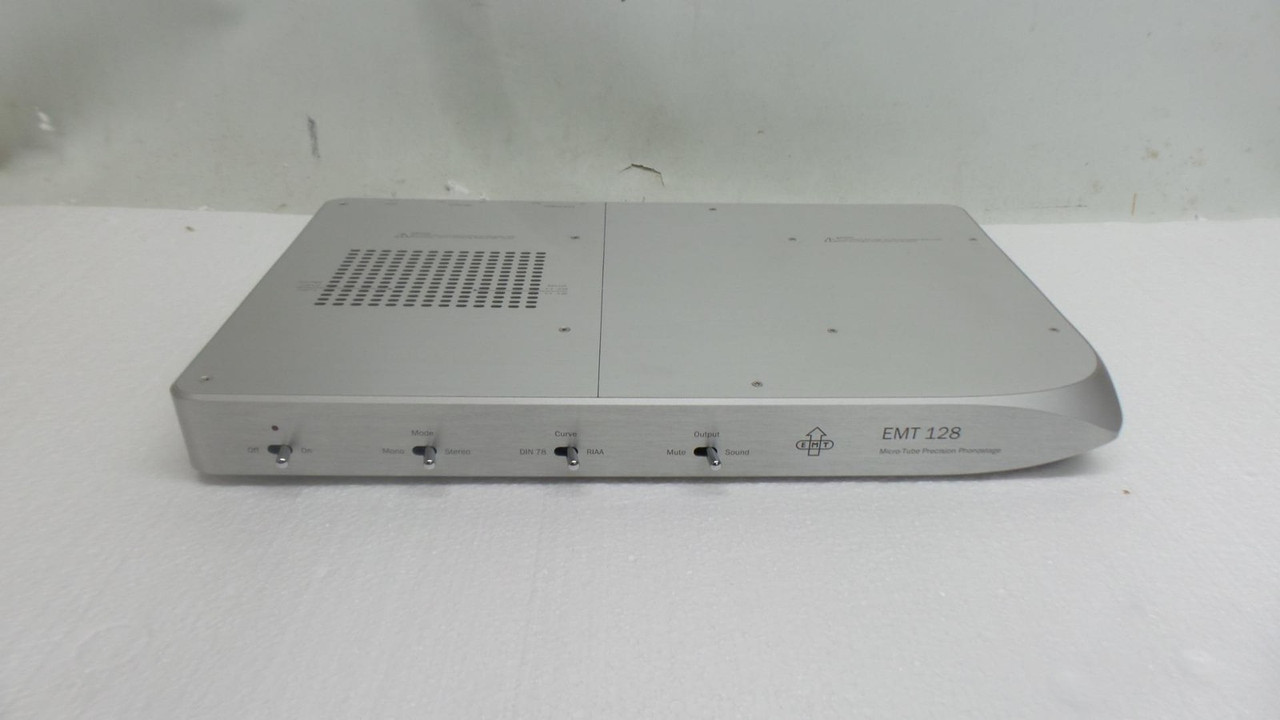
In function and appearance, the $12,830 128 is the opposite of the versatile, lab-like JPA 66. As for which is the cooler-looking design, I'd vote for both! The 128's sleek, low-profile chassis is milled out of a solid block of aluminum and utilizes "advanced air-flow and anti-vibration technology." It weighs 26.5lb.
The front panel features four toggle switches, one each for Off/On, Mono/Stereo, DIN 78/RIAA EQ (footnote 1), and Mute/Sound. The rear panel features one pair each of single-ended (RCA) inputs and balanced (XLR) outputs plus a banana plug–compatible ground lug receptacle on the right and an IEC connector and power switch on the left. Apart from a small identification plate, also on the rear panel, that's all there is on the outside.
Inside the chassis is a PCB populated with high-quality parts featuring a pair of Lundahl step-up transformers on the input side and a pair of Lundahl output transformers on the output side, between which are a pair of large Mundorf MCap ZN Classic Tin Foil "Audiophiler" capacitors. In between the step-up and output transformers are one trio per channel of Raytheon 5784WB subminiature, dual-pentode, wire-terminated tubes; EMT says these tubes were developed for "US missile technology."
422emt.bac2
There's no need to be concerned about tube availability. An online search shows that NOS (new old stock) 5784WB tubes are plentiful and cheap; I saw them for as little as $1.50. Online user reports claim great performance uniformity among tested samples and overall quiet. No doubt, in this critical application, HiFiction extensively tests each tube before soldering its bare wires to a small PCB fitted with pins that get inserted into sockets on the main board. Changing tubes, should it be necessary, is neither difficult nor time consuming and requires no soldering.
The instruction manual says the EMT 128 is "specifically designed for EMT MC cartridges," but it also states a range of useable cartridge impedances (12 to 30 ohms) and output voltages (0.3mV to 1mV). A pair of internally mounted jumpers lets you easily adjust gain to either 64dB (for cartridges with outputs ranging from 0.6mV to 1mV) or 70dB (for cartridges with outputs between 0.3mV and 0.5mV).
To make the review more broadly applicable, I also auditioned the 128 with a second cartridge. Because of the requirements of moderate output and relatively high impedance (for an MC), finding one in my collection that would work was a bit of a challenge. I found two. One was the X-quisite ST (16 ohms; 0.3mV), also manufactured by HiFiction; the other was the limited-edition Miyajima Labs Madake Snakewood (16 ohms; output a little low at 0.23mV), which, like the X-quisite, I had to buy after I tried it. I decided to use the Madake because the X-quisite performs best with its dedicated step-up transformer.
Heavenly "ether" sound
First up was the JSD Novel Titan. Having gotten acclimated to Verismo into the CH Precision P1/X1 phono preamp, swapping that out for an unfamiliar combo took some acclimation, but it didn't take long to recollect the similarly pristine, velvety sound of the Hovland HP-100 vacuum tube preamp with built-in MC phono preamp that I reviewed and then purchased back in 2000. Who said aural memory is fleeting?
The longer I listened to the Novel–128 combo, the more I appreciated its near-magical sonic attributes and its similarity to the Hovland. The bottom octaves were well-extended and delivered nimble low-frequency transient textures—fingers plucking double bass strings for instance—and yet the 128 would not be my rock'n'roll phono preamp of choice. It doesn't offer brute, gut-socking punch or sufficiently incisive low-frequency transients. It's a sort of sound that, in my experience, is typical of tubed phono preamps.
But the sound of the 128 was far from typical. The 128 produced that magic ether that only the best tube-based phono preamps produce, and it resolved and unraveled small details in the upper frequencies of many familiar recordings. Ether, yes, but without lower-midband timbral bloat or thickness, without midrange excess but with mesmerizing transparency and delicacy. That sound brought out a parade of records, some newly acquired and some not played in quite some time, that I figured would show off the 128's strengths.
422emt.Handel
One recent acquisition is Handel's Apollo e Dafne, a 1985 release performed by the Philharmonia Baroque Orchestra (Harmonia Mundi USA HMC 5157) and recommended to me by Peter McGrath of Wilson Audio Specialties, its recording engineer, as we sat in the stands at the 2021 Abu Dhabi Formula One race (footnote 2). As the cars zoomed by on qualifying day, I went online on my phone and ordered the record on Discogs for not much money. There's something special about being halfway around the world and ordering a record that's waiting for you when you get home. Not sure what that something is, but it is something!
That minimally miked recording at Old St. Hilary's Church in Tiburon, California, produced a seamless, expansive spatial picture of the small wooden space constructed of redwood, with redwood doors and a Douglas fir ceiling. From the first warm, reverberant note, you'd know that the venue where the small ensemble (soprano, bass, flute, oboes, bassoon, strings, continuo) plays isn't made of stone.
422emt.Nat-King-Cole-Sands
This recording sounds especially coherent through the solid state CH Precision P1/X1, but through the 128, the spaciousness was more spacious, the reverberant warmth was warmer, and the sense of effortlessly being in a three-dimensional space intensified, as did imaging verisimilitude. That experience had me unshelving Nat King Cole at the Sands (Capitol SMAS 2434), a recording I always thought was exciting but spatially and timbrally flawed, with vocal edge, brass harshness, and an overall metallic sound. It was recorded in 1960 but not released until after his death. I had low expectations going in.
I sat fully engaged in the entire after-hours concert, transported to the nightclub filled with Nat's celebrity friends—who couldn't attend the earlier shows because they were doing the same thing Nat was, at other Las Vegas nightclubs. Through the 128, Nat's cover of "I Wish You Love," a sonic and musical treat on which he's accompanied by lush strings on one side and mellow woodwinds, muted brass, and double bass on the other, sounded better than I'd ever heard it.Do you know John Hartford's 1981 album Catalogue (Flying Fish 259)? I didn't know it either until AnalogPlanet writer Joseph Washek wrote about it. It's what the title suggests: a run-through of Hartford songs first performed on other albums, mostly for RCA, here recorded solo, direct to a two-track Scully tape recorder at 30ips using a few great microphones—it says so right on the jacket. Coincidentally, reverb effects were achieved with EMT plates. It's entertaining, eclectic, and sonically "you are there." Hartford plays banjo (of course), Dobro, fiddle, tennis shoes, and guitars through a variety of effects boxes, all of which are displayed on the cover, laid out in front of his tour bus.
Again, it sounded great through both preamps, but the 128 delivered more three-dimensionality and instrumental texture and more generous room sound. There's no bass on the record, so little was lost compared to the CH Precision, and plenty was gained. Not that it didn't sound really good—and punchier—through the CH Precision, because it did.
Another record I'd not played in years caught my mental attention: Bobby Vee Meets the Crickets (Sunset SLS 50357). (Bob Dylan gigged with teen idol Vee playing piano as Elston Gunnn, but that's another story for another time.) 15-year-old Vee and some friends filled in for Buddy Holly at a Moorhead, Minnesota, show Holly was flying to when his plane went down.
Engineered mostly by Eddie Brackett (who also engineered Dream with Dean among many other sonic greats), and originally released in 1962, this is Vee channeling Holly backed by the Crickets doing a few Holly tunes plus some Chuck Berry, a Roy Orbison, and a few others. It's pure, exuberant, well-recorded rock'n'roll.
This one sounded good through both phono preamps, especially on top, where the 128 delivered Jerry Allison's drum kit with all the crack and sizzle you could want, especially on "Well ... All Right," where he adds intense, chime-y percussive accents banging on what sounds like an anvil. It rocked better through the CH because of the taut, muscular bass, which the 128 softened somewhat.
Do I have to tell you which phono preamp produced more sonic magic on Sonatas for Two Violins (Columbia SAX 2531/ERC008) performed by Leonid Kogan and Elisabeth Gilels? People whine about ERC's prices, but an original of this one sold a few years ago for almost $7000! The CH Precision did a very good job with this one, but the 128 produced an incomparably silky, satiny, supple string finish. As on the John Hartford record, there's no bass content here, so no contest.
The Classic Records reissue of Shostakovich's The Age of Gold/Ballet Suite/Symphony No.1 (RCA LSC-2322), with Jean Martinon conducting the London Symphony Orchestra at Kingsway Hall, demonstrated the 128's rich, luxurious (but not oversaturated) timbral presentation, beginning with the round, woody clarinet figure and continuing through spectacular orchestral crescendos that revealed the 128's impressive dynamic presentation and, on percussive explosions, its unlimited high-frequency response and fast, precise transients more typical of the best solid state phono preamplifiers. This recording also showed that the bottom-end extension is there—you can hear a train or two rumbling through the Underground at the beginning of the Ballet Suite—it's just not as impactful as the CH Precision's bottom end.
Changing partners
I think you get the picture with the 128 paired with the EMT Novel cartridge. What about the 128 with the Madake Snakewood, which is fitted with a Shibata stylus? In the column where I reviewed the Snakewood (which by coincidence appeared on Stereophile's website the day I wrote this part of this review), I described the Snakewood's sound as "a meth-infused Madake. As good as the Madake is, the Snakewood was faster, leaner, cleaner, and a definite notch more transparent, without losing any of the Madake's coherent appeal." I noted its "smooth bandwidth and snappy bottom-to-top transient response free of hyper-edged detail." Which is just how the Snakewood sounded through the 128.
There's a section in the Shostakovich Symphony No.1 that features xylophone, wood block, strings, and woodwinds. It sounds like a traffic jam. The presentation was super snappy, detailed, transient-precise, fast, and yet 100% free of hyper-edged detail.
Side 2 of the Kogan-Gilels ERC record is Belgian composer Eugene Ysaòe's Sonata No.1 in C Major for two violins. Through the Snakewood, the string sheen of the two closely miked violins was hyper-real without ever turning hard or etchy. Especially in the lower registers, the instruments' hollowness was fully revealed. So fast and clean. I don't think I'd want to hear this recording digitized.
422emt.Grant-Green
The Snakewood–EMT 128 proved to be a great pairing for jazz, too. This combination's rendering of Grant Green's Idle Moments (Blue Note Music Matters MMBST-84154) produced almost overwhelming textural richness and completeness on every instrument. Green's every pick-to-string touch became a fully realized event. Al Harewood's brushwork didn't sizzle—instead, it appropriately steamed, while Duke Pearson's piano exuded wood. Joe Henderson's sax was harmonically rich and fully saturated, and when Bobby Hutcherson entered center stage on vibraphone—round and full—it was almost too much for one set of ears to process.
It was like swapping out speakers. This was a totally different but equally valid and enticing presentation than that of the Ortofon Verismo into the CH Precision P1/X1. Rounder and fuller. This is what makes reproduced music and the opinions surrounding it so interesting and at times contentious. I could make a strong case for both versions.
Conclusion
The EMT 128 exudes elegance of design and execution, inside and out. Its sound, too, exudes elegance. It goes about its business without calling too much attention to itself, producing black backgrounds that the best solid state units would be proud of. (I'm prepared for measurement humiliation.) The 128 combines an essentially neutral timbral balance with pristine and seemingly unlimited high-frequency extension and glorious transient clarity that resolves fine detail, free of spotlighting. The tubes provide a kiss of pleasing harmonic structure, especially in the midrange—welcome warmth without thickness or veil.
422emt.2
Some tube-based phono preamps shout "tubes." This one doesn't. Neither does the Ypsilon VPS100, which I own and use but left out of this review to avoid overcomplicating things.
Defects? Bottom-end transient slam is in short supply; that's really only an issue on electric rock. The 128's rendering of double bass on jazz and classical records sounded correct and satisfying in every way.
The EMT 128 is not for every audio system. It's made to work with moving coil cartridges with relatively high internal impedance and moderately low output. In today's low-output moving coil cartridge world, the lowest output voltages are usually achieved with fewer coil turns, which of course produces low internal impedance. The EMT 128 is made, is intended to work best with EMT cartridges. It worked wonderfully with the 0.26mV Miyajima Labs Madake Snakewood, but this was one of only two cartridges in my collection that fit the bill.
If you're interested in the EMT 128—and I don't blame you if you are—there's a line of excellent EMT cartridges with your name on them, and quite a few non-EMT cartridges that it will work well with. I've written more about one of those EMTs—the JSD Novel Titan, which I used (above) to audition the EMT 128 phono preamp—in this issue's Analog Corner.
Exzellent und originalverpackt.
2018 übernahm die HiFiction AG von Micha Huber, Hersteller von Thales-Tonarmen und Plattenspielern, die Kontrolle über EMT Tontechnik und damit auch das Tonabnehmergeschäft inklusive Entwicklung, Produktion, Reparatur und internationalem Vertrieb – mit Ausnahme der EMT-Broadcast-Tonabnehmer für den EU-Markt, die weiterhin von EMT Studiotechnik vom ursprünglichen Firmensitz in Mahlberg im Schwarzwald vertrieben werden.
Die Vorgeschichte – oder zumindest Teile davon – ist wichtig, um den eigentlichen Kern dieser Rezension vollständig zu verstehen. Bleiben Sie also dran. EMT wurde 1940 von Wilhelm Franz in Berlin gegründet und begann als Hersteller von Messgeräten für Rundfunkanstalten. 1956 gründete Wilhelms Bruder Walter das Gerätewerk Lahr, das die Produktion der EMT-Produkte aufnahm.
Spulen wir vor zum Ende des Jahrzehnts, kurz nachdem EMT seinen berühmten Hallplatten-Effekt entwickelt hatte. Die Broadcast-Plattenspieler EMT 927 und 930 sind in Studios auf der ganzen Welt im Einsatz und mit von Ortofon gelieferten Tonarmen ausgestattet. Sie werden demnächst durch den berühmten EMT 997 „Bananen“-Tonarm ersetzt – eine Geschichte für sich. Die Plattenteller dieser industrietauglichen Plattenspieler mit Reibradantrieb waren groß genug für die damals im Rundfunk üblichen 16-Zoll-Schallplatten. Der Plattenspieler 930, der zunächst Mono war, verfügte über einen eingebauten Röhren-Phono-Vorverstärker, den 139.
1959 stieg EMT aus naheliegenden Gründen in den Tonabnehmermarkt ein und entwickelte ein Jahr später einen Stereo-Moving-Coil-Tonabnehmer. 1966 übernahm Gerätewerk Lahr die Produktion von Thorens – für diesen Testbericht nicht relevant, aber eine interessante Randnotiz. Wilhelm Franz verstarb 1971, doch das Unternehmen wurde von seiner Frau weitergeführt.
Von da an bis 1989, als EMT an die belgische Barco-Gruppe verkauft wurde, wurden Tonabnehmerdesign, -entwicklung und -fertigung am ursprünglichen Standort in Mahlberg, Deutschland, fortgeführt. 2003 verkaufte Barco EMT Studiotechnik an Walter Derrer. 2005 trat Jules Limon in das Unternehmen ein und übernahm die Leitung der Produktentwicklung sowie des Vertriebs. Marketing. Ein Jahr später brachte EMT die High-End-Tonabnehmerserie „Jubilee Series“ auf den Markt und präsentierte den herausragenden Phono-Vorverstärker JPA 66.
2007 verstarb Derrer bei einem Flugzeugabsturz, woraufhin Herr Limon die Leitung von EMT Studiotechnik übernahm. Ein Jahr später gründete er die EMT International GmbH, die die Kontrolle über die EMT-Markenrechte sowie Vertrieb und Produktion, einschließlich des JPA 66, übernahm.
422emt.ins
Limon lernte Micha Huber 2009 kennen, und die beiden entwarfen Pläne für gemeinsame, hochpräzise mechanische Entwicklungsprojekte. 2014, nach dem Ausscheiden des EMT-Tonabnehmer-Produktionsteams – einige Mitarbeiter hatten dort 45 Jahre gearbeitet –, wurde die EMT-Tonabnehmerproduktion inklusive aller Anlagen und Werkzeuge schrittweise zur HiFiction AG in Winterthur, Schweiz, verlagert, wo ein neu ausgebildetes junges Team die Produktion übernahm.
Vier Jahre später, im Juli 2018, schloss die HiFiction AG die Übernahme des Tonabnehmergeschäfts von EMT ab, einschließlich Entwicklung, Produktion, Reparatur und internationalem Vertrieb. Die Broadcast-Tonabnehmerlinie sowie der JPA 66 (mittlerweile in der Mk3-Version) verblieben bei EMT Studiotechnik in Mahlberg. Es ist unklar, wem die Marke EMT nun gehört.
Um sowohl der EMT-Produktionslinie als auch der gestiegenen Nachfrage nach Thales-Produkten gerecht zu werden, zog die HiFiction AG 2019 in ein geräumigeres Hauptgebäude um – eine ehemalige Spinnerei aus dem Jahr 1833 – im Dorf Turbenthal, in der Nähe von Winterthur und dem Flughafen Zürich. Eine Werksführung können Sie in einem Video sehen, das ich im Frühjahr 2019 aufgenommen habe.
Wichtig ist, dass die EMT-Tonabnehmerlinie in diesem Zeitraum kontinuierlich verbessert und weiterentwickelt wurde.
Der EMT 128
Dieser neue EMT-Phono-Vorverstärker entstand 1985 als Projekt zur Ablösung der Phono-Vorstufe in den bereits erwähnten EMT-Plattenspielern für Rundfunkübertragungen. Herr Huber erzählte mir, er habe den inzwischen pensionierten Projektleiter kontaktiert und ihn überzeugt, die elektronischen Komponenten des Designs fertigzustellen. Hubers Team übernahm die mechanischen Arbeiten und die Schwingungsdämpfung. Die Leiterplatte wird in Deutschland gefertigt.
422emt.bac
In Funktion und Aussehen ist der 12.830 US-Dollar teure 128 das genaue Gegenteil des vielseitigen, laborähnlichen JPA 66. Welches Design besser aussieht? Ich würde sagen: beide! Das schlanke, flache Gehäuse des 128 ist aus einem massiven Aluminiumblock gefräst und nutzt fortschrittliche Luftstrom- und Antivibrationstechnologie. Er wiegt 12 kg.
Die Vorderseite verfügt über vier Kippschalter: je einen für Ein/Aus, Mono/Stereo, DIN 78/RIAA-Entzerrung (Fußnote 1) und Stummschaltung/Ton. Die Rückseite bietet je ein Paar unsymmetrische (Cinch-)Eingänge und symmetrische (XLR-)Ausgänge sowie eine Bananenstecker-kompatible Erdungsbuchse rechts und einen IEC-Anschluss und den Netzschalter links. Abgesehen von einem kleinen Typenschild auf der Rückseite ist das alles, was sich äußerlich befindet.
Im Inneren des Gehäuses befindet sich eine Leiterplatte mit hochwertigen Bauteilen. Auf der Eingangsseite sind zwei Lundahl-Aufwärtstransformatoren verbaut, auf der Ausgangsseite ebenfalls. Dazwischen befinden sich zwei große Mundorf MCap ZN Classic Zinnfolienkondensatoren in „Audiophiler“-Qualität. Zwischen den Aufwärts- und Ausgangstransformatoren ist pro Kanal jeweils ein Trio Raytheon 5784WB Subminiatur-Doppelpentodenröhren mit Drahtanschlüssen angeordnet. Laut EMT wurden diese Röhren für die US-Raketentechnologie entwickelt.
422emt.bac2
Sie brauchen sich keine Sorgen um die Verfügbarkeit der Röhren zu machen. Eine Online-Suche zeigt, dass NOS-Röhren (New Old Stock) des Typs 5784WB reichlich vorhanden und günstig sind; ich habe sie schon für 1,50 $ gesehen. Online-Nutzerberichte bestätigen eine hohe Leistungskonstanz der getesteten Exemplare und ein insgesamt rauscharmes Verhalten. Zweifellos testet HiFiction in dieser wichtigen Anwendung jede Röhre eingehend, bevor die blanken Drähte auf eine kleine Platine mit Stiftleisten gelötet werden, die in Buchsen auf der Hauptplatine gesteckt werden. Ein Röhrenwechsel ist, falls nötig, weder schwierig noch zeitaufwendig und erfordert kein Löten.
Die Bedienungsanleitung besagt, dass der EMT 128 „speziell für EMT MC-Tonabnehmer entwickelt“ wurde, gibt aber auch einen Bereich verwendbarer Tonabnehmerimpedanzen (12 bis 30 Ohm) und Ausgangsspannungen (0,3 mV bis 1 mV) an. Zwei intern angebrachte Jumper ermöglichen die einfache Einstellung der Verstärkung auf entweder 64 dB (für Tonabnehmer mit Ausgangsspannungen von 0,6 mV bis 1 mV) oder 70 dB (für Tonabnehmer mit Ausgangsspannungen zwischen 0,3 mV und 0,5 mV).
Um die Aussagekraft des Tests zu erweitern, habe ich den 128 auch mit einem zweiten Tonabnehmer getestet. Aufgrund der Anforderungen an moderate Ausgangsleistung und relativ hohe Impedanz (für eine MC-Gitarre) gestaltete sich die Suche nach einem passenden Verstärker in meiner Sammlung etwas schwierig. Ich fand zwei. Der eine war der X-quisite ST (16 Ohm; 0,3 mV), ebenfalls von HiFiction hergestellt; der andere die limitierte Miyajima Labs Madake Snakewood (16 Ohm; Ausgangsspannung mit 0,23 mV etwas niedrig), die ich, wie den X-quisite, nach dem Testen kaufen musste. Ich entschied mich für den Madake, da der X-quisite mit seinem eigenen Übertrager die beste Leistung erbringt.
Himmlischer, ätherischer Klang
Als Erstes kam der JSD Novel Titan zum Einsatz. Nachdem ich mich an Verismo im CH Precision P1/X1 Phono-Vorverstärker gewöhnt hatte, brauchte der Wechsel zu einer ungewohnten Kombination etwas Eingewöhnungszeit, aber es dauerte nicht lange, bis ich mich wieder an den ähnlich klaren, samtigen Klang des Hovland HP-100 Röhrenvorverstärkers mit eingebautem MC-Phono-Vorverstärker erinnerte, den ich im Jahr 2000 getestet und dann gekauft hatte. Wer sagt denn, dass das Hörgedächtnis flüchtig ist?
Je länger ich die Kombination aus Novel und 128 hörte, desto mehr schätzte ich ihre beinahe magischen Klangeigenschaften und die Ähnlichkeit zum Hovland. Die tiefen Oktaven waren gut ausgedehnt und lieferten agile Tiefton-Transienten – etwa das Zupfen von Kontrabasssaiten –, und dennoch wäre der 128 nicht meine erste Wahl für Rock'n'Roll-Phonovorverstärker. Ihm fehlt der brachiale, druckvolle Punch und die ausreichend prägnanten Tiefton-Transienten. Es ist ein Klang, der meiner Erfahrung nach typisch für Röhren-Phonovorverstärker ist.
Doch der Klang des 128 war alles andere als typisch. Der 128 erzeugte jene magische Atmosphäre, die nur die besten Röhren-Phonovorverstärker bieten, und er löste und enthüllte feinste Details in den oberen Frequenzen vieler bekannter Aufnahmen. Äther, ja, aber ohne aufdringliche oder dicke Mitten, ohne übertriebene Mitten, dafür mit faszinierender Transparenz und Feinheit. Dieser Klang brachte eine ganze Reihe von Schallplatten zum Vorschein, einige neu erworben, andere schon lange nicht mehr gehört, von denen ich mir erhoffte, dass sie die Stärken des 128er-Verstärkers optimal zur Geltung bringen würden.
422emt.Handel
Eine meiner jüngsten Errungenschaften ist Händels „Apollo e Dafne“, eine Aufnahme von 1985, eingespielt vom Philharmonia Baroque Orchestra (Harmonia Mundi USA HMC 5157). Peter McGrath von Wilson Audio Specialties, der Toningenieur der Aufnahme, hatte sie mir empfohlen, als wir 2021 beim Formel-1-Rennen in Abu Dhabi auf der Tribüne saßen (Fußnote 2). Während die Boliden am Qualifikationstag vorbeirasten, bestellte ich die Platte mit meinem Handy bei Discogs für wenig Geld. Es hat etwas Besonderes, am anderen Ende der Welt zu sein und eine Platte zu bestellen, die bei der Heimkehr auf einen wartet. Ich kann nicht genau sagen, was es ist, aber es ist definitiv etwas Besonderes!
Diese minimalistisch mikrofonierte Aufnahme in der Old St. Hilary's Church in Tiburon, Kalifornien, erzeugte ein nahtloses, weitläufiges Raumbild des kleinen, aus Redwoodholz erbauten Raumes mit Redwood-Türen und einer Decke aus Douglasie. Schon der erste warme, hallende Ton ließ erahnen, dass der Raum, in dem das kleine Ensemble (Sopran, Bass, Flöte, Oboen, Fagott, Streicher, Continuo) spielte, nicht aus Stein war.
422emt.Nat-King-Cole-Sands
Diese Aufnahme klingt besonders stimmig über den Transistorverstärker CH Precision P1/X1, doch über den 128 war die Räumlichkeit noch größer, der Hall noch wärmer und das Gefühl, sich mühelos im dreidimensionalen Raum zu befinden, verstärkt, ebenso wie die realistische Klangabbildung. Dieses Erlebnis veranlasste mich, Nat King Coles „At the Sands“ (Capitol SMAS 2434) wieder hervorzuholen, eine Aufnahme, die ich zwar immer für aufregend, aber räumlich und klanglich fehlerhaft hielt – mit scharfer Stimme, harschem Blechbläserklang und einem insgesamt metallischen Sound. Sie wurde 1960 aufgenommen, aber erst nach seinem Tod veröffentlicht. Ich hatte also keine großen Erwartungen.
Ich saß da und genoss das gesamte After-Hours-Konzert. Ich fühlte mich in den Nachtclub versetzt, der mit Nats prominenten Freunden gefüllt war – die die früheren Shows verpasst hatten, weil sie dasselbe taten wie Nat, nur in anderen Las Vegas-Nachtclubs. Auf der 128 klang Nats Cover von „I Wish You Love“, ein klanglicher und musikalischer Genuss, bei dem er auf der einen Seite von üppigen Streichern und auf der anderen von sanften Holzbläsern, gedämpften Blechbläsern und Kontrabass begleitet wird, besser als je zuvor. Kennst du John Hartfords Album „Catalogue“ (Flying Fish 259) von 1981? Ich wusste es auch nicht, bis Joseph Washek von AnalogPlanet darüber schrieb. Es ist genau das, was der Titel verspricht: eine Reihe von Hartford-Songs, die er bereits auf anderen Alben, hauptsächlich für RCA, veröffentlicht hatte. Hier wurden sie solo direkt auf einem Zweispur-Scully-Tonbandgerät mit 30 ips und einigen hervorragenden Mikrofonen aufgenommen – das steht sogar auf dem Cover. Zufällig wurden die Halleffekte mit EMT-Plattenhallgeräten erzielt. Es ist unterhaltsam, vielseitig und klanglich so, als wäre man live dabei. Hartford spielt Banjo (natürlich), Dobro, Geige, Tennisschuhe und Gitarren über verschiedene Effektgeräte, die alle auf dem Cover vor seinem Tourbus ausgestellt sind.
Es klang über beide Vorverstärker großartig, aber der 128er lieferte mehr Räumlichkeit, mehr Instrumentaltextur und einen volleren Raumklang. Da auf der Platte kein Bass zu hören ist, ging im Vergleich zum CH Precision kaum etwas verloren, und es wurde viel gewonnen. Nicht, dass es über den CH Precision nicht richtig gut – und druckvoller – geklungen hätte, denn das tat es.
Eine andere Platte, die ich seit Jahren nicht mehr gehört hatte, weckte meine Aufmerksamkeit: Bobby Vee Meets the Crickets (Sunset SLS 50357). (Bob Dylan trat mit dem Teenie-Idol Vee als Elston Gunnn am Klavier auf, aber das ist eine andere Geschichte.) Der 15-jährige Vee und einige Freunde sprangen für Buddy Holly bei einem Konzert in Moorhead, Minnesota, ein, zu dem Holly unterwegs war, als sein Flugzeug abstürzte.
Diese Aufnahme, größtenteils von Eddie Brackett (der unter anderem auch „Dream“ mit Dean Martin produzierte) und ursprünglich 1962 veröffentlicht, präsentiert Vee im Stil von Holly, begleitet von den Crickets, die neben einigen Holly-Songs auch Stücke von Chuck Berry, Roy Orbison und anderen Künstlern spielen. Es ist purer, überschwänglicher und hervorragend aufgenommener Rock'n'Roll.
Diese Aufnahme klang über beide Phono-Vorverstärker gut, insbesondere im Hochtonbereich. Der 128er-Verstärker lieferte Jerry Allisons Schlagzeug mit all dem Druck und der Brillanz, die man sich wünschen kann, besonders bei „Well… All Right“, wo er intensive, glockenhelle perkussive Akzente setzt, die an einen Amboss erinnern. Über den CH-Verstärker klang die Platte noch besser, da der straffe, kraftvolle Bass vom 128er-Verstärker etwas abgemildert wurde.
Muss ich Ihnen wirklich sagen, welcher Phono-Vorverstärker bei den Sonaten für zwei Violinen (Columbia SAX 2531/ERC008), gespielt von Leonid Kogan und Elisabeth Gilels, den besseren Klang erzeugt hat? Man beschwert sich ja oft über die Preise von ERC, aber ein Original dieses Modells wurde vor einigen Jahren für fast 7000 Dollar verkauft! Der CH Precision hat hier sehr gute Arbeit geleistet, aber der 128er erzeugte einen unvergleichlich seidigen, samtigen und geschmeidigen Saitenklang. Wie schon bei der Aufnahme von John Hartford gibt es auch hier keine Bässe, also keine Frage.
Die Wiederveröffentlichung von Schostakowitschs „Das goldene Zeitalter“/Ballettsuite/Sinfonie Nr. 1 (RCA LSC-2322) durch Classic Records, mit Jean Martinon am Pult des London Symphony Orchestra in der Kingsway Hall, demonstrierte die reiche, luxuriöse (aber nicht übersättigte) Klangwiedergabe des 128. Dies begann mit der runden, warmen Klarinettenfigur und setzte sich in spektakulären Orchester-Crescendi fort, die die beeindruckende Dynamik des 128 offenbarten. Bei perkussiven Ausbrüchen zeigte er zudem seinen unbegrenzten Hochtonbereich und die schnellen, präzisen Transienten, die man sonst nur von den besten Transistor-Phono-Vorverstärkern kennt. Diese Aufnahme zeigte auch, dass der Bassbereich vorhanden ist – man kann zu Beginn der Balletsuite ein oder zwei Züge durch die U-Bahn rumpeln hören –, er ist nur nicht so druckvoll wie der des CH Precision.
Partnerwechsel
Ich denke, Sie verstehen, was Sie mit dem 128 in Kombination mit dem EMT Novel-Tonabnehmer meinen. Und wie klingt der 128 mit dem Madake Snakewood, der mit einer Shibata-Nadel ausgestattet ist? In meiner Rezension des Snakewood (die zufälligerweise am selben Tag auf der Stereophile-Website erschien, an dem ich diesen Teil der Rezension schrieb) beschrieb ich seinen Klang als „einen mit Meth versetzten Madake“. So gut der Madake auch ist, der Snakewood war schneller, schlanker, klarer und deutlich transparenter, ohne dabei an der stimmigen Gesamtwirkung des Madake einzubüßen. Ich hob seine „ausgewogene Bandbreite und die knackige Impulswiedergabe über den gesamten Frequenzbereich hervor, frei von übertriebenen Details“. Genau so klang der Snakewood auch über den 128.
Es gibt eine Passage in Schostakowitschs 1. Sinfonie mit Xylophon, Holzblock, Streichern und Holzbläsern. Es klingt wie ein Verkehrsstau. Die Wiedergabe war extrem knackig, detailreich, präzise im Impulsverhalten, schnell und dennoch absolut frei von übertriebenen Details.
Seite 2 der Kogan-Gilels ERC-Schallplatte enthält die Sonate Nr. 1 in C-Dur für zwei Violinen des belgischen Komponisten Eugène Ysaòe. Über den Snakewood-Verstärker wirkte der Klang der beiden nah mikrofonierten Violinen überaus realistisch, ohne jemals schrill oder kratzig zu klingen. Besonders in den tieferen Lagen wurde die Hohlheit der Instrumente vollends offenbart. So schnell und klar. Ich glaube nicht, dass ich diese Aufnahme digital hören möchte.
422emt.Grant-Green
Der Snakewood-Verstärker und der EMT 128 erwiesen sich auch für Jazz als hervorragende Kombination. Die Wiedergabe von Grant Greens „Idle Moments“ (Blue Note Music Matters MMBST-84154) durch diese Kombination erzeugte eine fast überwältigende Klangfülle und -vollkommenheit auf jedem Instrument. Jeder Anschlag von Green wurde zu einem vollendeten Erlebnis. Al Harewoods Besenspiel klang nicht schrill, sondern eher warm und rauchig, während Duke Pearsons Klavier einen warmen, holzigen Klang ausstrahlte. Joe Hendersons Saxophon war harmonisch reichhaltig und volltönend, und als Bobby Hutcherson mit seinem runden, vollen Vibraphon die Bühne betrat, war es fast überwältigend für ein einzelnes Ohr.
Es war, als würde man die Lautsprecher austauschen. Die Wiedergabe war völlig anders, aber ebenso überzeugend und fesselnd wie die des Ortofon Verismo am CH Precision P1/X1. Runder und voller. Genau das macht Musikwiedergabe und die damit verbundenen Meinungen so interessant und mitunter kontrovers. Ich könnte für beide Versionen überzeugende Argumente vorbringen.
Fazit: Der EMT 128 besticht durch elegantes Design und Verarbeitung, sowohl innen als auch außen. Auch sein Klang ist elegant. Er verrichtet seine Arbeit unaufdringlich und erzeugt einen so tiefen, schwarzen Hintergrund, dass selbst die besten Transistorverstärker neidisch wären. (Ich bin auf eine peinliche Messung gefasst.) Der 128 vereint eine im Wesentlichen neutrale Klangbalance mit einer makellosen und scheinbar unbegrenzten Höhenwiedergabe sowie einer brillanten Impulstreue, die feinste Details ohne Überbetonung auflöst. Die Röhren verleihen dem Klang eine angenehme harmonische Struktur, insbesondere im Mitteltonbereich – eine willkommene Wärme ohne Dicke oder Schleier.
422emt.2
Manche Röhren-Phono-Vorverstärker schreien förmlich „Röhren“. Dieser hier nicht. Auch der Ypsilon VPS100, den ich besitze und nutze, aber der Einfachheit halber hier nicht erwähne, macht da nichts aus.
Mängel? Der Tiefbass ist etwas druckvoll; das fällt aber eigentlich nur bei E-Rock auf. Die Wiedergabe von Kontrabass auf Jazz- und Klassik-Schallplatten war durch den EMT 128 in jeder Hinsicht korrekt und überzeugend.
Der EMT 128 ist nicht für jede Anlage geeignet. Er ist für Moving-Coil-Tonabnehmer mit relativ hoher Innenimpedanz und moderat niedriger Ausgangsspannung ausgelegt. Heutzutage werden bei Moving-Coil-Tonabnehmern mit niedriger Ausgangsspannung die niedrigsten Ausgangsspannungen meist mit weniger Spulenwindungen erreicht, was natürlich zu einer niedrigen Innenimpedanz führt. Der EMT 128 ist für die optimale Zusammenarbeit mit EMT-Tonabnehmern konzipiert. Er harmonierte hervorragend mit dem 0,26 mV Miyajima Labs Madake Snakewood, aber das war einer von nur zwei Tonabnehmern in meiner Sammlung, die diese Anforderungen erfüllten.
Wenn Sie sich für den EMT 128 interessieren – und das kann ich gut verstehen –, gibt es eine Reihe exzellenter EMT-Tonabnehmer, die perfekt zu Ihnen passen, und auch einige Tonabnehmer anderer Hersteller, mit denen er gut harmoniert. Über einen dieser EMT-Tonabnehmer, den JSD Novel Titan, mit dem ich den EMT 128 Phono-Vorverstärker (siehe oben) getestet habe, habe ich in der Rubrik „Analog Corner“ dieser Ausgabe ausführlicher geschrieben.
Excelente estado y en su caja original.
En 2018, HiFiction AG, de Micha Huber, fabricante de brazos y tocadiscos Thales, tomó el control de EMT Tontechnik, haciéndose cargo del negocio de cápsulas de EMT, incluyendo el desarrollo, la producción, la reparación y la distribución internacional, con la excepción de la línea de cápsulas EMT para radiodifusión destinada al mercado europeo, que aún distribuye EMT Studiotechnik desde su sede original en la Selva Negra, en Mahlberg, Alemania.
La historia previa —o parte de ella— es fundamental para comprender la historia principal: esta reseña. Así que, permítanme seguir leyendo. Fundada por Wilhelm Franz en Berlín en 1940, EMT comenzó como fabricante de equipos de medición para emisoras. En 1956, Walter, hermano de Wilhelm, fundó Gerätewerk Lahr, que comenzó a fabricar los productos de EMT.
Avanzando rápidamente hasta finales de la década, poco después de que EMT desarrollara su famosa "reverberación de placa". Los tocadiscos de radiodifusión EMT 927 y 930 se utilizan en estudios de todo el mundo, equipados con brazos de lectura suministrados por Ortofon, que pronto serán reemplazados por el famoso brazo de lectura "banana" EMT 997, una historia aparte. Los platos de estos tocadiscos industriales con transmisión por polea eran lo suficientemente grandes como para alojar los discos de transcripción de 16 pulgadas que se utilizaban entonces en la radiodifusión. El tocadiscos 930, que inicialmente era monofónico, incorporaba un preamplificador de fono integrado basado en válvulas, el modelo 139.
En 1959, EMT entró en el mercado de las cápsulas fonográficas por razones obvias y, un año después, desarrolló una cápsula estéreo de bobina móvil. En 1966, Gerätewerk Lahr se hizo cargo de la producción de Thorens (dato no relevante para esta reseña, pero interesante). Wilhelm Franz falleció en 1971, pero la empresa, dirigida por su esposa, continuó su actividad.
Desde entonces hasta 1989, cuando EMT fue vendida al grupo belga Barco, el diseño, desarrollo y fabricación de las cápsulas fonográficas continuaron en la sede original de Mahlberg, Alemania. En 2003, Barco vendió EMT Studiotechnik a Walter Derrer. En 2005, Jules Limon se unió a la empresa, dirigiendo el desarrollo de productos. Además de las ventas y el marketing, EMT lanzó la línea de cápsulas de alta gama "Jubilee Series" e introdujo el impresionante preamplificador de fono JPA 66.
En 2007, Derrer falleció en un accidente aéreo y el Sr. Limon tomó las riendas de EMT Studiotechnik. Un año después, fundó EMT International GmbH, que asumió el control de las marcas registradas de EMT, así como las ventas y la producción, incluyendo el JPA 66.
422emt.ins
Limon conoció a Micha Huber en 2009, y juntos trazaron planes para proyectos de desarrollo mecánico de alta precisión en colaboración. En 2014, tras la jubilación del equipo de producción de cartuchos de EMT —algunos con 45 años de experiencia—, la producción de cartuchos de EMT, incluyendo todo el equipo y las herramientas, se trasladó gradualmente a HiFiction AG en Winterthur, Suiza, donde un equipo joven y recién formado se hizo cargo.
Cuatro años después, en julio de 2018, HiFiction AG completó la adquisición del negocio de cartuchos de EMT, incluyendo el desarrollo, la producción, las reparaciones y las ventas internacionales. EMT Studiotechnik en Mahlberg dejó la línea de cartuchos para radiodifusión, así como el JPA 66 (ahora en su versión Mk3). Se desconoce quién es el propietario actual de la marca registrada EMT.
En 2019, para dar cabida tanto a la línea de producción de EMT como a la creciente demanda de productos Thales, HiFiction AG se trasladó a una sede más espaciosa —una antigua fábrica textil construida en 1833— en el pueblo de Turbenthal, cerca de Winterthur y del aeropuerto de Zúrich. Puedes ver un recorrido por la fábrica en un vídeo que grabé en la primavera de 2019.
Es importante destacar que, a lo largo de este proceso, la línea de cápsulas EMT se ha ido mejorando y actualizando.
El EMT 128
Este nuevo preamplificador de fono EMT nació en 1985 como un proyecto para reemplazar la etapa de fono de los tocadiscos EMT mencionados anteriormente. El Sr. Huber me comentó que contactó con el jefe de proyecto, ahora jubilado, y lo convenció para que completara la parte electrónica del diseño. El equipo de Huber se encargó del trabajo mecánico y del control de vibraciones. La placa de circuito impreso se fabrica en Alemania.
422emt.bac
En cuanto a funcionalidad y apariencia, la 128, con un precio de 12.830 dólares, es la antítesis de la versátil y minimalista JPA 66. En cuanto a cuál tiene un diseño más atractivo, ¡me decanto por ambas! El elegante chasis de perfil bajo de la 128 está mecanizado a partir de un bloque sólido de aluminio y utiliza tecnología avanzada de flujo de aire y antivibración. Pesa 12 kg.
El panel frontal cuenta con cuatro interruptores de palanca: uno para encendido/apagado, otro para mono/estéreo, otro para ecualizador DIN 78/RIAA (nota 1) y otro para silencio/sonido. El panel trasero incluye un par de entradas RCA y un par de salidas XLR balanceadas, además de un conector banana a la derecha y un conector IEC con interruptor de encendido a la izquierda. Aparte de una pequeña placa de identificación, también en el panel trasero, eso es todo lo que se puede apreciar en el exterior.
Dentro del chasis se encuentra una placa de circuito impreso con componentes de alta calidad, que incluye un par de transformadores elevadores Lundahl en la entrada y un par de transformadores de salida Lundahl en la salida, entre los cuales se ubican dos condensadores Mundorf MCap ZN Classic Tin Foil "Audiophiler" de gran tamaño. Entre los transformadores elevadores y de salida se encuentra un trío por canal de tubos Raytheon 5784WB subminiatura, de doble pentodo y con terminación de hilo; EMT afirma que estos tubos fueron desarrollados para la tecnología de misiles de EE. UU.
422emt.bac2
No hay que preocuparse por la disponibilidad de los tubos. Una búsqueda en línea muestra que los tubos 5784WB NOS (nuevos de stock antiguo) son abundantes y económicos; los vi por tan solo 1,50 dólares. Los comentarios de los usuarios en línea destacan la gran uniformidad de rendimiento entre las muestras probadas y un funcionamiento silencioso en general. Sin duda, en esta aplicación crítica, HiFiction prueba exhaustivamente cada tubo antes de soldar sus cables a una pequeña placa de circuito impreso con pines que se insertan en los zócalos de la placa principal. Cambiar los tubos, si fuera necesario, no es difícil ni lleva mucho tiempo y no requiere soldadura.
El manual de instrucciones indica que el EMT 128 está "diseñado específicamente para cápsulas EMT MC", pero también especifica un rango de impedancias de cápsula utilizables (de 12 a 30 ohmios) y voltajes de salida (de 0,3 mV a 1 mV). Un par de puentes internos permiten ajustar fácilmente la ganancia a 64 dB (para cápsulas con salidas de entre 0,6 mV y 1 mV) o a 70 dB (para cápsulas con salidas de entre 0,3 mV y 0,5 mV).
Para que la reseña fuera más general, también probé el 128 con una segunda cápsula. Debido a los requisitos de salida moderada y una impedancia relativamente alta (para una cápsula MC), encontrar una en mi colección que funcionara fue todo un reto. Encontré dos. Una era la X-quisite ST (16 ohmios; 0,3 mV), también fabricada por HiFiction; la otra era la edición limitada Miyajima Labs Madake Snakewood (16 ohmios; salida algo baja a 0,23 mV), que, al igual que la X-quisite, tuve que comprar después de probarla. Decidí usar la Madake porque la X-quisite rinde mejor con su transformador elevador dedicado.
Un sonido celestial, etéreo.
La primera fue la JSD Novel Titan. Tras haberme acostumbrado al sonido Verismo en el preamplificador de fono CH Precision P1/X1, cambiarlo por una combinación desconocida requirió un periodo de adaptación, pero no tardé en recordar el sonido igualmente nítido y aterciopelado del preamplificador de válvulas Hovland HP-100 con preamplificador de fono MC integrado que reseñé y luego compré en el año 2000. ¿Quién dijo que la memoria auditiva es efímera?
Cuanto más escuchaba la combinación Novel-128, más apreciaba sus atributos sonoros casi mágicos y su similitud con el Hovland. Las octavas graves se extendían con fluidez y ofrecían texturas transitorias de baja frecuencia ágiles —como el sonido de los dedos pulsando las cuerdas de un contrabajo—, y aun así, el 128 no sería mi preamplificador de fono preferido para rock and roll. No ofrece una pegada brutal e impactante ni transitorios de baja frecuencia suficientemente incisivos. Es un tipo de sonido que, en mi experiencia, es típico de los preamplificadores de fono de válvulas.
Pero el sonido del 128 distaba mucho de ser típico. El 128 producía esa atmósfera mágica que solo los mejores preamplificadores de fono de válvulas logran, y resolvía y desvelaba pequeños detalles en las frecuencias altas de muchas grabaciones conocidas. Éter, sí, pero sin la hinchazón ni la densidad tímbrica de las frecuencias medias-bajas, sin exceso de frecuencias medias, pero con una transparencia y delicadeza fascinantes. Ese sonido me hizo escuchar una serie de discos, algunos recién adquiridos y otros que no había escuchado en mucho tiempo, que pensé que mostrarían las virtudes del 128.
422emt.Handel
Una adquisición reciente es Apollo e Dafne de Handel, una grabación de 1985 interpretada por la Orquesta Barroca Philharmonia (Harmonia Mundi USA HMC 5157) que me recomendó Peter McGrath de Wilson Audio Specialties, su ingeniero de grabación, mientras estábamos en las gradas de la carrera de Fórmula 1 de Abu Dabi de 2021 (nota 2). Mientras los coches pasaban a toda velocidad el día de la clasificación, entré en mi móvil y pedí el disco en Discogs por muy poco dinero. Hay algo especial en estar al otro lado del mundo y pedir un disco que te espera cuando llegas a casa. No sé qué es, ¡pero es algo! Esta grabación, realizada con una mínima cantidad de micrófonos en la iglesia Old St. Hilary's de Tiburon, California, produjo una imagen espacial fluida y expansiva del pequeño espacio de madera, construido con secuoya, con puertas de secuoya y techo de abeto Douglas. Desde la primera nota cálida y reverberante, se percibe que el lugar donde toca el pequeño conjunto (soprano, bajo, flauta, oboes, fagot, cuerdas y continuo) no es de piedra.
422emt.Nat-King-Cole-Sands
Esta grabación suena especialmente coherente a través del preamplificador de estado sólido CH Precision P1/X1, pero con el 128, la amplitud era mayor, la calidez de la reverberación más intensa y la sensación de estar en un espacio tridimensional se acentuaba, al igual que la verosimilitud de la imagen sonora. Esa experiencia me llevó a desempolvar Nat King Cole at the Sands (Capitol SMAS 2434), una grabación que siempre me pareció emocionante, pero con fallos espaciales y tímbricos, con una voz estridente, metales ásperos y un sonido metálico en general. Fue grabada en 1960, pero no se publicó hasta después de su muerte. Tenía bajas expectativas.
Disfruté plenamente del concierto nocturno, transportado al club nocturno repleto de amigos famosos de Nat, quienes no pudieron asistir a los conciertos anteriores porque estaban haciendo lo mismo que él, en otros clubes nocturnos de Las Vegas. A través del disco de 128 rpm, la versión de Nat de "I Wish You Love", una delicia sonora y musical en la que está acompañado por exuberantes cuerdas en un lado y suaves vientos, metales con sordina y contrabajo en el otro, sonó mejor que nunca. ¿Conoces el álbum Catalogue (Flying Fish 259) de John Hartford, de 1981? Yo tampoco lo sabía hasta que Joseph Washek, redactor de AnalogPlanet, escribió sobre ello. Es tal como lo indica el título: un repaso de canciones de Hartford interpretadas originalmente en otros álbumes, principalmente para RCA, aquí grabadas en solitario, directamente en una grabadora de cinta Scully de dos pistas a 30 ips con unos micrófonos excelentes; así lo indica la carátula. Casualmente, los efectos de reverberación se lograron con placas EMT. Es entretenido, ecléctico y, sonoramente, te transporta al lugar. Hartford toca el banjo (por supuesto), el dobro, el violín, zapatillas de tenis y guitarras a través de una variedad de pedales de efectos, todos ellos mostrados en la portada, dispuestos frente a su autobús de gira.
De nuevo, sonaba genial con ambos preamplificadores, pero el 128 ofrecía mayor tridimensionalidad, textura instrumental y un sonido de sala más generoso. No hay bajo en el disco, así que se perdió poco en comparación con el CH Precision, y se ganó mucho. No es que no sonara realmente bien —y con más pegada— con el CH Precision, porque sí que sonaba bien. Otro disco que no había escuchado en años me llamó la atención: Bobby Vee Meets the Crickets (Sunset SLS 50357). (Bob Dylan tocó con el ídolo juvenil Vee al piano bajo el nombre de Elston Gunnn, pero esa es otra historia). Vee, de 15 años, y algunos amigos sustituyeron a Buddy Holly en un concierto en Moorhead, Minnesota, al que Holly se dirigía cuando su avión se estrelló.
Producido principalmente por Eddie Brackett (quien también trabajó con Dean Beckham en Dream, entre otros grandes del sonido), y lanzado originalmente en 1962, este disco presenta a Vee canalizando a Holly Holly, acompañado por los Crickets, interpretando algunos temas de Holly, además de canciones de Chuck Berry, Roy Orbison y otros artistas. Es puro rock and roll, exuberante y con una excelente grabación.
Este disco sonó bien con ambos preamplificadores de fono, especialmente en las frecuencias altas, donde el 128 reprodujo la batería de Jerry Allison con toda la nitidez y el brillo deseados, sobre todo en "Well... All Right", donde añade intensos acentos percusivos con un sonido metálico, como si golpeara un yunque. Sonó mejor con el CH debido a los bajos potentes y contundentes, que el 128 suavizó ligeramente.
¿Hace falta que les diga qué preamplificador de fono produjo una magia sonora mayor en las Sonatas para dos violines (Columbia SAX 2531/ERC008) interpretadas por Leonid Kogan y Elisabeth Gilels? La gente se queja de los precios de ERC, ¡pero un original de este se vendió hace unos años por casi 7000 dólares! El CH Precision hizo un trabajo excelente con esta grabación, pero el 128 produjo un acabado de cuerdas incomparablemente sedoso, satinado y flexible. Al igual que en el disco de John Hartford, aquí no hay graves, así que no hay comparación.
La reedición de Classic Records de La Edad de Oro/Suite de Ballet/Sinfonía n.º 1 de Shostakovich (RCA LSC-2322), con Jean Martinon dirigiendo la Orquesta Sinfónica de Londres en el Kingsway Hall, demostró la rica y suntuosa (pero no sobresaturada) presentación tímbrica del 128, comenzando con la redonda y cálida figura del clarinete y continuando a través de espectaculares crescendos orquestales que revelaron la impresionante presentación dinámica del 128 y, en las explosiones percusivas, su ilimitada respuesta de alta frecuencia y transitorios rápidos y precisos más típicos de los mejores preamplificadores de fono de estado sólido. Esta grabación también demostró que la extensión de graves está presente —se puede oír el estruendo de uno o dos trenes en el metro al comienzo de la Suite de Ballet—, aunque no es tan impactante como la de los graves del CH Precision.
Cambiando de equipo.
Creo que se entiende la idea con el 128 combinado con la cápsula EMT Novel. ¿Qué tal el 128 con la cápsula Madake Snakewood, equipada con una aguja Shibata? En la columna donde reseñé la Snakewood (que, casualmente, apareció en la página web de Stereophile el mismo día que escribí esta parte de la reseña), describí su sonido como "un Madake con un toque de adrenalina. Por muy bueno que sea el Madake, la Snakewood era más rápida, más nítida, más limpia y con una transparencia notablemente superior, sin perder nada de su coherencia". Destaqué su "ancho de banda suave y su respuesta transitoria ágil de principio a fin, libre de detalles excesivamente definidos". Y así es precisamente como sonaba la Snakewood con el 128.
Hay una sección en la Sinfonía n.º 1 de Shostakovich que incluye xilófono, bloque de madera, cuerdas y vientos. Suena como un atasco. La reproducción fue sumamente ágil, detallada, con una respuesta transitoria precisa, rápida y, sin embargo, completamente libre de detalles excesivamente definidos.
La cara B del disco de Kogan-Gilels ERC incluye la Sonata n.º 1 en do mayor para dos violines del compositor belga Eugene Ysaòe. A través del Snakewood, el brillo de las cuerdas de los dos violines, microfoneados muy de cerca, era hiperrealista sin llegar a sonar áspero ni estridente. Especialmente en los registros graves, se revelaba por completo la resonancia de los instrumentos. Un sonido rápido y nítido. No creo que quisiera escuchar esta grabación digitalizada.
422emt.Grant-Green
La combinación Snakewood-EMT 128 demostró ser excelente también para el jazz. La interpretación de Idle Moments de Grant Green (Blue Note Music Matters MMBST-84154) produjo una riqueza textural y una plenitud casi abrumadoras en cada instrumento. Cada toque de púa sobre la cuerda de Green se convertía en un acontecimiento plenamente realizado. El trabajo de escobillas de Al Harewood no chisporroteaba, sino que humeaba adecuadamente, mientras que el piano de Duke Pearson desprendía madera. El saxofón de Joe Henderson era armónicamente rico y completamente saturado, y cuando Bobby Hutcherson entró en escena con el vibráfono —redondo y lleno—, era casi demasiado para que un solo par de oídos pudiera procesarlo.
Era como cambiar los altavoces. Esta era una presentación totalmente diferente, pero igualmente válida y atractiva que la del Ortofon Verismo en el CH Precision P1/X1. Más redonda y plena. Esto es lo que hace que la música reproducida y las opiniones que la rodean sean tan interesantes y, a veces, polémicas. Podría defender con argumentos sólidos ambas versiones.
Conclusión
El EMT 128 irradia elegancia en su diseño y ejecución, tanto por dentro como por fuera. Su sonido también irradia elegancia. Cumple su función sin llamar demasiado la atención, produciendo fondos silenciosos de los que los mejores equipos de estado sólido estarían orgullosos. (Estoy preparado para la humillación de las mediciones). El 128 combina un equilibrio tímbrico esencialmente neutro con una extensión de alta frecuencia prístina y aparentemente ilimitada, y una gloriosa claridad transitoria que resuelve los detalles más sutiles, sin destacar demasiado. Las válvulas aportan una agradable estructura armónica, especialmente en las frecuencias medias: una calidez bienvenida sin opacidad ni velo.
422emt.2
Algunos preamplificadores de fono a válvulas hacen hincapié en su tecnología. Este no. Tampoco el Ypsilon VPS100, que poseo y uso, pero que no incluyo en esta reseña para no complicar demasiado las cosas.
¿Defectos? La respuesta transitoria en los graves es escasa; esto solo se nota en el rock eléctrico. La reproducción del contrabajo en discos de jazz y música clásica del EMT 128 es correcta y satisfactoria en todos los sentidos.
El EMT 128 no es para cualquier sistema de audio. Está diseñado para funcionar con cápsulas de bobina móvil con una impedancia interna relativamente alta y una salida moderadamente baja. En el mundo actual de las cápsulas de bobina móvil de baja salida, los voltajes de salida más bajos se suelen conseguir con menos espiras, lo que, por supuesto, produce una baja impedancia interna. El EMT 128 está diseñado para funcionar mejor con cápsulas EMT. Funcionó de maravilla con la cápsula Miyajima Labs Madake Snakewood de 0,26 mV, pero esta era una de las dos únicas cápsulas de mi colección que cumplían con los requisitos.
Si te interesa la EMT 128 —y lo entiendo perfectamente—, existe una excelente gama de cápsulas EMT ideales para ti, además de varias cápsulas de otras marcas con las que funciona bien. He escrito más sobre una de esas EMT —la JSD Novel Titan, que utilicé (arriba) para probar el preamplificador de fono EMT 128— en la sección "Rincón Analógico" de este número.
Mükemmel ve kutulu.
2018 yılında, Thales pikap kolları ve pikaplarının üreticisi Micha Huber'in HiFiction AG şirketi, EMT Tontechnik'in kontrolünü ele geçirerek, EMT'nin kartuş işini (geliştirme, üretim, onarım ve uluslararası dağıtım dahil) devraldı; ancak AB pazarı için üretilen EMT yayın kartuş serisi, şirketin Almanya'daki Mahlberg'deki orijinal merkezinden EMT Studiotechnik tarafından dağıtılmaya devam ediyor.
Bu incelemeyi tam olarak anlamak için arka plan hikayesinin (veya bazı bölümlerinin) önemi büyük. Bu yüzden lütfen benimle kalın. 1940 yılında Berlin'de Wilhelm Franz tarafından kurulan EMT, yayıncılar için ölçüm ekipmanı üreticisi olarak başladı. 1956'da Wilhelm'in kardeşi Walter, EMT'nin ürünlerini üretmeye başlayan Gerätewerk Lahr'ı kurdu.
On yılın sonuna doğru, EMT'nin ünlü "plaka yankısı"nı geliştirmesinden kısa bir süre sonra... EMT'nin 927 ve 930 model yayın pikapları, Ortofon tarafından sağlanan tonkollarla donatılmış olarak dünyanın dört bir yanındaki stüdyolarda kullanılmaktadır ve yakında yerini ünlü EMT 997 "muz" tonkoluna bırakacaktır - bu da başlı başına bir hikaye. Bu endüstriyel sınıf pikapların plakaları, o zamanlar yayıncılıkta kullanılan 16 inçlik transkripsiyon disklerini barındıracak kadar büyüktü. Başlangıçta mono olan 930 pikap, dahili bir vakum tüpü tabanlı fono ön yükseltici olan 139'u içeriyordu.
1959'da EMT, bariz nedenlerle kartuş pazarına girdi ve bir yıl sonra stereo hareketli bobinli bir pikap geliştirdi. 1966'da Gerätewerk Lahr, Thorens'in üretimini devraldı - bu incelemeyle ilgili değil, ancak ilginç bir ayrıntı. Wilhelm Franz 1971'de vefat etti, ancak şirket, eşi tarafından yönetilmeye devam etti.
O zamandan 1989'a kadar, EMT Belçikalı Barco grubuna satılana kadar, kartuş tasarımı, geliştirme ve üretimi orijinal Mahlberg, Almanya lokasyonunda devam etti. Daha sonra 2003'te Barco, EMT Studiotechnik'i Walter Derrer'e sattı. 2005'te Jules Limon şirkete katıldı ve ürün yönetiminin başına geçti. Geliştirmenin yanı sıra satış ve pazarlamayı da üstlendi. Bir yıl sonra, EMT üst düzey "Jubilee Serisi" kartuş serisini piyasaya sürdü ve göz kamaştırıcı JPA 66 fono preamplifikatörünü tanıttı.
2007 yılında Derrer bir uçak kazasında hayatını kaybetti ve Bay Limon, EMT Studiotechnik'in başına geçti. Bir yıl sonra, EMT ticari markalarının yanı sıra satış ve üretimi de (JPA 66 dahil) üstlenen EMT International GmbH'yi kurdu.
422emt.ins
Limon, 2009 yılında Micha Huber ile tanıştı ve ikili, iş birliğine dayalı, yüksek hassasiyetli mekanik geliştirme projeleri için planlar hazırladı. 2014 yılında, EMT kartuş üretim ekibinin (bazıları 45 yıl boyunca orada çalışmıştı) emekli olmasının ardından, tüm ekipman ve aletler de dahil olmak üzere EMT kartuş üretimi, yavaş yavaş İsviçre'nin Winterthur kentindeki HiFiction AG'ye taşındı ve burada yeni eğitim almış genç bir ekip devraldı.
Dört yıl sonra, Temmuz 2018'de HiFiction AG, geliştirme, üretim, onarım ve uluslararası satışlar da dahil olmak üzere EMT'nin kartuş işini devralmayı tamamladı ve yayın kartuş hattını ve JPA 66'yı (şimdi Mk3 versiyonunda) Mahlberg'deki EMT Studiotechnik'e bıraktı. EMT ticari markasının şu anda kime ait olduğu belli değil.
2019 yılında, hem EMT üretim hattını hem de Thales ürünlerine olan artan talebi karşılamak amacıyla HiFiction AG, Winterthur kasabasına ve Zürih havaalanına yakın Turbenthal köyündeki daha geniş bir genel merkeze (1833 yılında inşa edilmiş eski bir iplik fabrikası) taşındı. Fabrika turunu, 2019 baharında çektiğim bir videoda izleyebilirsiniz.
Bu süreç boyunca EMT kartuş serisinin geliştirildiğini ve yükseltildiğini belirtmek önemlidir.
EMT 128
Bu yeni EMT fono preamplifikatörü, 1985 yılında yukarıda bahsedilen EMT yayın pikaplarının içindeki fono aşamasını değiştirmek için bir proje olarak hayata başladı. Bay Huber bana, artık emekli olan proje lideriyle iletişime geçtiğini ve onu tasarımın elektronik bileşenini tamamlamaya ikna ettiğini söyledi. Huber'in ekibi mekanik ve titreşim kontrolü çalışmalarını yaptı. Baskılı devre kartı Almanya'da üretiliyor.
422emt.bac
İşlev ve görünüm açısından, 12.830 dolarlık 128, çok yönlü, laboratuvar benzeri JPA 66'nın tam tersidir. Hangi tasarımın daha havalı göründüğüne gelince, ben ikisine de oy verirdim! 128'in şık, düşük profilli kasası, sağlam bir alüminyum bloktan işlenmiştir ve "gelişmiş hava akışı ve titreşim önleyici teknoloji" kullanır. Ağırlığı 26,5 lb'dir.
Ön panelde, her biri Açık/Kapalı, Mono/Stereo, DIN 78/RIAA EQ (dipnot 1) ve Sessiz/Ses için olmak üzere dört adet açma/kapama düğmesi bulunur. Arka panelde, sağda muz fişi uyumlu topraklama bağlantı noktası ve solda IEC konektörü ve güç anahtarı olmak üzere bir çift tek uçlu (RCA) giriş ve dengeli (XLR) çıkış bulunur. Arka panelde bulunan küçük bir tanıtım plakası dışında, dış kısımda başka bir şey yoktur.
Şasinin içinde, giriş tarafında bir çift Lundahl yükseltici transformatör ve çıkış tarafında bir çift Lundahl çıkış transformatörü bulunan, yüksek kaliteli parçalarla donatılmış bir PCB bulunur; bunların arasında bir çift büyük Mundorf MCap ZN Classic Tin Foil "Audiophiler" kapasitör yer alır. Yükseltici ve çıkış transformatörleri arasında, her kanal için bir üçlü Raytheon 5784WB minyatür, çift pentodlu, tel uçlu tüp bulunur; EMT, bu tüplerin "ABD füze teknolojisi" için geliştirildiğini söylüyor.
422emt.bac2
Tüp bulunabilirliği konusunda endişelenmenize gerek yok. Çevrimiçi bir arama, NOS (yeni eski stok) 5784WB tüplerinin bol ve ucuz olduğunu gösteriyor; bunları 1,50 dolara kadar düşük fiyatlarla gördüm. Çevrimiçi kullanıcı raporları, test edilen örnekler arasında mükemmel performans homojenliği ve genel olarak sessiz olduğunu iddia ediyor. Şüphesiz ki, bu kritik uygulamada HiFiction, çıplak tellerini ana kart üzerindeki soketlere takılan pimlerle donatılmış küçük bir PCB'ye lehimlemeden önce her bir tüpü kapsamlı bir şekilde test eder. Gerekirse tüpleri değiştirmek ne zor ne de zaman alıcıdır ve lehimleme gerektirmez.
Kullanım kılavuzunda EMT 128'in "özellikle EMT MC kartuşları için tasarlandığı" belirtiliyor, ancak aynı zamanda kullanılabilir kartuş empedansları (12 ila 30 ohm) ve çıkış voltajları (0,3 mV ila 1 mV) aralığı da belirtiliyor. Dahili olarak monte edilmiş bir çift jumper, kazancı kolayca 64 dB'ye (çıkışları 0,6 mV ila 1 mV arasında olan kartuşlar için) veya 70 dB'ye (çıkışları 0,3 mV ila 0,5 mV arasında olan kartuşlar için) ayarlamanıza olanak tanır.
İncelemeyi daha geniş bir kitleye uygulanabilir hale getirmek için, 128'i ikinci bir kartuşla da denedim. Orta düzeyde çıkış gücü ve nispeten yüksek empedans (bir MC için) gereksinimleri nedeniyle, koleksiyonumda çalışacak birini bulmak biraz zor oldu. İki tane buldum. Biri, yine HiFiction tarafından üretilen X-quisite ST (16 ohm; 0,3 mV); diğeri ise, tıpkı X-quisite gibi, denedikten sonra satın almak zorunda kaldığım sınırlı sayıda üretilen Miyajima Labs Madake Snakewood (16 ohm; çıkış gücü biraz düşük, 0,23 mV) idi. X-quisite'in özel yükseltici transformatörüyle en iyi performansı gösterdiği için Madake'i kullanmaya karar verdim.
Cennet gibi "eter" sesi
İlk olarak JSD Novel Titan vardı. Verismo'nun CH Precision P1/X1 fono preamplifikatörüne alıştıktan sonra, alışılmadık bir kombinasyonla değiştirmek biraz alışma gerektirdi, ancak 2000 yılında inceleyip satın aldığım, dahili MC fono preamplifikatörlü Hovland HP-100 vakum tüplü preamplifikatörün benzer şekilde kusursuz, kadifemsi sesini hatırlamam uzun sürmedi. İşitsel hafızanın geçici olduğunu kim söyledi?
Novel-128 kombinasyonunu ne kadar uzun süre dinlediysem, neredeyse büyülü ses özelliklerini ve Hovland'a olan benzerliğini o kadar çok takdir ettim. Alt oktavlar oldukça geniş bir aralığa sahipti ve çevik düşük frekanslı geçiş dokuları sunuyordu—örneğin, kontrbas tellerini çeken parmaklar—ancak 128 benim rock'n'roll için tercih edeceğim fono preamplifikatörü olmazdı. Kaba, sarsıcı bir vuruş veya yeterince keskin düşük frekanslı geçişler sunmuyor. Bu, benim deneyimime göre, tüplü fono preamplifikatörlerinin tipik bir sesi.
Ancak 128'in sesi tipik olmaktan çok uzaktı. 128, yalnızca en iyi tüplü fono preamplifikatörlerinin ürettiği o büyülü havayı üretti ve birçok tanıdık kaydın üst frekanslarındaki küçük ayrıntıları çözüp ortaya çıkardı. Evet, eter gibi ama alt orta frekanslarda tınısal şişkinlik veya kalınlık olmadan, orta frekanslarda aşırıya kaçmadan, büyüleyici bir şeffaflık ve incelikle. Bu ses, 128'in güçlü yönlerini sergileyeceğini düşündüğüm, bazıları yeni edinilmiş, bazıları ise uzun zamandır çalınmamış bir dizi plakı ortaya çıkardı.
422emt.Handel
Son zamanlarda edindiğim plaklardan biri, Philharmonia Baroque Orchestra tarafından seslendirilen (Harmonia Mundi USA HMC 5157) ve 2021 Abu Dabi Formula 1 yarışında tribünde otururken kayıt mühendisi Wilson Audio Specialties'ten Peter McGrath tarafından bana önerilen Handel'in Apollo e Dafne'si. Sıralama gününde arabalar hızla geçerken, telefonumdan internete girdim ve Discogs'tan çok az bir paraya plağı sipariş ettim. Dünyanın öbür ucunda olup, eve döndüğünüzde sizi bekleyen bir plak sipariş etmenin özel bir yanı var. O şeyin ne olduğundan emin değilim ama bir şey!
Tiburon, Kaliforniya'daki Old St. Hilary Kilisesi'nde yapılan bu minimal mikrofonlu kayıt, kızılçamdan yapılmış, kızılçam kapıları ve Douglas köknarından tavanı olan küçük ahşap mekanın kusursuz, geniş bir mekânsal görüntüsünü ortaya koydu. İlk sıcak, yankılı notadan itibaren, küçük topluluğun (soprano, bas, flüt, obua, fagot, yaylılar, continuo) çaldığı mekanın taştan yapılmadığını anlarsınız.
422emt.Nat-King-Cole-Sands
Bu kayıt, katı hal CH Precision P1/X1 ile özellikle tutarlı geliyor, ancak 128 ile genişlik daha da geniş, yankılı sıcaklık daha da sıcak ve üç boyutlu bir mekânda zahmetsizce bulunma hissi, görüntüleme gerçekçiliği gibi yoğunlaştı. Bu deneyim beni, her zaman heyecan verici bulduğum ama vokal keskinliği, sert nefesli çalgılar ve genel olarak metalik bir sese sahip, mekânsal ve tınısal olarak kusurlu bulduğum Nat King Cole'un Sands'deki (Capitol SMAS 2434) kaydını yeniden dinlemeye itti. 1960'ta kaydedilmişti ama ölümünden sonra yayınlanmıştı. Beklentilerim düşüktü.
Tüm gece boyunca tamamen kendimi kaptırdım, Nat'in ünlü arkadaşlarıyla dolu gece kulübüne ışınlanmış gibiydim; bu arkadaşlar, Nat'in yaptığı şeyi diğer Las Vegas gece kulüplerinde yaptıkları için önceki gösterilere katılamamışlardı. 128 devirde, Nat'in "I Wish You Love" cover'ı, bir tarafta gür yaylılar, diğer tarafta yumuşak nefesli çalgılar, kısık pirinç çalgılar ve kontrbas eşliğinde, ses ve müzik açısından bir ziyafet niteliğindeydi ve daha önce hiç duymadığım kadar iyi geliyordu. John Hartford'ın 1981 tarihli Catalogue (Flying Fish 259) albümünü biliyor musunuz? AnalogPlanet yazarı Joseph Washek hakkında yazana kadar ben de bilmiyordum. Başlıkta da belirtildiği gibi: Hartford'un çoğunlukla RCA için diğer albümlerinde ilk kez seslendirdiği şarkıların bir derlemesi; burada birkaç harika mikrofon kullanılarak, iki kanallı bir Scully teyp kaydediciye 30 ips hızında doğrudan kaydedilmiş. Tesadüfen, yankı efektleri EMT plakalarıyla elde edilmiş. Eğlenceli, eklektik ve ses açısından "orada bulunuyorsunuz" hissi veriyor. Hartford, çeşitli efekt kutuları aracılığıyla banjo (elbette), Dobro, keman, tenis ayakkabıları ve gitarlar çalıyor; bunların hepsi kapakta, tur otobüsünün önünde sergileniyor.
Yine, her iki preamplifikatörde de harika ses veriyordu, ancak 128 daha fazla üç boyutluluk, enstrümantal doku ve daha cömert bir oda sesi sunuyordu. Kayıtta bas yok, bu nedenle CH Precision'a kıyasla çok az şey kaybedildi ve çok şey kazanıldı. CH Precision amfiyle çalındığında gerçekten çok iyi ve daha güçlü bir ses çıkardığı doğruydu, çünkü öyleydi.
Yıllardır dinlemediğim bir başka plak da dikkatimi çekti: Bobby Vee Meets the Crickets (Sunset SLS 50357). (Bob Dylan, genç idol Vee ile Elston Gunnn adıyla piyano çalarak konserler vermişti, ama bu başka bir hikaye.) 15 yaşındaki Vee ve bazı arkadaşları, uçağı düşen Buddy Holly'nin yerine Minnesota, Moorhead'deki bir gösteride sahne almışlardı.
Çoğunlukla Eddie Brackett (Dean ile birlikte Dream'in de dahil olduğu birçok ses ustasının kayıtlarını da yapan) tarafından kaydedilen ve ilk olarak 1962'de yayınlanan bu albümde, Vee Holly'den esinlenerek Crickets grubuyla birlikte birkaç Holly şarkısı, ayrıca Chuck Berry, Roy Orbison ve birkaç başka şarkı da seslendiriliyor. Saf, coşkulu ve iyi kaydedilmiş bir rock'n'roll albümü.
Bu albüm, özellikle üst frekanslarda, her iki fono preamplifikatöründe de iyi ses verdi. 128, Jerry Allison'ın davul setini, özellikle "Well... All Right" şarkısında, istediğiniz tüm cızırtı ve patlamayla sunuyordu; burada Allison, adeta bir örs üzerinde vuruyormuş gibi yoğun, çınlayan perküsyon vurguları ekliyordu. CH'de ise, 128'in biraz yumuşattığı gergin, kaslı bas sayesinde daha iyi bir rock performansı sergiledi.
Leonid Kogan ve Elisabeth Gilels'in birlikte seslendirdiği İki Keman İçin Sonatlar (Columbia SAX 2531/ERC008) kaydında hangi fono preamplifikatörünün daha fazla ses büyüsü yarattığını söylememe gerek var mı? İnsanlar ERC'nin fiyatlarından şikayet ediyor, ancak bunun orijinali birkaç yıl önce neredeyse 7000 dolara satıldı! CH Precision bu kayıtta çok iyi bir iş çıkardı, ancak 128, kıyaslanamayacak kadar ipeksi, satenimsi, yumuşak bir tel bitişi sağladı. John Hartford kaydında olduğu gibi, burada bas içeriği yok, bu yüzden karşılaştırmaya gerek yok.
Classic Records'un Shostakovich'in Altın Çağı/Bale Süiti/1. Senfonisi (RCA LSC-2322) albümünün Jean Martinon yönetimindeki Londra Senfoni Orkestrası ile Kingsway Hall'da yeniden yayınlanan kaydı, 128'in zengin, lüks (ancak aşırı doygun olmayan) tını sunumunu gösterdi; yuvarlak, ahşap klarnet figürüyle başlayıp, 128'in etkileyici dinamik sunumunu ve vurmalı çalgı patlamalarında sınırsız yüksek frekans tepkisini ve en iyi katı hal fono preamplifikatörlerine daha tipik olan hızlı, hassas geçişlerini ortaya koyan muhteşem orkestra crescendo'larıyla devam etti. Bu kayıt ayrıca alt frekans uzantısının da mevcut olduğunu gösterdi—Bale Süiti'nin başında metroda bir veya iki trenin gürültüsünü duyabilirsiniz—sadece CH Precision'ın alt frekansları kadar etkili değil.
Eşleştirme
Sanırım 128'i EMT Novel kartuşuyla eşleştirdiğinizde resmi anladınız. Peki ya Shibata iğnesiyle donatılmış Madake Snakewood'lu 128 modeli? Snakewood'u incelediğim yazımda (tesadüfen bu yazının bu bölümünü yazdığım gün Stereophile'ın web sitesinde de yayınlanmıştı), Snakewood'un sesini "metamfetaminle aşılanmış bir Madake" olarak tanımlamıştım. Madake ne kadar iyi olsa da, Snakewood daha hızlı, daha yalın, daha temiz ve Madake'nin tutarlı çekiciliğinden hiçbir şey kaybetmeden kesinlikle bir tık daha şeffaftı. "Aşırı keskin detaylardan arınmış, pürüzsüz bant genişliği ve hızlı, alttan üste doğru geçiş tepkisi"ne dikkat çekmiştim. Snakewood'un 128 modeliyle verdiği ses de tam olarak böyleydi.
Şostakoviç'in 1. Senfonisi'nde ksilofon, tahta blok, yaylılar ve üflemeli çalgıların yer aldığı bir bölüm var. Sanki bir trafik sıkışıklığı gibi geliyor. Sunum son derece keskin, detaylı, geçiş hassasiyeti yüksek, hızlı ve yine de %100 aşırı keskin detaylardan arınmış.
Kogan-Gilels ERC plağının 2. yüzü, Belçikalı besteci Eugene Ysaòe'nin iki keman için Do Majör 1 No'lu Sonatını içeriyor. Snakewood aracılığıyla, yakından mikrofonlanmış iki kemanın tellerinin parlaklığı, sert veya keskin olmadan hiper gerçekçiydi. Özellikle alt registerlerde, enstrümanların boşluğu tamamen ortaya çıktı. Çok hızlı ve temiz. Bu kaydı dijitalleştirilmiş olarak duymak istemezdim sanırım.
422emt.Grant-Green
Snakewood–EMT 128, caz için de harika bir eşleşme olduğunu kanıtladı. Bu kombinasyonun Grant Green'in Idle Moments (Blue Note Music Matters MMBST-84154) eserini yorumlaması, her enstrümanda neredeyse ezici bir dokusal zenginlik ve bütünlük üretti. Green'in her tel vuruşu tamamen gerçekleşmiş bir olay haline geldi. Al Harewood'un fırça tekniği cızırtı yapmadı - bunun yerine, uygun şekilde buharlaştı, Duke Pearson'ın piyanosu ise ahşap bir tını yaydı. Joe Henderson'ın saksafonunun armonik olarak zengin ve tamamen doygun sesi vardı ve Bobby Hutcherson vibrafonla sahneye çıktığında -yuvarlak ve dolgun- bu, bir çift kulağın işleyebileceğinden neredeyse fazlaydı.
Hoparlörleri değiştirmek gibiydi. Bu, Ortofon Verismo'nun CH Precision P1/X1'e bağlanmasından tamamen farklı ama aynı derecede geçerli ve cezbedici bir sunumdu. Daha yuvarlak ve daha dolgun. İşte bu, yeniden üretilen müziği ve etrafındaki görüşleri bu kadar ilginç ve zaman zaman tartışmalı kılan şeydir. Her iki versiyon için de güçlü bir savunma yapabilirim.
Sonuç
EMT 128, içten ve dıştan tasarım ve uygulama zarafeti sergiliyor. Sesi de zarafet sergiliyor. Kendine çok fazla dikkat çekmeden işini yapıyor ve en iyi katı hal ünitelerinin bile gurur duyacağı siyah arka planlar üretiyor. (Ölçüm konusunda utanmaya hazırım.) 128, esasen nötr bir tını dengesini, kusursuz ve görünüşte sınırsız yüksek frekans uzantısı ve ince ayrıntıları vurgulamadan çözen muhteşem geçici netlikle birleştiriyor. Lambalar, özellikle orta frekanslarda hoş bir harmonik yapı sunuyor; kalınlık veya örtü olmadan hoş bir sıcaklık.
422emt.2
Bazı lambalı fono preamplifikatörler "lambalı" diye bağırır. Bu ise bağırmıyor. Sahip olduğum ve kullandığım ancak işleri fazla karmaşıklaştırmamak için bu incelemeye dahil etmediğim Ypsilon VPS100 de öyle.
Eksiklikler? Bas frekanslarında geçici vurucu etki az; bu gerçekten sadece elektrikli rock müzikte sorun teşkil ediyor. 128'in caz ve klasik müzik kayıtlarındaki kontrbas yorumu her açıdan doğru ve tatmin ediciydi.
EMT 128 her ses sistemi için uygun değildir. Nispeten yüksek iç empedansa ve orta derecede düşük çıkışa sahip hareketli bobin kartuşlarıyla çalışmak üzere üretilmiştir. Günümüzün düşük çıkışlı hareketli bobin kartuş dünyasında, en düşük çıkış voltajları genellikle daha az bobin sarımıyla elde edilir, bu da elbette düşük iç empedans üretir. EMT 128, EMT kartuşlarıyla en iyi şekilde çalışmak üzere üretilmiştir ve tasarlanmıştır. 0.26mV Miyajima Labs Madake Snakewood ile harika çalıştı, ancak bu, koleksiyonumdaki bu amaca uygun sadece iki kartuştan biriydi.
Eğer EMT 128 ile ilgileniyorsanız -ki ilgileniyorsanız sizi suçlamıyorum- tam size göre bir dizi mükemmel EMT kartuşu ve onunla iyi çalışacak birçok EMT olmayan kartuş da var. Bu sayının Analog Köşesi'nde, EMT 128 fono preamplifikatörünü denemek için kullandığım (yukarıda) JSD Novel Titan adlı EMT kartuşlarından biri hakkında daha fazla bilgi yazdım.